

Economy & Market
Wietersdorfer & Peggauer acquires Buzzi Unicems plant




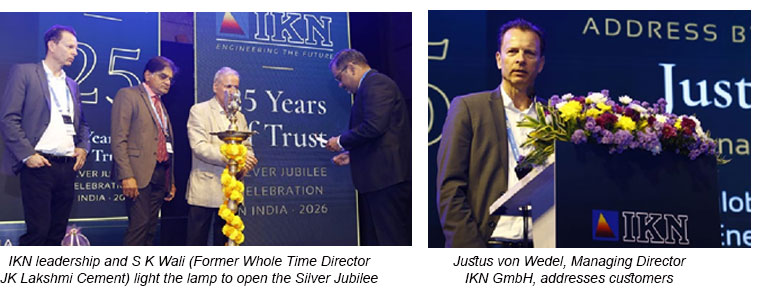
Justus von Wedel, Managing Director, IKN GmbH, discusses long-term service commitments and sustained performance the company has delivered over 25 years.
Twenty-five years after its first Indian cooler started up at Arasmeta, IKN counts more than 80 coolers across the country. Justus von Wedel, Managing Director, IKN GmbH, explains how a single-product specialist earned that trust through engineering depth, local execution and accountability that begins only after commissioning.
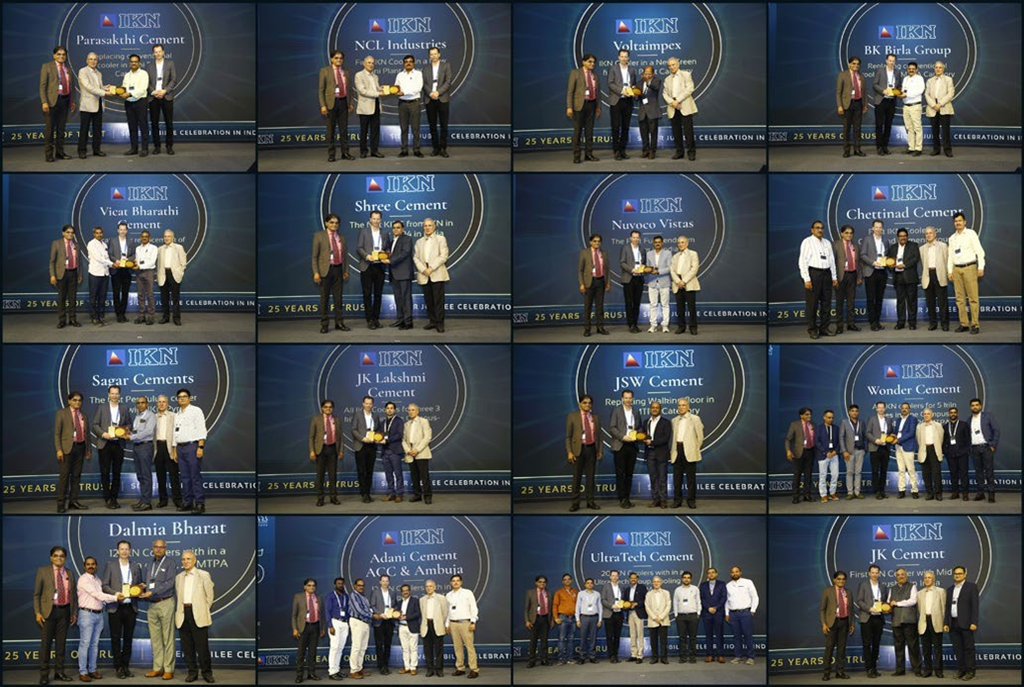
Silver Jubilee awards: IKN India thanks its customers on stage, from first-cooler partners to India’s largest cement groups
Which defining milestones and strategic decisions have shaped the company’s engineering philosophy and established its reputation in the cement industry?
IKN was founded on one conviction: the clinker cooler requires a specialist. While most suppliers treat the cooler as one item in a pyro package, we have built our company around the cooler for four and a half decades. This focus is in line with the often-heard comment “the cooler is the heart of the pyroline”. While it is less than three per cent of a greenfield project cost, it decides kiln stability, fuel efficiency and plant availability.
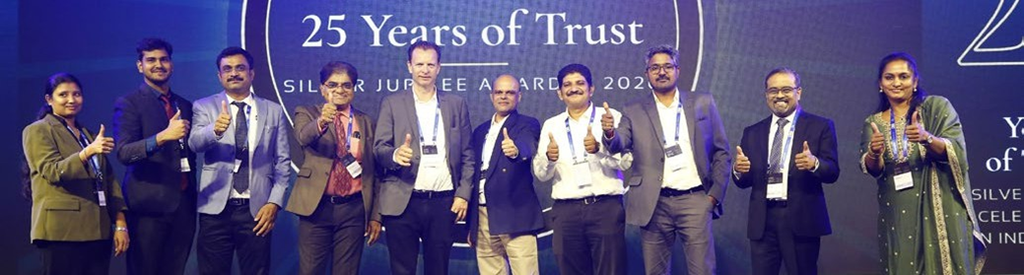
Team IKN India with IKN GmbH leadership
In India, the defining milestone was our first cooler at Lafarge Arasmeta in 2001. More than 24 years later, it still runs at above 70 per cent recuperation
efficiency and a power consumption below 4 kWh/t, without a second capex. That cooler became proof that a machine bought once should deliver the same benefits for at least three decades.
The second decisive step was building a strong IKN India team for engineering, execution and after-sales, backed by a spare parts warehouse in Chennai. German design with Indian execution is what allowed us to scale.
The third was a strategic choice we have never changed: We do not compete on purchase price; instead, we compete on lifecycle cost. Today IKN has more than 80 coolers operating in India, cooling cooling more than 180 million tonnes of clinker a year (over 200 million tonnes including KIDS installations), with 18 lines at 10,000 t/d or more.
How has IKN’s expertise in clinker cooling and pyro processing evolved to address the industry’s growing demands for operational efficiency, reliability and sustainability?
Indian plants are among the most demanding in the world: high throughput, abrasive raw materials, aggressive fuel choice, variable clinker quality and rising alternative fuel use. Our technology has evolved directly from these conditions.
The Pendulum Cooler moves clinker without any transport element passing through the bed, so the full grate area is available for cooling and the bed is not mixed. This gives a steeper cooling curve, lower air demand and loadings well beyond 50 t/d/ m². At the inlet, the IKN KIDS has progressed to the KIDS 4.0, with Coanda Wing® aeration and Inlet Motion Devices that easily handle agglomerations, snowman formation and fine clinker. The majority of the Indian coolers supplied by us operate with hot air recirculation up to 120°C, which is possible because there are no bearings or oil lines inside the under-grate compartments. Our coolers operate reliably at a 40 to 50 per cent thermal substitution rate (TSR) with alternative fuels and raw materials (AFR).
Against other designs available in the market, our operating references show 1.5 to 2.0 kWh/t lower electrical power consumption and 10 to 15 kcal/kg lower cooler losses. For a 10,000 t/d line that is roughly INR 10 crore a year, every year. In pyro
processing, the IKN Alternative Fuel Converter (AFC) combines gasification and pyrolysis to produce syngas that can replace coal or lignite in the kiln burner. The technology is being deployed in markets with mature waste management systems, markets with established waste management systems, and it is ready for India as the country’s alternative fuel ecosystem matures.
Which technological breakthroughs best demonstrate IKN’s ability to translate complex engineering challenges into measurable customer benefits, and how are these innovations shaping its future solutions?
I would point to three. First, the pendulum suspension and net cooling area. This is the reason our coolers carry higher loads at lower discharge temperatures, and it is also why 45 of our Indian installations are replacements or retrofits of other cooler designs. In many retrofits, power fell by 1.5 kWh/t and cooler losses dropped by 20 to 50 kcal/kg Second, the IKN KIDS with Coanda Wing® technology. Uniform aeration at the inlet is what protects the grate, prevents red river and sustains recuperation. More than 800 KIDS systems operate worldwide.
Third, digital condition monitoring. Our Cooler Condition Monitoring (CCM) system records hydraulic or electric drive and process data, including pyro data, at millisecond resolution and gives our analytics team remote visibility of the cooler health. We now regularly identify deviations before they become breakdowns, and advise the plant with specific corrective actions.
These innovations shape where we go next: smarter inlet geometry for higher alternative fuel use, deeper analytics, and service models in which IKN takes accountability for sustained performance and spare parts cost over the life of the cooler.
How have long-standing customer relationships and project experiences influenced IKN’s engineering approach, project execution and commitment to delivering lasting value?
Our customers have taught us that successful commissioning is only the beginning. The real test is whether performance holds in year five, year ten and year twenty. Many of our largest customers started with one order after careful evaluation, then returned for line after line. Together, India’s leading cement groups operate more than 80 IKN coolers, cooling over 200 million tonnes of clinker a year including KIDS installations.
These relationships changed how we work. Project execution is now led locally, with IKN India engineers on site from erection through the performance test. We learned that sustaining performance depends on genuine parts, correct operating practice and early detection of problems. That led to our Customer Care Service Program (CCSP): structured expert
visits, remote monitoring through CCM, prioritised supply of original spares and predictable spare parts cost. With CCSP, the plant gets predictable maintenance costs, and IKN stays accountable for the outcome long after handover.
For us, trust is built in the shutdowns and the difficult days, not only at inauguration. We always stay at our customer’s side.
As IKN celebrates 25 years of engineering excellence and trust, what are its strategic priorities and growth ambitions for the next decade, particularly in supporting the cement industry’s decarbonisation and digitalisation goals?
Our priorities for the next decade follow the industry’s two big shifts.
On decarbonisation, every kcal/kg the cooler recovers is fuel, and CO2, the kiln does not need. We will keep pushing recuperation efficiency and accepting higher alternative fuel rates without loss of cooler performance. The IKN AFC is designed to let plants move a large share of the kiln burner fuel to syngas made out of alternative fuels. IKN is also part of the LEILAC2 project on CO2 capture in cement production.
On digitalisation, CCM is the foundation. We are expanding analytics across the installed base so plants can move from reactive maintenance to predictive, data-led operation, with IKN experts supporting remotely.
Growth will come from India’s capacity expansion, from retrofits of older coolers, and from lifecycle service. Our ambition is simple: that every IKN Pendulum Cooler in India performs in its twentieth year as it did at commissioning, and that our customers continue to choose IKN for the next 25 years.
India’s economy and cement demand are growing fast, while inflation and exchange
rate fluctuations raise the cost of imported technology. How does IKN keep its solutions affordable for Indian cement producers?
Growth in India is an opportunity, but every producer is watching cost per tonne closely. We address this in four ways.
First, localisation. IKN India brings strong local engineering, project execution and site supervision, while the core technology comes from IKN in Germany. This keeps our solutions competitive and reduces the impact of currency movement.
Second, lifecycle value and payback. The capex of a cooler is spent once, while the savings in power and fuel are earned in rupees every year. Inflation and currency movement do not act only on the equipment price. They raise the customer’s fuel and power costs in the same way, so the value of every kcal/kg and kWh/t saved rises with them. This is why the payback period of an IKN cooler has remained essentially the same over the years, whatever the market conditions. In an inflationary environment,
an efficient cooler protects the plant’s margin more, not less. Third, predictability. For imported spares and multi-year service contracts, we follow transparent, rule-based pricing, so the customer knows in advance how costs are set. We also keep critical spares in stock in Chennai, so plants are not exposed to sudden price or freight changes during an urgent shutdown. Fourth, continuous improvement. Looking back over IKN’s four and a half decades worldwide, this relationship between price and value has not changed. Our focus has always been on engineering and on improving the value the customer receives. Each generation of the cooler recovers more heat, uses less power, carries higher loads and lasts longer than the one before, and every such improvement adds to the customer’s annual savings and makes the payback faster. Measured by the value delivered for every euro or rupee invested, an IKN cooler today is more affordable than it was 40 years ago.
Spare part consumption and purchase price are a major concern for plant maintenance teams. How does IKN help customers control the real cost of spares?
The purchase price of a spare part is only one part of the cost. What the plant really pays for is the cost per tonne of clinker, which depends on how long the part lasts and, on the production loss when it fails.
Genuine IKN parts are made to the original design and tolerances. The geometry of a nozzle or a grate element decides how air is distributed across the clinker bed. A copy made to different tolerances or out of a different material can change this pattern, create hot zones and shorten the life of the surrounding components. Non-OEM copies also carry no reliability guarantee and no performance responsibility, so the plant carries the full risk when they fail.
Through our CCSP, we make spare cost predictable. The plant gets a predictable spares budget and pays only for what it actually uses. Our engineers visit regularly, the CCM data shows how components are wearing, and spares are planned before each shutdown. Our experience is clear: a plant running original parts within the right operating conditions achieves longer campaigns and a lower cost per tonne, even if the unit price of a copy looks cheaper. When IKN is with the plant, our technology and more than 300 specialists stand behind it for the entire life cycle of the plant.

Join the 16th Cement Expo 2026 from 15–17 December 2026. Scan here to know more.
Economy & Market
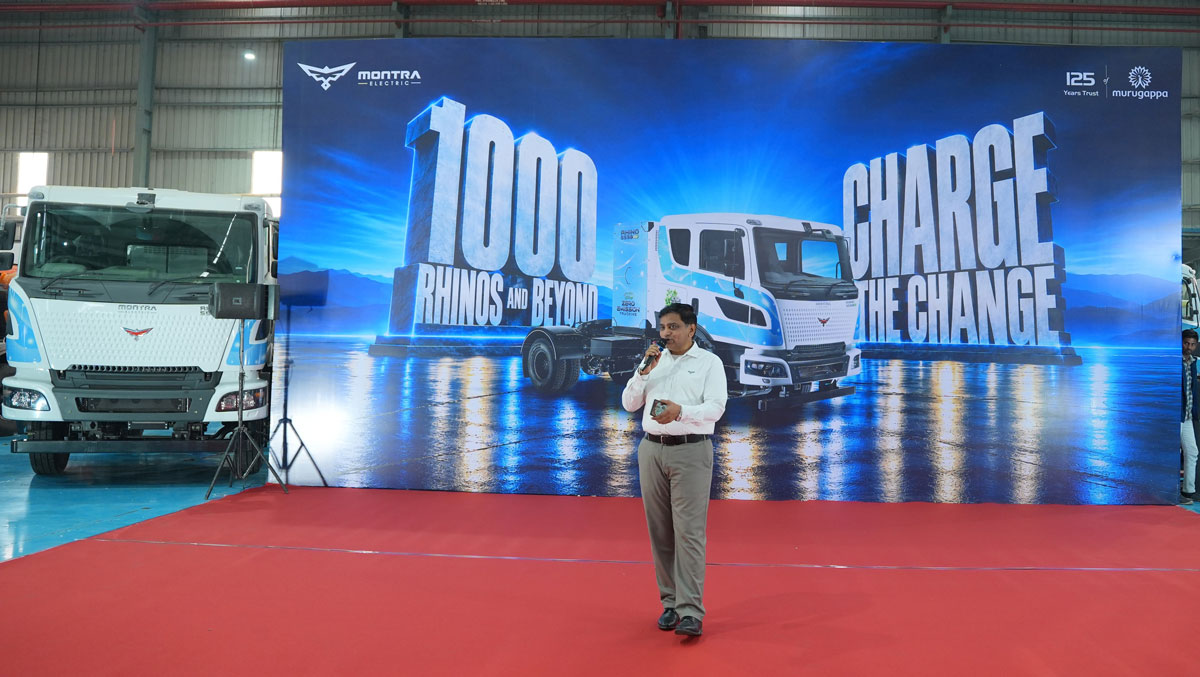
Montra Electric becomes First Indian Brand to roll out 1,000 electric heavy-duty trucks

We always stay at our customer’s side

Montra Electric becomes First Indian Brand to roll out 1,000 electric heavy-duty trucks

NCL Industries Approves Rs. 5.95 bn Solar-Wind Investment

Cement Makers See Margin Relief as Oil Prices Lower Fuel Costs

ABB Extends Drive Lifespan at ACC Cement Plant Without Production Shutdown
We always stay at our customer’s side
Montra Electric becomes First Indian Brand to roll out 1,000 electric heavy-duty trucks
NCL Industries Approves Rs. 5.95 bn Solar-Wind Investment
Cement Makers See Margin Relief as Oil Prices Lower Fuel Costs
ABB Extends Drive Lifespan at ACC Cement Plant Without Production Shutdown
-
 Concrete4 weeks ago
CII Calls for Greater Alternative Fuel Use in Cement Industry
-
 Concrete2 weeks ago
Shree Cement Expands Bangur Concrete Network with Patna Plant
-
 Concrete4 weeks ago
Sameera Group Enters Industrial and Logistics Real Estate
-
 Concrete4 weeks ago
Martin Engineering Appoints Ashwini Khunte as India General Manager