Connect with us

Concrete

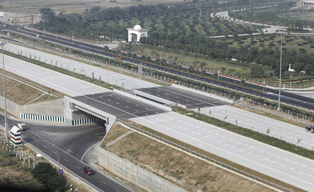
Cement Concrete Roads Way towards economic growth

Published

on

Shares

Roads are the lifelines of a nation and a good network of highways is absolutely essential for the development of trade, commerce and other activities that characterise a vibrant and forward-looking nation. John F Kennedy once said, ?The US did not build concrete roads because it was a great country, but it is a great country because of the concrete roads it had built.? It is high time that we too realise the value of concrete roads and do away with bitumen pavements wherever possible.

The government of India has been stretching its budget allocations year after year to upgrade Indian roads to meet the global standards. However, despite all such efforts our roads are still in a very pathetic condition mainly due to the preference given to the conventional bitumen roads. These roads deteriorate faster requiring heavy expenditure on maintenance. Bitumen roads exhaust a major chunk of the annual road funds for their frequent maintenance leaving behind very small amount to build new roads and extend the network.

Building concrete roads
If we are to make our infrastructure durable and at par with international standards, it is high time for us to shift our construction practices from bitumen roads to techno-economically superior cement concrete roads. Cement roads have a definite edge over bitumen roads in all respects, viz., construction cost, maintenance, service life, etc. The construction of cement roads has become all the more necessary looking at the scarce and erratic availability of bitumen the world over, as also its ever-rising price. India is fully dependent on imported bitumen. On the other hand, cement, an indigenous product, is available in plenty on demand, across the country and its availability is assured for many years to come. The present cement production capacity of the nation is 360 MLT, which will be 700 MLT by 2022 and will comfortably meet all domestic cement demand. The quality and technology of Indian cement is already of international standards.

The IT and Telecommunication sectors in the country saw a revolutionary change after the government took bold policy decisions and adopted modern technologies in these sectors. Indian road infrastructure too can benefit immensely once we adopt and implement cement concrete technology in the roads sector on a larger scale as has been done in many countries.

It is a happy augury that the Minister of Road Transport and Highways, Nitin Gadkari, has not only realised and acknowledged this, but has also taken various positive initiatives for adopting techno-economically superior cement concrete roads in the country to steer the flagging economy back on fast trajectory of growth.

Road Network of India
Construction is the second largest economic activity in India after agriculture. India?s total road network is of 4.11 million km, which is the second largest in the world. National highways, the arteries of the nation, carrying nearly 40 per cent of the total road traffic, are in immediate need of modernisation. Nearly 21 per cent of their length has only a single lane pavement and at least one in every three km is in need of immediate attention due to cumulative neglect for the past two decades. The break-up of different categories of road network is shown below.

Indian Road Network National highways/ expressways – 80,000 km State highways – 1,46,294 km Major district roads – 2,66,058 km Other district roads and rural roads – 36,17,240 km Total 41,09,592 km

Pavements in India have many inherent weaknesses. Inadequate thickness, poor compaction of sub grade soil, ineffective drainage, low-cost specifications and poor riding quality are some of them. Excessive overloading of goods carriers adds to the problem. Maintenance of pavements is a neglected activity, leading to premature failures and loss of assets.

Pavements, which bear the heavy loads of modern vehicles, are the costly component of the road. Pavement design, construction and maintenance call for a high degree of skill and expertise. Good performance and economy are the key attributes of a pavement. There are two types of pavements in use, viz., flexible pavement and the rigid pavement. So far India has preferred the age-old conventional flexible pavement due to certain compelling reasons such as amenability to stage construction; constraints of funds; lower initial cost; and scarcity of cement.

Global scenario
In many European countries, notably Germany, France, Austria, Belgium, Netherlands and Switzerland, concrete roads were built on considerable length of the most heavily trafficked routes. In USA, nearly 60 per cent of the interstate highway system was built in concrete.

Recognising the need to foster competition and thereby ensure economical options, many countries have made it compulsory when calling for road-building tenders, to invite bids on both flexible and concrete specifications. In such cases, concrete roads scored over bituminous roads in several instances. The wide acceptability of concrete as a road pavement material is mainly due to certain principal advantages it scores over bituminous material.

Realising the loss of thousands of crores of rupees to the economy due to bitumen roads, which develop potholes and become unserviceable particularly after rains, the government of India has been providing major thrust to the construction of durable and long-lasting highways, urban and rural roads. Several schemes such as NHDP, PMGSY and JNNURM have been launched to achieve this goal. For the XII plan, the government has earmarked one trillion dollars for the infrastructure development of the country, a large chunk of this would be spent in the construction of roads and highways.

Concrete overlay/white topping
Deterioration of bituminous roads in the cities specially during the rainy seasons is an annual feature and a perpetual problem. During the monsoon, the roads constructed with bituminous binders suffer severe damage causing great inconvenience to the users. All this results in wastage of precious and expensive fuel, increased travel time and creation of more pollution.

Concrete overlay over the existing bitumen roads (known as White Topping technology) is one of several such technologies that can provide long lasting road network in India. It is a major rehabilitation technology for improving old pavements with a strong, long life, and low maintenance structure. This technology has been developed over the last two decades, especially in USA, to improve the highways, runways, light duty roads and streets. It is very cost effective, fast and easy to construct.

In view of the serious doubts over the future availability of bitumen, a petroleum crude based commodity and its steep rising prices, many countries abroad are now adopting concrete overlays (white topping). In India, Mumbai city has taken a big lead in this direction. Many other cities like Pune, Nagpur, Indore, Chennai and Bengaluru have also been adopting white topping technology for city roads. The Cement Manufacturers? Association and cement companies in recent times have completed successfully three white topping technology demo projects in Jaipur, Bangalore and Chennai, which were all well accepted and appreciated by the concerned authorities of these states.

Why cement concrete roads
A few major advantages of cement concrete roads are mentioned below:
Long life
The one big advantage of cement concrete road is the long life of 30-40 years. If the condition of the road is carefully monitored and a concrete overlay is provided just before the occurrence of extensive cracks, the life can be extended further.

Practically maintenance free
Unlike a flexible pavement, the cement concrete pavement does not develop potholes and rutting. Thus, routine repairs such as pothole filling and patching so common in flexible pavements are not necessary. This saves money, materials and hindrance to traffic.

Economics of concrete roads
One of the commonly held beliefs is that the initial cost of a cement concrete pavement is higher than that of a flexible pavement. This argument might have been valid when bitumen was available at low prices. Since the price of bitumen has sky rocketed in past few years, the construction of cement concrete road is now cheaper than bitumen roads by 4-10 per cent even initially. Although white topping and cement roads constructed in villages are a bit costlier initially due to their design aspects, they become cheaper after 4-5 years of their construction. Thus, when whole-life-cycle-costs are considered, a cement concrete pavement always emerges as the better and cost-effective alternative. The table above shows cost comparison of 7 mtr wide bituminous and concrete highway.

14 per cent Fuel Savings
When heavy wheel load is put on a pavement, it deflects. The amount of deflection in pavement depends upon various factors such as, the wheel load; the flexural strength of the pavement and the soil support strength. A flexible pavement has low flexural strength, whereas a concrete pavement has high flexural strength. Because of its low flexural strength, a flexible pavement deflects considerably as the wheel of a vehicle passes over it. In case of concrete pavement, this deflection is very little. As a result, in the former case, the wheel has to overcome the large deflection bowl created in the flexible pavement as it moves along. This consumes a significant part of the energy that would otherwise be available to propel the vehicle. The consumption of fuel is consequently more on pavements that deflect excessively than on those that deflect less. Rigid pavements are thus more fuel efficient than flexible pavements, when the riding quality of both is the same. Commercial vehicles, which have heavy wheel loads, can thus derive the benefit of lower fuel consumption on rigid concrete roads. Experiments conducted in America have reported fuel savings of up to 20 per cent.

Limited experiments carried out in India have also shown fuel savings up to 14 per cent on concrete roads.

Assuming that all Indian trucks numbering approx 82 lakh in 2013 ply on cement roads and cover 300 km. in a day, the annual savings on account of diesel alone would work out to be over Rs. 1.71 lakh crore, considering the pan India average diesel price is Rs 60/ltr and that one ltr diesel gives a mileage of 4 km.

Savings on foreign exchange
India imports about 83 per cent of its annual crude requirement. Crude import at high price leads to heavy drainage of foreign exchange. As per the provisional data released by the commerce and industry minister, the nation?s crude oil bill touched the Rs 7.85 lakh crore mark during the financial year ended 31st March, 2013. In the context of current depreciating value of rupee against dollar, the outgo of forex for the same quantity of crude import will go up significantly. The country?s colossal annual import bill on crude oil can definitely be brought down by at least 8 per cent if techno-economically superior cement concrete roads are constructed in the country as a policy, instead of conventional bitumen roads constructed which are mostly with the imported crude (bitumen is a residue of crude). In absolute terms, the value of the savings, if calculated on year 2013 import bill, would be Rs 63,000 crore to the least.

Better reflectivity resulting in 10 per cent savings on street lights
Concrete being light coloured, reflects light. Hence, the illumination required for a concrete road is less than that for the dark coloured bituminous surface. For city streets, consumption of energy is thus 10 per cent less on cement concrete roads which if translated into money would work out to several crores of rupees to the economy.

Effective utilisation of fly ash
Fly ash can replace cement up to 25-35 per cent in concrete for almost all usages. It is well known that fly ash is a waste-material produced in thermal power plants where coal is used as the fuel. Fly ash is pozzolanic and reacts with lime as the cement hydrates, thereby producing cementitious materials. Fly ash improves concrete strength, improves workability, increases durability and reduces the cost of concrete. Its disposal has become a great nuisance and health hazard.

Pollution-free construction
Concrete batching and mixing plants do not cause pollution the way hot-mix bituminous plants do. This is a considerable advantage near towns and cities. There is mounting concern among the public to shift polluting bitumen plants away from habitations. In fact, the Supreme Court has banned hot mix plants in the capital.

Conservation of stone materials
For a highway carrying high volume and heavy axle load traffic consumption of aggregate in flexible (bituminous) pavement will be approximately 50-70 per cent more than concrete pavement. Though various types of stone raw materials are available in good quantity is some parts of the country, they are scarce in the plains of northern India. Any technology that conserves aggregates should thus get precedence in national interest.

Ambient temperature
A large volume of literature available (such as an article published in ?R&T Update,? by American Concrete Pavement Association (ACPA) dealing with heat reflectance; as also one published by the European Concrete Paving Association (EUPAVE) titled ?Concrete Roads: A Smart and Sustainable Choice?) establishes that construction of cement concrete roads lead to reduction in ambient temperature.

Misconception
Apart from the mistaken belief that the cost of initial construction of cement roads is high, which has been amply clarified earlier, there has been another common misconception about higher incidents of tyre bursting on cement concrete roads which is not true. It has been found that the tyre burst cases are reported on small passenger cars when they were driven at 100 km/hr or higher speed. Under such conditions incidents of tyre burst would be similar on both concrete or bituminous roads. Highway specialists recommend that during long distance travel tyres should not be fully inflated. At high speeds that CC roads enable the driver to attain easily, the air inside the tyres gets heated up and expands. So it is of utmost importance to ensure that tyre inflation is kept within prescribed parameters in addition to ensuring that the speed restrictions indicated on the signages are scrupulously observed.

In conclusion
It could be said there is a serious case for the government and other stakeholders in the road infrastructure segment to seriously consider concrete roads as a solution to many of the problems experienced with conventional road building methods. Cement roads would also go a long way in addressing a host of major concerns of the government without making any specific additional expenditure in respect of evolving measures for conservation of diesel/petrol, minimisation of forex outgo, protection of environment, generation of ample downstream employment opportunities, etc. All these, in turn, would have a ?domino effect?on our economy.

Sl. No. Bonding Material Initial Cost Maintenance cost Construction and Maintenance cost (Life Cycle Cost) Concrete Road Cheaper by %age
1 Bituminous 242 117 359
2 Concrete 241 17 258 28.13%
3 Concrete with Fly ash Replacement@25% 230 17 247 31.19%

Continue Reading
Click to comment

Leave a Reply

Your email address will not be published. Required fields are marked *

Concrete

CarbonStrong Raises Rs 125 Million To Scale Low Carbon Cement Tech

To build capacity of 100,000 tonnes a year

Published

on

By

Shares

CarbonStrong has raised Rs 125 million (125 mn) to scale a low carbon cement technology and build commercial production capacity. The startup was founded in 2022 by Harsh Jain and Vikramaditya Singh and has moved from customer trials to plans for industrial supply. The company said its material replaces up to 50 per cent of cement in concrete while reducing costs and improving durability.

CarbonStrong states the product is around 30 per cent cheaper than cement and compatible with existing concrete plants, reducing the need for new equipment and operational disruption. Trials and paid pilots have been conducted in Bengaluru, Hyderabad and Chennai with demonstration projects involving ready-mix firms and precast manufacturers. Compatibility with current workflows forms a central part of the commercial strategy, aiming to ease adoption by builders and contractors.

The funding will support construction of a facility with capacity of up to 100,000 tonnes (100,000 t) a year over the next two years to supply early customers commercially. The firm is also developing materials from steel slag, copper slag and mine tailings to expand its feedstock base, while noting the technical challenge of homogenising different waste streams. Recognition by HCL ClimaForce in 2026 and by the Avaana-Startup India-NITI Aayog AIM Grand Challenge in 2025 has underscored progress.

Industry adoption remains the principal test and will require consistent material performance, supply reliability and competitive economics. CarbonStrong projects the Indian market for cement substitutes could reach Rs 250 billion (250 bn) by 2030 and has set an ambition to produce 10 million tonnes a year by 2035 (10 mn t), a target far above its near term capacity. Moving from pilots to production demands capital, manufacturing discipline and customers willing to specify the material beyond demonstrations. The recent Rs 125 million raise is intended to fund the next phase of scale and to demonstrate that industrial waste can become a dependable input for lower carbon construction.

Continue Reading

Concrete

Protect Your Margins

Published

on

By

Shares

In a research-backed article, Dr SB Hegde examines why carbon-adjusted profitability and LC3 will decide the next set of winners in cement manufacturing.

The Indian cement industry has achieved world-class operational efficiency through lower specific energy consumption, high plant utilisation and a reduced average clinker factor of approximately 67.5 per cent. These traditional measures of operational excellence remain essential. However, they are no longer sufficient. Carbon now carries a measurable financial cost under India’s Carbon Credit Trading Scheme (CCTS) and under European carbon markets. Future leadership will be defined by carbon-adjusted profitability, the ability to generate strong returns while systematically lowering the carbon intensity of every ton sold.
Limestone calcined clay cement (LC3) offers a practical, scalable pathway to achieve this dual objective. By replacing up to 50 per cent of clinker with calcined clay and limestone, LC3 can reduce CO2 emissions by 30–40 per cent while delivering comparable or superior durability performance.
This article examines the technical foundations of LC3, European industrial practices, the emerging Indian carbon market and a concrete roadmap for Indian companies to embed carbon-adjusted metrics and LC3 into daily operations, incentives and commercial strategy.

Limits of traditional operational excellence
For many years, plant performance has been judged primarily by five indicators: specific heat consumption, specific power consumption, kiln and mill utilisation, clinker factor and overall equipment effectiveness. These metrics drove continuous improvement and helped the industry reduce energy use and increase the share of blended cement. Three structural changes have rendered them incomplete as sole measures of success.
First, carbon now carries a real or opportunity cost. Plants that improve volume or lower cash cost while raising or stagnating emissions intensity create a hidden liability that will surface as CCTS trading matures and as green procurement expands.
Second, lower-carbon products such as LC3 and high-performance blended cements are creating differentiated market segments. Customers in infrastructure, real estate and export-oriented construction are beginning to specify embodied-carbon limits.
Third, investors and lenders increasingly treat carbon intensity as a financial risk factor. Traditional KPIs can mask the divergence between short-term cash profit and long-term carbon-adjusted value.

What is carbon-adjusted profitability?
Carbon-adjusted profitability evaluates normal profit after explicit adjustment for carbon performance. A practical expression is:
Carbon-Adjusted EBITDA = Conventional EBITDA – Carbon Cost + Green Premium Income
Carbon cost may be an internal carbon price, the actual cost of purchasing Carbon Credit Certificates under CCTS, or the opportunity cost of high emissions relative to peers. Green premium income arises when customers pay more for verified lower-carbon cement or when the company sells surplus credits. Tracking both conventional and carbon-adjusted profit side-by-side gives management a clearer picture of value creation under evolving market rules.

Table 1. Traditional KPIs versus Carbon-Adjusted Leadership Metrics
Traditional Focus New Leadership Metric Why It Matters
Specific energy consumption Emissions intensity (kg CO2/t cement) Directly linked to future CCTS and CBAM costs
Kiln utilisation Carbon-adjusted contribution margin Reveals true value of incremental volume
Clinker factor Share of lower-carbon products sold (incl. LC3) Measures commercial success of the transition
Power cost per tonne Effective carbon cost per tonne sold Expose hidden liabilities
Absolute EBITDA Carbon-adjusted EBITDA + green premium Aligning profit with future market reality

LC3: Technical foundations and performance advantages
LC3 is a ternary blended cement that typically combines approximately 50 per cent clinker, 30 per cent calcined clay, 15 per cent limestone and 5 per cent gypsum (the classic LC3-50 formulation). The decisive technical advantage is that clay is calcined at 700–850 °C, far below the 1,450 °C required for clinker production. This lower temperature, together with the substantial reduction in clinker content, delivers CO2 reductions of 30–40 per cent relative to ordinary Portland cement (OPC).
Chemistry is synergistic. Calcined kaolinitic clay (metakaolin) reacts with calcium hydroxide from clinker hydration and with limestone to form additional C-A-S-H gel and carboaluminate phases. These phases densify the microstructure, reduce porosity and improve durability.
Field experience shows superior resistance to chloride ingress, sulphate attack and alkali–silica reaction. Early-age strength can match OPC with high-reactivity clays; later-age strengths routinely meet 42.5 and 52.5 grade requirements.
Importantly, LC3 does not require high-purity kaolin. Clays with 40 per cent or even lower kaolinite content can be activated successfully, expanding raw-material availability across India. Calcination can use adapted rotary kilns or dedicated flash calciners, making the technology compatible with existing plant infrastructure and far less capital-intensive than carbon capture.
Economic analyses show that LC3 can be produced at equal or lower cost than OPC in many locations because of reduced energy demand and cheaper clay. Life-cycle assessments consistently report 30–40 per cent lower embodied CO2 per tonne of cement.
Table 2. Comparative profile: OPC versus LC3-50
Parameter OPC LC3-50
Typical clinker content ~95 per cent ~50 per cent
CO2 emissions (relative) Baseline (≈0.85 t CO2/t cement process + fuel) 30–40 per cent lower
Clay calcination temperature Not applicable 700–850 °C
Key hydration products C-S-H, portlandite, ettringite C-A-S-H + carboaluminates
Chloride & sulphate resistance Good Superior
Production cost potential Baseline Equal or lower in most locations
Infrastructure compatibility Existing High (minor adaptations)

In India, commercial adoption has begun in earnest. JK Cement commenced the first commercial production of LC3 in the Indian subcontinent at its Mangrol plant in Rajasthan in 2025 under BIS standard IS 18189.
By early 2026, approximately 2,000 tonnes had been produced and sold, avoiding an estimated 500 tonnes of CO2. JK Lakshmi Cement followed with commercial launch of its Green PRO LC3 grade from the Jaykaypuram plant. As of mid-2026, two producers are supplying LC3 to the market. The first large-scale infrastructure application is the Noida International Airport (Jewar), where LC3 was used in the runway and a building complex, demonstrating full constructability and performance under demanding conditions. These early volumes are still small relative to national cement demand, but they mark the critical transition from pilot to commercial reality. Companies that scale capacity now will be positioned to capture both CCTS credits and emerging green-procurement demand.

Why the shift is accelerating
According to the World Bank’s State and Trends of Carbon Pricing 2026, direct carbon pricing now covers nearly 30 per cent of global greenhouse-gas emissions and generated more than US$107 billion in public revenue in 2025. The average global carbon price stands at approximately US$21 per tonne, although regional prices vary widely.
In Europe, the EU ETS price has traded near €80–85 per tonen in mid-2026. Free allocation for cement is being withdrawn in parallel with CBAM. European producers therefore face a clear signal: every tonne of avoided CO2 improves both compliance and competitiveness. Holcim has scaled calcined-clay production, including Europe’s first dedicated line at Saint-Pierre-la-Cour (France) and a second line in the Czech Republic (2026). Heidelberg Materials, Cementir (FUTURECEM) and others have commercialised low-clinker calcined-clay blends across multiple markets, showing that carbon-adjusted profitability is already reshaping capital allocation in the world’s most mature carbon market.India’s CCTS is now operational. Binding emission intensity targets apply to 186 cement facilities for FY 2025–26 and FY 2026–27. Average required reductions for integrated plants are modest (around 2.7 per cent by FY 2027), yet the direction is clear.
Trading of Carbon Credit Certificates is expected in the second half of 2026, with early prices likely in the `800–1,500 per tonne range. Plants that outperform targets can sell credits; those that underperform must buy them or face compensation. Cement is well positioned to be a net supplier of credits if clinker factor continues to fall through LC3 and other low-clinker systems.

Way forward for India
India starts from a strong baseline, world-class energy efficiency and a clinker factor already lower than the global average. The next competitive frontier is the deliberate reduction of process emissions through clinker substitution at scale. LC3 is uniquely suited to Indian conditions because suitable clays are widely distributed, the technology fits existing kiln and grinding infrastructure, and the resulting product can meet the performance demands of both infrastructure and building construction.
A practical national pathway contains five interlocking elements:

  1. Standards and acceptance: Accelerated finalisation and promotion of BIS specifications for calcined-clay and limestone–calcined-clay cements will remove a key barrier to commercial uptake. Alignment with European practice (EN 197-5) can facilitate knowledge transfer and export readiness.
  2. Supply-chain development: Investment in flash calcination capacity and systematic characterisation of regional clay deposits will secure reliable, low-cost feedstock. Existing rotary kilns can be adapted for initial volumes while dedicated calciners are built.
  3. Incentive alignment: Part of variable compensation for plant managers, sales teams and senior leadership should be linked to emissions intensity reduction and to the volume of lower-carbon products (including LC3) sold. Without this link, traditional volume and cost targets will continue to dominate behaviour.
  4. Product-level carbon accounting: Reliable measurement of emissions intensity at the individual cement grade level, supported by third-party verification where required, is essential for both CCTS compliance and credible green claims.
  5. Demand-side pull: Green public procurement policies that specify maximum embodied-carbon thresholds for major infrastructure projects will create a predictable market for LC3 and other low-carbon cements, accelerating scale and cost reduction.
    Companies that treat LC3 as a strategic product line rather than a niche offering will be better positioned to generate surplus Carbon Credit Certificates, capture any emerging green premium, and protect margins as carbon costs rise.

Organisational changes required
Technical capability alone is insufficient. Three organisational shifts are required.
Daily management: Emissions intensity must appear on the same daily and monthly dashboards as heat consumption, power consumption and utilization. Plant reviews should examine both conventional and carbon-adjusted results.
Incentives: A meaningful portion of bonuses for plant heads, technical teams and sales leadership should be tied to lower emissions intensity and successful commercialisation of LC3 and other low-carbon grades.
Commercial approach: Sales teams need clear volume and pricing targets for lower-carbon products, supported by technical service that helps customers specify and place the material correctly. Without commercial pull, excellent technical performance remains under-utilised.

Table 3. Three-stage roadmap to carbon-adjusted profitability
Time Horizon Priority Actions Expected Outcome
Next 12 months Add emissions intensity to plant dashboards; establish internal carbon price; initiate LC3 pilot production and customer trials Visibility and early organisational learning
12–24 months Revise incentive systems; scale LC3 and other low-carbon grades to key accounts; secure third-party verification capability People and sales aligned with carbon goals
24–36 months Embed carbon-adjusted metrics in board reporting and capital allocation; expand calcined-clay capacity Full system integration and competitive advantage

Questions senior leaders should ask
Boards can accelerate the transition by insisting on answers to a short list of questions:
• Is our carbon-adjusted profit improving, stable or declining relative to conventional EBITDA?
• Did recent volume growth improve or worsen our emissions intensity?
• What share of sales already comes from lower-carbon products, including LC3, and what is the trajectory?
• How exposed is our capital expenditure plan to rising carbon costs under CCTS and potential CBAM-related requirements?
• Do our incentive systems still reward only volume and cost, or have they been updated to include carbon performance?
Treating carbon with the same seriousness as energy cost or kiln utilization does not diminish operational excellence; it expands the definition of excellence to match the new competitive reality.

Looking ahead
By 2030 the gap between leading and lagging cement companies will not be decided by who records the lowest specific heat consumption. It will be decided by who delivers the strongest carbon-adjusted profits.
Absolute emissions may still rise as national production grows. That is not the issue. Companies that reduce intensity year after year and successfully sell cleaner products will pull ahead in both domestic and export markets. Those that do not will fall behind, even if their traditional efficiency numbers look strong.
Operational excellence built the Indian cement industry. It remains the foundation. It is no longer the complete picture. Carbon-adjusted profitability is the clearer measure of success.
LC3 is not a distant technology. It is available now. It cuts CO3 by 30–40 per cent, works with existing plants, and is already in commercial production in India. Companies that treat it as a strategic product, not a pilot, will protect their margins and generate tradable credits.
Leaders who act now will place carbon metrics on daily dashboards, link incentives to intensity reduction and LC3 sales, invest in calcined-clay capacity, and build commercial capability to sell lower-carbon products. They will shape the next chapter of the industry.

References

  1. World Bank. (2026). State and Trends of Carbon Pricing 2026. Washington, DC: World Bank Group.
  2. International Carbon Action Partnership (ICAP). (2026). India Carbon Credit Trading Scheme – Status and Coverage. Berlin: ICAP.
  3. Ministry of Environment, Forest and Climate Change / Bureau of Energy Efficiency. (2025). Greenhouse Gases Emission Intensity Target Rules, 2025. New Delhi: Government of India.
  4. Scrivener, K., Martirena, F., Bishnoi, S., & Maity, S. (2018). Calcined clay limestone cements (LC3). Cement and Concrete Research, 114, 49–56.
  5. RMI. (2024). The Business Case for LC3. Rocky Mountain Institute.
  6. European Commission. (2026). EU Emissions Trading System – Allowance Price Data and Free Allocation Phase-out Schedule. Brussels.
  7. Holcim. (2025–2026). Scaling Calcined Clay for Sustainable Building – Corporate Updates on European and Latin American Capacity. Zurich: Holcim Ltd.
  8. LC3 Project / EPFL. (2026). LC3 – A Guide to Best Practices for Scalable, Affordable and Sustainable Low-Carbon Building. Lausanne: École Polytechnique Fédérale de Lausanne.
  9. Business Today / Industry Reports. (2026). First Large-Scale LC3 Application at Noida International Airport, Jewar. New Delhi.
  10. NITI Aayog / Industry Analyses. (2026). Roadmap and Baseline Performance Indicators for the Indian Cement Sector. New Delhi.
  11. Springer / Innovative Infrastructure Solutions. (2026). LC3 Systems: A Review of Chemistry, Performance, Durability and Sustainability toward Market Adoption.
  12. Cementir Holding / Industry Sources. (2025–2026). FUTURECEM and Related Low-Clinker Technologies in Europe.
  13. Climate Risk Horizons & Independent Analyses. (2026). Assessment of Emission Intensity Targets under India’s CCTS for Cement and Other Hard-to-Abate Sectors.
  14. GCCA / TERI. (Various years). Decarbonization Roadmaps for the Indian Cement Industry.
  15. EN 197-5:2021. Cement – Part 5: Portland-composite cement CEM II/C-M and Composite cement CEM VI. European Committee for Standardization.

Continue Reading

Concrete

More Oversight Makes Cement Plants Less Safe

Published

on

By

Shares

Dijam Panigrahi makes a counterintuitive but data-backed argument that routing every sensor alert through human approval does not make cement plants safer.

India’s cement industry has spent the last two years wiring kilns, mills and coolers with sensors and automated control systems, and the safety case for doing so is strong on paper. Contract workers still make up the majority of the industry’s workforce, and fatal accidents remain a recurring problem. The Indian National Cement Workers Federation has noted that around 83 per cent of workers in the sector hold precarious positions, a fact that resurfaced after an oxygen cylinder explosion killed three contract workers at a plant in Chhattisgarh.
Industry tallies compiled by IndustriALL found cement plants recorded at least seventeen accidents in one year with 21 workers killed, and ten accidents the following year with nine killed, most of them contract staff. Automated monitoring, in theory, closes that gap. A sensor never gets complacent and never skips a check because a shift is short staffed.
However, plants that respond by routing every anomaly reading to a person for approval are quietly building a system that fails the same way understaffing does. When operators receive dozens of flagged deviations a shift, most of them minor, they learn a simple lesson: the fastest way through the queue is to approve without reading closely. The safety benefit disappears, not because the technology failed, but because the humans supervising it adapted to the volume.

Why alerts get ignored
A study cited by manufacturing technology publisher Applied SmartFactory found more than 95 per cent of alarms in a semiconductor fab were low priority, and only about 4 per cent ever triggered an action, with just 100 out of 5,000 alarms accounting for 70 per cent of all alarm activity. The mechanism is the same whether the trigger is a vibration sensor or an AI model flagging a kiln temperature swing. Once the ratio of noise to signal crosses a threshold, workers stop treating the system as a decision aid and start treating it as a formality to clear.
The scale of AI deployment underway makes this more than a theoretical risk. Stanford’s 2026 AI Index Report found organisational adoption of AI has reached 88 per cent, even as documented AI incidents rose to 362 in 2025, up sharply from 233 the year before, according to analysis of the report. The Index also found only about a third of organisations have adopted a formal governance framework, with NIST’s AI Risk Management Framework cited by 33 per cent and ISO/IEC 42001 cited by 36 per cent.
Most manufacturers are deploying monitoring systems faster than they are building the judgment for when a flagged event actually needs a person’s attention. In India, plants run by JK Cement have begun pairing CCTV feeds with AI to define safe zones around heavy machinery, a promising direction that still depends on operators trusting and reading the alerts the system generates.

A three-tier model for cement plant
The fix is not less monitoring or more monitoring. It is classifying decisions by risk and by novelty, rather than treating human oversight as a single switch that is either on or off. A workable model sorts factory floor events into three tiers.
The first tier, proceed, covers deviations the plant has seen before that fall within known safe bounds, such as a kiln feed rate adjustment within an established range. These should run without a stop for approval, because routing them to a person only trains that person to click through.
The second tier, pause, covers events that are unusual but not yet dangerous, such as a vibration reading trending toward a limit or a fuel blend shifting outside its typical mix. These warrant a brief human check before the system proceeds, giving an operator the chance to apply judgment the model does not yet have.
The third tier, escalate, covers events that are both high risk and unfamiliar, such as a pressure reading combined with a temperature spike that has no close precedent in the plant’s history. These should stop the process entirely and require a decision from someone with the authority to shut down a line.

Who should set the threshold
Where these tiers get drawn matters as much as the framework itself. Threshold setting is frequently handed to the vendor supplying the monitoring software or to a plant’s IT department, both of which understand the technology but not the specific tolerances of a given kiln, mill or line. Operations staff, who know that a particular grinding unit runs hotter under monsoon humidity or that a calciner behaves differently after a refractory reline, are better positioned to calibrate what counts as routine on their own equipment.
Handing threshold ownership to operations does not remove IT or vendors from the process, but it puts the calibration decision closest to the people who live with its consequences on the floor.

Signals that oversight is actually working
A few concrete indicators reveal whether a monitoring setup is functioning as intended or simply providing the appearance of safety. The escalation rate over time is the first: a rate that stays flat or climbs slowly as operations mature is healthy, while one that spikes and then falls sharply often means operators have started overriding the system rather than engaging with it. Time to resolution is the second: escalations that take progressively longer to close suggest fatigue or confusion about ownership, not diligence. The third, and most telling, is how accurate the system’s own uncertainty estimates turn out to be, meaning whether events flagged as high risk actually correlated with real incidents, and whether events waved through stayed incident free. A system whose escalations do not track with actual outcomes trains operators toward the same complacency that unmonitored equipment produces.
None of this argues against automation in Indian cement manufacturing, where a labor structure built on contract work and a track record of serious accidents make better monitoring an urgent need. It argues for treating human oversight as a design problem with three distinct settings, rather than a single
dial turned up whenever a plant wants to look safer on paper.

About the author:
Dijam Panigrahi, Co-founder and COO, GridRaster, is a spatial computing platform for industrial enterprises and manufacturers.

Continue Reading

Video Thumbnail
â–

    SIGN-UP FOR OUR GENERAL NEWSLETTER


    Trending News

    SUBSCRIBE TO THE NEWSLETTER


    Don't miss out on valuable insights and opportunities to connect with like minded professionals.


      This will close in 0 seconds