Connect with us

Product Development

Actuator Sensor-Interface: Intelligent Cabling for a Machine

Published

on

Shares

Automation involves exchange of data from across the field to a central control unit. In the conventional system, the entire machine is surrounded by cables which increase the hassles and time involved in maintenance, commissioning and diagnostics. Field bus technology involves the use of a common protocol for data exchange in a serial way between the central control unit and the field devices thereby eliminating the need of traditional hardwiring. Decentralized I/O modules are kept on the field and the sensors and actuators are wired to these. These remote I/O modules communicate to the PLC by bus-systems or communication protocols like PROFIBUS/ MODBUS/ AS-i etc.In the yester years, there was no scarcity of materials like copper, iron etc. Supplies of the materials were more than the demand. Labour was also available in abundance. However, over the years, the labour cost and the material cost has been increasing which in turn means an increase in the production cost or the product cost. Additionally there is an ever-increasing pressure to reduce the prices of the products due to the increasing competition. Hence the manufacturers are on a constant look-out for reducing the cost of production and thereby to reduce the price of their products. Automation is one of the ways to achieve this.Centralized SystemThe introduction of automation was a revolution in itself. Automation involves exchange of data from across the field to a central control unit. The data exchanged can be of various types ranging from system data, process parameters, analogue data or binary data. Also the nature of exchange of these data varies and can be cyclic or acyclic. Taking an example of a conventionally wired conveyor system:Along the conveyor line, there are sensors like limit switches, proximity sensors etc. which give input to the PLC about the materials being conveyed. Based on the requirement, the PLC gives output to the contactors to switch off or switch on the conveyor. The switching action can also be done locally by means of actuators like push buttons, E-stop button etc. Conventionally, each of the actuator/ sensor along the conveyor was connected by hard-wire to the marshalling tier. From the marshalling tier, the inputs and outputs are connected to the PLC by means of a multi-core cable. This was referred to as "centralized control" where in all the data from the entire plant would be wired to the PLC located at certain location in the plant. The following drawbacks were encountered:These drawbacks lead to the development of the decentralized control systems – which means distributing intelligence in the field. To make communication faster and the automation hardware simpler, field bus concepts came into existence. Field bus technology involves the use of a common protocol for data exchange in a serial way between the central control unit and the field devices thereby eliminating the need of traditional hardwiring. In this system, only the hardware or the hardware as well as the software can be decentralized. Decentralized I/O modules are kept on the field and the sensors and actuators are wired to these. These remote I/O modules communicate to the PLC by bus-systems or communication protocols like PROFIBUS/ MODBUS/ AS-i etc.Decentralized System (System using AS-i)

Actuator sensor interface is a bus system designed as an interface (connection media) for all simple binary ON/ OFF field devices (pushbuttons, limit switches, proximity sensors, valves, contactor coils) to the higher level of automation. In this communication bus system or protocol, the hardware is only decentralized. In this system, the basic components at the field level are AS-i master, AS-i slaves (or I/O modules) and the AS-i power supply. AS-i, slave modules (I/O Module selected based on the number and type of inputs and outputs) are mounted near the sensor cluster. A single AS-i cable runs through the slaves, to the AS-i master and power supply. The AS-i master in turn is connected to the PLC. Thus, AS-I replaces the cable tree at the lowest level of automation in the industry where conventional hardwiring/ field bus tend to be too complicated, too slow or too expensive. The result is an immense reduction in wiring – "one instead of a thousand cables".What is AS-i??AS-i is an open and manufacturer-independent bus system transmitting process- and machine-level digital/ analog signals and safety-oriented signals to the PLC. It’s a universal interface between actuators and sensors on the field level to the superior control level of PROFIBUS/ Ethernet/ others. AS-I is basically a Master-Slave system. Master-Slave refers to the method the field-bus uses to transfer information. The master is responsible for the operations of the bus system. One AS-I master can have a maximum of 62 slaves of 4I/4O each (according to AS-I specification ver 3.0) over a length of 100m (expandable upto 600 m with repeaters and other accessories).AS-interface was conceived as a single master system with cyclic polling. This means that there is only one control module (master) in the AS-Interface network which polls the data of the other nodes (slaves) at precisely defined intervals. Up to four useable input bits and four useable output bits are exchanged between a slave and the master in any one cycle. AS-interface has been optimised for volumes of data that correspond precisely to the requirements of the lowest field levelThe basic components in an AS-i system consist of master, slaves, power supply and the AS-i cable.AS-i Master – It provides an interface between the slaves and the PLC. The AS-Interface master forms the connection to higher level controls. It independently organizes the data traffic on the AS-Interface line and is responsible for parameter settings, monitoring and diagnostic functions.AS-i Slaves – The AS-i slaves can either be AS-i enabled valves, push button stations, limit switches etc or can be AS-i enabled I/O cards on which the actuators and sensors are connected.AS-Interface slaves include the AS-i electronics. The I/O cards can either be IP20 (can be installed in a control cabinet) or IP67 modules (that are directly used in the field).AS-i Power Supply – This is a special 30V DC power supply which decouples the power and the data signal. The power supply units generate a controlled DC voltage of 24 or 30 V with a high degree of stability and low residual ripple. They supply the network’s electronics, i.e. the AS-i modules and the master as well as the connected sensors. AS-Interface power supply units generate a nominal voltage of 30 V DC.AS-i cable – The AS-i cable has to meet the specifications laid down in the AS-i standard specifications. The yellow, flat cable is characteristic for the AS-Interface. Data and power for the sensors are transferred along this cable. A second, black flat cable is used to supply the actuators with 24 V. Both of these cables use the piercing technology, specifically developed for AS-i. This allows every node to be simply snapped onto the two profiled cables at any location – also with the correct polarity. In case of the IP67 AS-i slaves, the wiring is done by "piercing technology". In this case, the geometry of the cable is such that polarity reversal is not possible and hence errors during installation are minimized. The trapezoidal profile with the profiled lug ensures a high degree of protection against polarity reversal (mechanical code). In case of IP20 modules, regular copper wires can be used. The IP20 modules have removable terminals which makes the wiring easy.Benefits of AS-i"One instead of a thousand cables"In the conventional system, the entire machine is surrounded by cables which increase the hassles in maintenance. By AS-i, maintenance is hassle-free.

  • Less wiring implies less cost – cabling, wiring, maintenance etc.
  • No wiring faults. Confusion of terminals excluded.

Short downtimes thanks to fast replacementThe IP67 modules enable quick installation. The slaves in an AS-i network hooks on to the cable without any trouble due to the piercing technology of the cables. Hot-replacement, ie., replacement of the modules without shutting down of the system is possible. Contact needles pierce through the cable insulation and make secure contact with the copper conductor. When the needles are pulled out again to remove a slave, the cable’s self-healing capability ensures that the holes close automatically, providing full insulation again (in the case of EPDM cables)Less commissioning and configuration timeThe slaves can be pre-addressed using the addressing tool. The master can be parameterized easily without putting it on-line.Less maintenance timeIn case of any failure, the diagnostics are fast. The replacements of the salves are easy due to the hot-replacement featureEasier diagnosticsDue to diagnostics available at various levels the down-time of the plant reduces. AS-i provides diagnostic information at the device level by means of LEDs. Diagnostic information are also available on the AS-i Master. It can also be configured to get diagnostic information on PLC/ SCADA/ HMI panels.ExpandabilityThe system is flexible and hence is expandable very easily with minimal downtime. A shut-down of the plant is not required for a long time due to the off-line configurability, hot-replacement etc.AS-i – as part of Totally Integrated AutomationThe AS-i association was founded in 1991 and since then, the specifications for AS-i has undergone continuous improvement. Presently, AS-i adheres to specification version 3.0.Some of the features of AS-i specification ver 3.0 are:

  • Binary I/O nodes supporting A/B addressing with 4 Inputs and 4 Outputs
  • Binary I/O nodes supporting A/B addressing with 8 Inputs and 8 Outputs
  • Integrated safety (AS-i safe)
  • Improved diagnostics

All AS-Interface products correspond to

  • Euro Norm EN 50295 and
  • World Standard IEC 62026-2

All certified AS-i products (recognisable by the AS-interface shadow logo and the corresponding test number) are fully compatible with each other independent of the manufacturer and are interchangeable.AS-i forms part of the TIA pyramid (Totally Integrated Automation – the hierarchy of the communication protocols available.) AS-i is at the lowest control level, where it is used to interlink process-related devices like sensors, actuators etc, with one-another and to the next higher automation level.The next level is either the field-bus level like Profibus/ Modbus etc followed by the operating control level like Industrial Ethernet.Being the lowest level of automation, AS-i is not designed to handle large volumes of data. The structure and length of the data frame is fixed. Up to four useable input bits and four useable output bits are exchanged between a slave and the master in any one cycle. At this level, however, there are a high number of connected devices all with the requirement for real time/deterministic capability.From AS-i, gateways to EtherNet/IPTM, PROFINET, Modbus/TCP and others are available. With the new and continuously improving capabilities, AS-interface is the ideal partner network for any of the currently available Ethernet based industrial protocols. The future of the communication networks are seen as a 2-level hierarchy comprising of Field bus like AS-i and then the Ethernet based protocols.The author is Mangala R. Nair, Control Products Department, Siemens Ltd

Continue Reading
Click to comment

Leave a Reply

Your email address will not be published. Required fields are marked *

Economy & Market

Power Build’s Core Gear Series

Published

on

By

Shares

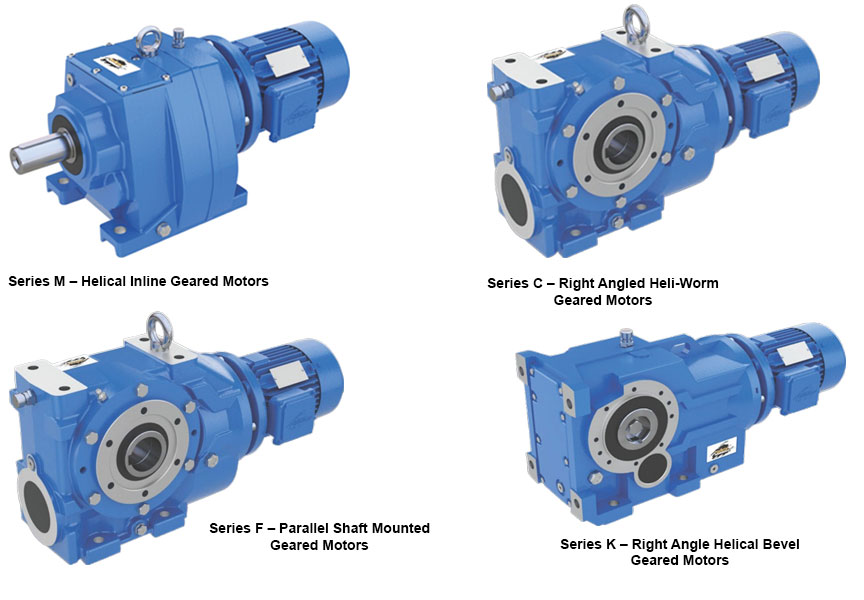
A deep dive into Core Gear Series of products M, C, F and K, by Power Build, and how they represent precision in motion.

At the heart of every high-performance industrial system lies the need for robust, reliable, and efficient power transmission. Power Build answers this need with its flagship geared motor series: M, C, F and K. Each series is meticulously engineered to serve specific operational demands while maintaining the universal promise of durability, efficiency, and performance.

Series M – Helical Inline Geared Motors
Compact and powerful, the Series M delivers exceptional drive solutions for a broad range of applications. With power handling up to 160kW and torque capacity reaching 20,000 Nm, it is the trusted solution for industries requiring quiet operation, high efficiency, and space-saving design. Series M is available with multiple mounting and motor options, making it a versatile choice for manufacturers and OEMs globally.

Series C – Right Angled Heli-Worm Geared Motors
Combining the benefits of helical and worm gearing, the Series C is designed for right-angled power transmission. With gear ratios of up to 16,000:1 and torque capacities of up to 10,000 Nm, this series is optimal for applications demanding precision in compact spaces. Industries looking for a smooth, low-noise operation with maximum torque efficiency rely on Series C for dependable performance.

Series F – Parallel Shaft Mounted Geared Motors
Built for endurance in the most demanding environments, Series F is widely adopted in steel plants, hoists, cranes and heavy-duty conveyors. Offering torque up to 10,000 Nm and high gear ratios up to 20,000:1, this product features an integral torque arm and diverse output configurations to meet industry-specific challenges head-on.

Series K – Right Angle Helical Bevel Geared Motors
For industries seeking high efficiency and torque-heavy performance, Series K is the answer. This right-angled geared motor series delivers torque up to 50,000 Nm, making it a preferred choice in core infrastructure sectors such as cement, power, mining and material handling. Its flexibility in mounting and broad motor options offer engineers the freedom in design and reliability in execution.
Together, these four series reflect Power Build’s commitment to excellence in mechanical power transmission. From compact inline designs to robust right-angle drives, each geared motor is a result of decades of engineering innovation, customer-focused design and field-tested reliability. Whether the requirement is speed control, torque multiplication or space efficiency, Radicon’s Series M, C, F and K stand as trusted powerhouses for global industries.

http://www.powerbuild.in
Call: +919727719344

Continue Reading

Economy & Market

Conveyor belts are a vital link in the supply chain

Published

on

By

Shares


Kamlesh Jain, Managing Director, Elastocon, discusses how the brand delivers high-performance, customised conveyor belt solutions for demanding industries like cement, mining, and logistics, while embracing innovation, automation, and sustainability.

In today’s rapidly evolving industrial landscape, efficient material handling isn’t just a necessity—it’s a competitive advantage. As industries such as mining, cement, steel and logistics push for higher productivity, automation, and sustainability, the humble conveyor belt has taken on a mission-critical role. In this exclusive interview, Kamlesh Jain, Managing Director, Elastocon, discusses how the company is innovating for tougher terrains, smarter systems and a greener tomorrow.

Brief us about your company – in terms of its offerings, manufacturing facilities, and the key end-user industries it serves.
Elastocon, a flagship brand of the Royal Group, is a trusted name in the conveyor belt manufacturing industry. Under the brand name ELASTOCON, the company produces both open-end and endless belts, offering tailor-made solutions to some of the most demanding sectors such as cement, steel, power, mining, fertiliser, and logistics. Every belt is meticulously engineered—from fabric selection to material composition—to ensure optimal performance in tough working conditions. With advanced manufacturing facilities and strict quality protocols, Elastocon continues to deliver high-performance conveyor solutions designed for durability, safety, and efficiency.

How is the group addressing the needs for efficient material handling?
Efficient material handling is the backbone of any industrial operation. At Elastocon, our engineering philosophy revolves around creating belts that deliver consistent performance, long operational life, and minimal maintenance. We focus on key performance parameters such as tensile strength, abrasion resistance, tear strength, and low elongation at working tension. Our belts are designed to offer superior bonding between plies and covers, which directly impacts their life and reliability. We also support clients
with maintenance manuals and technical advice, helping them improve their system’s productivity and reduce downtime.

How critical are conveyor belts in ensuring seamless material handling?
Conveyor belts are a vital link in the supply chain across industries. In sectors like mining, cement, steel, and logistics, they facilitate the efficient movement of materials and help maintain uninterrupted production flows. At Elastocon, we recognise the crucial role of belts in minimising breakdowns and increasing plant uptime. Our belts are built to endure abrasive, high-temperature, or high-load environments. We also advocate proper system maintenance, including correct belt storage, jointing, roller alignment, and idler checks, to ensure smooth and centered belt movement, reducing operational interruptions.

What are the key market and demand drivers for the conveyor belt industry?
The growth of the conveyor belt industry is closely tied to infrastructure development, increased automation, and the push for higher operational efficiency. As industries strive to reduce labor dependency and improve productivity, there is a growing demand for advanced material handling systems. Customers today seek not just reliability, but also cost-effectiveness and technical superiority in the belts they choose. Enhanced product aesthetics and innovation in design are also becoming significant differentiators. These trends are pushing manufacturers to evolve continuously, and Elastocon is leading the way with customer-centric product development.

How does Elastocon address the diverse and evolving requirements of these sectors?
Our strength lies in offering a broad and technically advanced product portfolio that serves various industries. For general-purpose applications, our M24 and DINX/W grade belts offer excellent abrasion resistance, especially for RMHS and cement plants. For high-temperature operations, we provide HR and SHR T2 grade belts, as well as our flagship PYROCON and PYROKING belts, which can withstand extreme heat—up to 250°C continuous and even 400°C peak—thanks to advanced EPM polymers.
We also cater to sectors with specialised needs. For fire-prone environments like underground mining, we offer fire-resistant belts certified to IS 1891 Part V, ISO 340, and MSHA standards. Our OR-grade belts are designed for oil and chemical resistance, making them ideal for fertiliser and chemical industries. In high-moisture applications like food and agriculture, our MR-grade belts ensure optimal performance. This diverse range enables us to meet customer-specific challenges with precision and efficiency.

What core advantages does Elastocon offer that differentiate it from competitors?
Elastocon stands out due to its deep commitment to quality, innovation, and customer satisfaction. Every belt is customised to the client’s requirements, supported by a strong R&D foundation that keeps us aligned with global standards and trends. Our customer support doesn’t end at product delivery—we provide ongoing technical assistance and after-sales service that help clients maximise the value of their investments. Moreover, our focus on compliance and certifications ensures our belts meet stringent national and international safety and performance standards, giving customers added confidence.

How is Elastocon gearing up to meet its customers’ evolving needs?
We are conscious of the shift towards greener and smarter manufacturing practices. Elastocon is embracing sustainability by incorporating eco-friendly materials and energy-efficient manufacturing techniques. In parallel, we are developing belts that seamlessly integrate with automated systems and smart industrial platforms. Our vision is to make our products not just high-performing but also future-ready—aligned with global sustainability goals and compatible with emerging technologies in industrial automation and predictive maintenance.

What trends do you foresee shaping the future of the conveyor belt industry?
The conveyor belt industry is undergoing a significant transformation. As Industry 4.0 principles gain traction, we expect to see widespread adoption of smart belts equipped with sensors for real-time monitoring, diagnostics, and predictive maintenance. The demand for recyclable materials and sustainable designs will continue to grow. Furthermore, industry-specific customisation will increasingly replace standardisation, and belts will be expected to do more than just transport material—they will be integrated into intelligent production systems. Elastocon is already investing in these future-focused areas to stay ahead of the curve.


Continue Reading

Economy & Market

Impactful Branding

Published

on

By

Shares

Advertising or branding is never about driving sales. It’s about creating brand awareness and recall. It’s about conveying the core values of your brand to your consumers. In this context, why is branding important for cement companies? As far as the customers are concerned cement is simply cement. It is precisely for this reason that branding, marketing and advertising of cement becomes crucial. Since the customer is unable to differentiate between the shades of grey, the onus of creating this awareness is carried by the brands. That explains the heavy marketing budgets, celebrity-centric commercials, emotion-invoking taglines and campaigns enunciating the many benefits of their offerings.
Marketing strategies of cement companies have undergone gradual transformation owing to the change in consumer behaviour. While TV commercials are high on humour and emotions to establish a fast connect with the customer, social media campaigns are focussed more on capturing the consumer’s attention in an over-crowded virtual world. Branding for cement companies has become a holistic growth strategy with quantifiable results. This has made brands opt for a mix package of traditional and new-age tools, such as social media. However, the hero of every marketing communication is the message, which encapsulates the unique selling points of the product. That after all is crux of the matter here.
While cement companies are effectively using marketing tools to reach out to the consumers, they need to strengthen the four Cs of the branding process – Consumer, Cost, Communication and Convenience. Putting up the right message, at the right time and at the right place for the right kind of customer demographic is of utmost importance in the long run. It is precisely for this reason that regional players are likely to have an upper hand as they rely on local language and cultural references to drive home the point. But modern marketing and branding domain is exponentially growing and it would be an interesting exercise to tabulate and analyse its impact on branding for cement.

Continue Reading

Trending News