Connect with us

Concrete

Putzmeister Breaks Concrete Pouring Record in the World

Published

on

Shares

Putzmeister`s machines are involved in the construction of metro rail projects, expansion and modernisation of international airports at Mumbai, Delhi, Kolkata and Bangalore; as well as building of diverse power plants, hydraulic projects, liquefied natural gas tanks, refineries, ports, roads, bridges, high-rises, and many such challenging projects.

Putzmeister Concrete Machines India is a 100 per cent subsidiary of Putzmeister GmbH, world?s No. 1 manufacturer of high capacity concrete machines. Putzmeister India manufactures an entire range of high-tech innovative concrete equipment, adapted to the Indian market specifications and the needs at its factory and head office in Verna, Goa. The company?s sales and service network is spread across India, continuously expanding further to cater to the growing infrastructure demands of the nation. As the pioneer of R&D in concrete pumping technology, Putzmeister is dedicated to offer the best and latest innovations in India.

Putzmeister?s machines are involved in the construction of metro rail projects, and expansion and modernisation of international airports at Mumbai, Delhi, Kolkata and Bengaluru; as well as building of diverse power plants, hydraulic projects, liquefied natural gas tanks, refineries, ports, roads, bridges, high-rises and many such challenging projects.

Continuous overnight concrete pour at NCC power project
Beginning of this year, Putzmeister completed a challenging pour at NCC power plant project at Krishnapatnam in Nellore district of Andhra Pradesh. Putzmeister?s boom pump-BSF 36.04H-ECI-withstood the continous concreting of the foundation, which was carried on overnight, completing this feat early morning the next day. The company is proud to be associated with clients who enable us to perform extraordinary tasks.

Putzmeister continues to provide the best innovations and quality in its concrete equipment. The world and our global partners know that Putzmeister is the one who sets standards ?every single time we pour?. At the same time, on the other side of the globe, Putzmeister was all set to create a new world record in Los Angeles, US.

Putzmeister sets new Guinness World Record for longest continuous pour in US
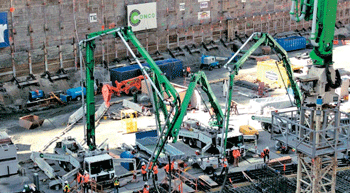
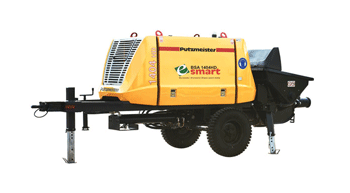
After a great successful concrete pour in India, the next day Putzmeister set a world record in Los Angeles, US. The massive pour took place with 12 Putzmeister truck-mounted concrete boom pumps ranging from 32 m to 47 m, two Putzmeister placing boom towers and two Putzmeister trailer-mounted pumps. These concrete pumps were strategically placed both inside and above the excavation. Total 19 pumps were utilised for this enormous 16,200 cm3 concrete pouring. It took 18.5 hours to complete the pour, which steered Putzmeister towards setting a new Guinness World Record for the largest continuous concrete pour on 15 February 2014 in Los Angeles.

The pour was to lay the foundation of the Wilshire Grand project, which will be the tallest structure west of the Mississippi when finished at 73 stories and 335 m in height. Turner and Conco, the general contractor of the project, devised a plan for the concrete pour, which was located 24-29 m below street level. For the past several months, crews have prepared the site by digging a 6 m-deep pit and lining it with 3,700 tonne of reinforcing steel. "We utilised Putzmeister equipment due to its durability and reliability," said Michael Marchesano, Turner?s general superintendent. "With a continuous pour of this magnitude, you need to be able to count on your equipment to keep doing its job, even under demanding conditions."

The pour included 227 ready mix trucks making more than 2,100 trips and pouring almost 39 mt of concrete during an 18 +-hour period.

"Each truck made 10-14 concrete drops, traveling through the night between eight different concrete plants within a 30 km radius," said Marchesano. "The first batch of concrete poured onto the site came from a plant in Vernon that poured the first concrete in Southern California ever."

"We were extremely happy with how all of the Putzmeister equipment performed," said Marchesano. "A pour this size requires extensive planning, precision, and dependable equipment. Everything went more smoothly than we could have imagined."

The concrete pour qualified as the largest continuous concrete pour in history and officially claimed a Guinness world record.

High-traffic, congested location
To minimise the impact on businesses and residents, the crew began the pour on a Saturday evening and concluded around noon the next day, working throughout the night.

Given that Los Angeles is the second most populous city in the US, the construction team anticipated logistical challenges when planning the large mat pour at the project?s downtown location. "Because the concrete must be poured within 90 mins of being mixed, trucks had to arrive on time," Marchesano explained. "In case of freeway jams, alternate routes were mapped."Not only was outside traffic a concern, but job site congestion also was a challenge. Equipment had to be carefully chosen to accommodate the site?s needs.

"Through its durability and diverse selection of pumps, Putzmeister helped us overcome the challenge of having a large amount of material that needed to be poured continuously in a dense urban area," said Marchesano. "Each piece of equipment had its role and was orchestrated to help make the pour run as smoothly and efficiently as possible."

Building up
Now that the foundation is in place, the crew will begin working on the attached parking structure and 73-story building that will make up the Wilshire Grand project. Both of the existing Putzmeister MX 34-4 Placing Boom Towers that were used for the concrete pour will remain in place while the crew builds up. Two additional Putzmeister placing booms will be constructed to help place concrete for the underground parking structure.The two Putzmeister trailer pumps used on the concrete pour will also be used to pump the concrete to the placing towers. The crew will be pumping more than 60,000 m3 of concrete vertically, including lightweight concrete and C55 mixes. With such well-planned and organised preparations, we are assertive of providing precise solutions to our clients in India.


Continue Reading
Click to comment

Leave a Reply

Your email address will not be published. Required fields are marked *

Concrete

FORNNAX Appoints Dieter Jerschl as Sales Partner for Central Europe

Published

on

By

Shares

FORNNAX TECHNOLOGY has appointed industry veteran Dieter Jerschl as its new sales partner in Germany to strengthen its presence across Central Europe. The partnership aims to accelerate the adoption of FORNNAX’s high-capacity, sustainable recycling solutions while building long-term regional capabilities.

FORNNAX TECHNOLOGY, one of the leading advanced recycling equipment manufacturers, has announced the appointment of a new sales partner in Germany as part of its strategic expansion into Central Europe. The company has entered into a collaborative agreement with Mr. Dieter Jerschl, a seasoned industry professional with over 20 years of experience in the shredding and recycling sector, to represent and promote FORNNAX’s solutions across key European markets.

Mr. Jerschl brings extensive expertise from his work with renowned companies such as BHS, Eldan, Vecoplan, and others. Over the course of his career, he has successfully led the deployment of both single machines and complete turnkey installations for a wide range of applications, including tyre recycling, cable recycling, municipal solid waste, e-waste, and industrial waste processing.

Speaking about the partnership, Mr. Jerschl said,
“I’ve known FORNNAX for over a decade and have followed their growth closely. What attracted me to this collaboration is their state-of-the-art & high-capacity technology, it is powerful, sustainable, and economically viable. There is great potential to introduce FORNNAX’s innovative systems to more markets across Europe, and I am excited to be part of that journey.”

The partnership will primarily focus on Central Europe, including Germany, Austria, and neighbouring countries, with the flexibility to extend the geographical scope based on project requirements and mutual agreement. The collaboration is structured to evolve over time, with performance-driven expansion and ongoing strategic discussions with FORNNAX’s management. The immediate priority is to build a strong project pipeline and enhance FORNNAX’s brand presence across the region.

FORNNAX’s portfolio of high-performance shredding and pre-processing solutions is well aligned with Europe’s growing demand for sustainable and efficient waste treatment technologies. By partnering with Mr. Jerschl—who brings deep market insight and established industry relationships—FORNNAX aims to accelerate adoption of its solutions and participate in upcoming recycling projects across the region.

As part of the partnership, Mr. Jerschl will also deliver value-added services, including equipment installation, maintenance, and spare parts support through a dedicated technical team. This local service capability is expected to ensure faster project execution, minimise downtime, and enhance overall customer experience.

Commenting on the long-term vision, Mr. Jerschl added,
“We are committed to increasing market awareness and establishing new reference projects across the region. My goal is not only to generate business but to lay the foundation for long-term growth. Ideally, we aim to establish a dedicated FORNNAX legal entity or operational site in Germany over the next five to ten years.”

For FORNNAX, this partnership aligns closely with its global strategy of expanding into key markets through strong regional representation. The company believes that local partnerships are critical for navigating complex market dynamics and delivering solutions tailored to region-specific waste management challenges.

“We see tremendous potential in the Central European market,” said Mr. Jignesh Kundaria, Director and CEO of FORNNAX.
“Partnering with someone as experienced and well-established as Mr. Jerschl gives us a strong foothold and allows us to better serve our customers. This marks a major milestone in our efforts to promote reliable, efficient and future-ready recycling solutions globally,” he added.

This collaboration further strengthens FORNNAX’s commitment to environmental stewardship, innovation, and sustainable waste management, supporting the transition toward a greener and more circular future.


Continue Reading

Concrete

Budget 2026–27 infra thrust and CCUS outlay to lift cement sector outlook

Published

on

By

Shares

Higher capex, city-led growth and CCUS funding improve demand visibility and decarbonisation prospects for cement

Mumbai

Cement manufacturers have welcomed the Union Budget 2026–27’s strong infrastructure thrust, with public capital expenditure increased to Rs 12.2 trillion, saying it reinforces infrastructure as the central engine of economic growth and strengthens medium-term prospects for the cement sector. In a statement, the Cement Manufacturers’ Association (CMA) has welcomed the Union budget 2026-27 for reinforcing the ambitions for the nation’s growth balancing the aspirations of the people through inclusivity inspired by the vision of Narendra Modi, Prime Minister of India, for a Viksit Bharat by 2047 and Atmanirbharta.

The budget underscores India’s steady economic trajectory over the past 12 years, marked by fiscal discipline, sustained growth and moderate inflation, and offers strong demand visibility for infrastructure linked sectors such as cement.

The Budget’s strong infrastructure push, with public capital expenditure rising from Rs 11.2 trillion in fiscal year 2025–26 to Rs 12.2 trillion in fiscal year 2026–27, recognises infrastructure as the primary anchor for economic growth creating positive prospects for the Indian cement industry and improving long term visibility for the cement sector. The emphasis on Tier 2 and Tier 3 cities with populations above 5 lakh and the creation of City Economic Regions (CERs) with an allocation of Rs 50 billion per CER over five years, should accelerate construction activity across housing, transport and urban services, supporting broad based cement consumption.

Logistics and connectivity measures announced in the budget are particularly significant for the cement industry. The announcement of new dedicated freight corridors, the operationalisation of 20 additional National Waterways over the next five years, the launch of the Coastal Cargo Promotion Scheme to raise the modal share of waterways and coastal shipping from 6 per cent to 12 per cent by 2047, and the development of ship repair ecosystems should enhance multimodal freight efficiency, reduce logistics costs and improve the sector’s carbon footprint. The announcement of seven high speed rail corridors as growth corridors can be expected to further stimulate regional development and construction demand.

Commenting on the budget, Parth Jindal, President, Cement Manufacturers’ Association (CMA), said, “As India advances towards a Viksit Bharat, the three kartavya articulated in the Union Budget provide a clear context for the Nation’s growth and aspirations, combining economic momentum with capacity building and inclusive progress. The Cement Manufacturers’ Association (CMA) appreciates the Union Budget 2026-27 for the continued emphasis on manufacturing competitiveness, urban development and infrastructure modernisation, supported by over 350 reforms spanning GST simplification, labour codes, quality control rationalisation and coordinated deregulation with States. These reforms, alongside the Budget’s focus on Youth Power and domestic manufacturing capacity under Atmanirbharta, stand to strengthen the investment environment for capital intensive sectors such as Cement. The Union Budget 2026-27 reflects the Government’s focus on infrastructure led development emerging as a structural pillar of India’s growth strategy.”

He added, “The Rs 200 billion CCUS outlay for various sectors, including Cement, fundamentally alters the decarbonisation landscape for India’s emissions intensive industries. CCUS is a significant enabler for large scale decarbonisation of industries such as Cement and this intervention directly addresses the technology and cost requirements of the Cement sector in context. The Cement Industry, fully aligned with the Government of India’s Net Zero commitment by 2070, views this support as critical to enabling the adoption and scale up of CCUS technologies while continuing to meet the Country’s long term infrastructure needs.”

Dr Raghavpat Singhania, Vice President, CMA, said, “The government’s sustained infrastructure push supports employment, regional development and stronger local supply chains. Cement manufacturing clusters act as economic anchors across regions, generating livelihoods in construction, logistics and allied sectors. The budget’s focus on inclusive growth, execution and system level enablers creates a supportive environment for responsible and efficient expansion offering opportunities for economic growth and lending momentum to the cement sector. The increase in public capex to Rs 12.2 trillion, the focus on Tier 2 and Tier 3 cities, and the creation of City Economic Regions stand to strengthen the growth of the cement sector. We welcome the budget’s emphasis on tourism, cultural and social infrastructure, which should broaden construction activity across regions. Investments in tourism facilities, heritage and Buddhist circuits, regional connectivity in Purvodaya and North Eastern States, and the strengthening of emergency and trauma care infrastructure in district hospitals reinforce the cement sector’s role in enabling inclusive growth.”

CMA also noted the Government’s continued commitment to fiscal discipline, with the fiscal deficit estimated at 4.3 per cent of GDP in FY27, reinforcing macroeconomic stability and investor confidence.

Continue Reading

Concrete

Steel: Shielded or Strengthened?

CW explores the impact of pro-steel policies on construction and infrastructure and identifies gaps that need to be addressed.

Published

on

By

Shares

Going forward, domestic steel mills are targeting capacity expansion
of nearly 40 per cent through till FY31, adding 80-85 mt, translating
into an investment pipeline of $ 45-50 billion. So, Jhunjhunwala points
out that continuing the safeguard duty will be vital to prevent a surge
in imports and protect domestic prices from external shocks. While in
FY26, the industry operating profit per tonne is expected to hold at
around $ 108, similar to last year, the industry’s earnings must
meaningfully improve from hereon to sustain large-scale investments.
Else, domestic mills could experience a significant spike in industry
leverage levels over the medium term, increasing their vulnerability to
external macroeconomic shocks.(~$ 60/tonne) over the past one month,
compressing the import parity discount to ~$ 23-25/tonne from previous
highs of ~$ 70-90/tonne, adds Jhunjhunwala. With this, he says, “the
industry can expect high resistance to further steel price increases.”

Domestic HRC prices have increased by ~Rs 5,000/tonne
“Aggressive
capacity additions (~15 mt commissioned in FY25, with 5 mt more by
FY26) have created a supply overhang, temporarily outpacing demand
growth of ~11-12 mt,” he says…

To read the full article Click Here

Continue Reading

Trending News

SUBSCRIBE TO THE NEWSLETTER


Don't miss out on valuable insights and opportunities to connect with like minded professionals.


    This will close in 0 seconds