Connect with us

Concrete

We intend to tap housing segment for sale of precast products

Published

on

Shares

Yashovardhan Daga Executive Director, RBBR Infrastructure

Indian construction industry is now slowly embracing precast building technology. Improving socio-economic development has increased demand for affordable housing. Indian government is planning to provide subsidies for builders to meet the shortage of 25 million affordable apartment buildings. Precast is also popular for commercial projects. With growing number of infrastructure projects initiated Precast industry is set to boom in India. The technology has been proven to be a good solution for ensuring work safety and dealing with shortage of skilled labour in the building industry. ICR interacted with Yashovardhan Daga, to understand the growth potential of the sector.

How is precast market evolving in India?
Precast is mostly suitable to companies that take up huge building projects that could be constructed from repetitive simple units. For example, large building companies. However, the demand from such companies is so large that they have their own precast units. So large companies build precast structures for their own captive consumption. Small contractors on the other hand come to precast manufacturers only when they get desperate. They come to us when five months of the six month project are over and now they have to rapidly finish a large chunk of the project in the remaining one month. They might be facing labour shortages and precast is their only way out.

Builders do understand the merit of precast, but the economics do not permit them to setup their own precast units. However, they are getting inspired from success of other builders exploring precast structures and are slowly moving to this method of building. We intend to tap housing segment for sale of precast products.

Why are large infrastructure companies not owning their own precast unit?
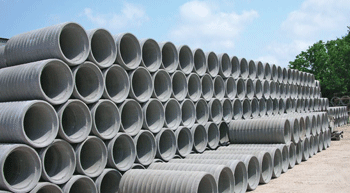
It is not necessary that all infrastructure building companies will opt for having a captive precast unit. For example, L&T is one of the largest infrastructure company in India, but they are not setting precast RCC pipe manufacturing units everywhere. Precast RCC pipe manufacturing is not their core business. Neither can one guarantee today how the infrastructure growth will be tomorrow. Today we have lots of road projects in hand, but five year down the line we may not have that many road building projects. So it will be better to outsource precast material, than to have your own unit.

How is the demand for concrete in India?
Concrete is a pretty standard product and there is always a certain amount of demand for this product in the market. However, the demand is low. We are not exactly in the concrete manufacturing business, but we keep interacting with equipment suppliers and we know that the demand is low. However, concrete market in India is large and unorganised and a lot of concrete manufacturing goes unreported.

How is availability of aggregates affecting the business? And what can be done to alleviate the issue?
We are facing aggregate shortage due to ban on mining. In India several mining operations are put to halt for environmental reasons. However, this is not a problem that cannot be solved. Concrete is manufactured in European countries too. European nations have some of the most strictest norms when it comes to environment. If aggregates and concrete can be manufactured there, then India too can find a way to manufacture it here.

One critical aspect here is that in India we do not have concretologists. If you look at the websites of international concrete suppliers, they give in-depth technical details of the material being supplied. Here we are rarely bothered about such details. Yes, we have shortage of aggregates, but then why are we not using granite as aggregate material, which is available in plenty. We are a bit hesitant when it comes to trying out a new technology.

What government initiatives can help precast industry?
Taxation must be rationalised for precast manufacturers. Just because we have a factory we are taxed extra. We often lose customers to competitors who are evading taxes. When a builder purchases a unit from us, they have to pay the VAT as well as Excise. This is an extra burden of around 15 per cent tax on the precast manufacturing industry. We are contributing to construction activity directly and should be treated as construction contractors while designing a tax policy that affects us.

What do you look at while selecting a vendor for suppling equipment?
While selecting a vendor, our first priority is to look at service quality. They must provide support in maintenance of the equipment. If we are churning out tonnes and tonnes of material on a daily basis, the machine is going to require maintenance too. So we want our equipment providers to support us when we need it. This is very important if we are trying a new product for the first time. We expect the vendors to support us for first two months at least. Second is price, but not at the cost of quality.

What about Chinese products? How is their quality?
I have not purchased any thing from china, but I have been visiting the Chinese market and their exploring equipment market. From what I have seen, there is nothing wrong with the quality of Chinese equipment. I saw that their customers are happy, both in and out of China. So, I feel that it is a myth that just because something is from China, its quality is bad.

Chinese manufacturers are perhaps falling short when it comes to marketing skills. We saw that a Chinese company may be selling 1 million units, but when we interact with their people we do not get satisfying answers to our queries. However, when we examine their equipment we do not see anything wrong with it. So I feel that it is just a language barrier.

We rarely develop indigenous products. Are we falling short on technological front?
I think that technology wise we are not lagging behind. A country that can build rockets can also build machinery for precast products. But we have to grow our appetite to take-on challenges. For example, there are only a few big precast manufacturers in India. But if one contacts them for a new product, then they have to contact their foreign partner for the know-how. We must learn to be come self sufficient and develop products indigenously.


Continue Reading
Click to comment

Leave a Reply

Your email address will not be published. Required fields are marked *

Concrete

Steel: Shielded or Strengthened?

CW explores the impact of pro-steel policies on construction and infrastructure and identifies gaps that need to be addressed.

Published

on

By

Shares

Going forward, domestic steel mills are targeting capacity expansion
of nearly 40 per cent through till FY31, adding 80-85 mt, translating
into an investment pipeline of $ 45-50 billion. So, Jhunjhunwala points
out that continuing the safeguard duty will be vital to prevent a surge
in imports and protect domestic prices from external shocks. While in
FY26, the industry operating profit per tonne is expected to hold at
around $ 108, similar to last year, the industry’s earnings must
meaningfully improve from hereon to sustain large-scale investments.
Else, domestic mills could experience a significant spike in industry
leverage levels over the medium term, increasing their vulnerability to
external macroeconomic shocks.(~$ 60/tonne) over the past one month,
compressing the import parity discount to ~$ 23-25/tonne from previous
highs of ~$ 70-90/tonne, adds Jhunjhunwala. With this, he says, “the
industry can expect high resistance to further steel price increases.”

Domestic HRC prices have increased by ~Rs 5,000/tonne
“Aggressive
capacity additions (~15 mt commissioned in FY25, with 5 mt more by
FY26) have created a supply overhang, temporarily outpacing demand
growth of ~11-12 mt,” he says…

To read the full article Click Here

Continue Reading

Concrete

JK Cement Commissions 3 MTPA Buxar Plant, Crosses 31 MTPA

Company becomes India’s fifth-largest grey cement producer

Published

on

By

Shares

JK Cement  has commissioned its new 3 MTPA grey cement plant in Buxar, Bihar, taking the company’s total installed capacity to 31.26 million tonnes per annum (MTPA) and moving it past the 30 MTPA milestone. With this addition, JK Cement now ranks among the top five grey cement manufacturers in India, strengthening its national presence.

Commenting on the development, Dr Raghavpat Singhania, Managing Director, JK Cement, said, “Crossing 31 MTPA is a significant turning point in JK Cement’s expansion and demonstrates the scale, resilience, and aspirations of our company. In addition to making a significant contribution to Bihar’s development vision, the commissioning of our Buxar plant represents a strategic step towards expanding our national footprint. We are committed to developing top-notch manufacturing capabilities that boost India’s infrastructure development and generate long-term benefits for local communities.”

Spread across 100 acres, the Buxar plant is located on the Patna–Buxar highway, enabling efficient distribution across Bihar and neighbouring regions. While JK Cement entered the Bihar market last year through supplies from its Prayagraj plant, the new facility will allow local manufacturing and deliveries within 24 hours across the state.

Mr Madhavkrishna Singhania, Joint Managing Director & CEO, JK Cement, said, “JK Cement is now among India’s top five producers of grey cement after the Buxar plant commissioning. Our capacity to serve Bihar locally, more effectively, and on a larger scale is strengthened by this facility. Although we had already entered the Bihar market last year using Prayagraj supplies, local manufacturing now enables us to be nearer to our clients and significantly raise service standards throughout the state. Buxar places us at the center of this chance to promote sustainable growth for both the company and the region in Bihar, a high-growth market with strong infrastructure momentum.”

The project has involved an investment of Rs 5 billion. Commercial production began on 29 January 2026, following construction commencement in March 2025. The company said the plant is expected to generate significant direct and indirect employment and support ancillary industrial development in the region.

Continue Reading

Concrete

JK Cement Crosses 31 MTPA Capacity with Commissioning of Buxar Plant in Bihar

Published

on

By

Shares

JK Cement has commissioned a 3 MTPA Grey Cement plant in Buxar, Bihar, taking its total capacity to 31.26 MTPA and placing it among India’s top five grey cement producers. The ₹500 crore investment strengthens the company’s national footprint while supporting Bihar’s infrastructure growth and local economic development.

JK Cement Ltd., one of India’s leading cement manufacturers, has announced the commissioning of its new state-of-the-art Grey Cement plant in Buxar, Bihar, marking a significant milestone in the company’s growth trajectory. With the commissioning of this facility, JK Cement’s total production capacity has increased to 31.26 million tonnes per annum (MTPA), enabling the company to cross the 30 MTPA threshold.

This expansion positions JK Cement among the top five Grey Cement manufacturers in India, strengthening its national footprint and reinforcing its long-term growth strategy.

Commenting on the strategic achievement, Dr Raghavpat Singhania, Managing Director, JK Cement, said, “Crossing 31 MTPA is a significant turning point in JK Cement’s expansion and demonstrates the scale, resilience, and aspirations of our company. In addition to making a significant contribution to Bihar’s development vision, the commissioning of our Buxar plant represents a strategic step towards expanding our national footprint. We are committed to developing top-notch manufacturing capabilities that boost India’s infrastructure development and generate long-term benefits for local communities.”

The Buxar plant has a capacity of 3 MTPA and is spread across 100 acres. Strategically located on the Patna–Buxar highway, the facility enables faster and more efficient distribution across Bihar and adjoining regions. While JK Cement entered the Bihar market last year through supplies from its Prayagraj plant, the Buxar facility will now allow the company to serve the state locally, with deliveries possible within 24 hours across Bihar.

Sharing his views on the expansion, Madhavkrishna Singhania, Joint Managing Director & CEO, JK Cement, said, “JK Cement is now among India’s top five producers of grey cement after the Buxar plant commissioning. Our capacity to serve Bihar locally, more effectively, and on a larger scale is strengthened by this facility. Although we had already entered the Bihar market last year using Prayagraj supplies, local manufacturing now enables us to be nearer to our clients and significantly raise service standards throughout the state. Buxar places us at the center of this chance to promote sustainable growth for both the company and the region in Bihar, a high-growth market with strong infrastructure momentum.”

The new facility represents a strategic step in supporting Bihar’s development vision by ensuring faster access to superior quality cement for infrastructure, housing, and commercial projects. JK Cement has invested approximately ₹500 crore in the project. Construction began in March 2025, and commercial production commenced on January 29, 2026.

In addition to strengthening JK Cement’s regional presence, the Buxar plant is expected to generate significant direct and indirect employment opportunities and attract ancillary industries, thereby contributing to the local economy and the broader industrial ecosystem.

Continue Reading

Trending News

SUBSCRIBE TO THE NEWSLETTER


Don't miss out on valuable insights and opportunities to connect with like minded professionals.


    This will close in 0 seconds