Connect with us

Environment

Setting standards in Sustainability

Published

on

Shares

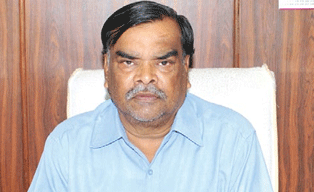
Chander Kumar Jain
Plant Head, Kesoram Industries
Cement Division, Unit: Vasavadatta Cement

If one looks at the various initiatives taken by Vasavdatta Cement to manufacture cement sustainably, it becomes obvious why the company was the winner of recent Mission Energy Challenge. The NDTV-Grundfos Mission Energy Challenge was supported by CII as Knowledge Partner, TERI as Content Partner and Shakti Sustainable Energy Foundation and AEEE as Energy Efficiency Partners. The company has also bagged the most coveted Green Co Gold rating from CII. The Green Co Rating System by CII Godrej GBC is the first of its kind in the world to evaluate industries on their environmental performance.

In an interaction with ICR, Chander Kumar Jain talks about the efforts taken by Vasavdatta to merit such applause. Excerpts from the interview.

How do you rate your company when it comes to sustainable production of cement?
We have installed Hot Disc instruments for utilising alternative fuel. We are utilising waste tyres, Plastic Waste, MSW as alternative fuel through Hot Disc, so use of additives is also reduced. All the waste is recycled in our plant. Ours is a green plant and we have got Green Co Gold rating from CII.

What is the scope for using raw material substitutes in cement production?
Cement manufacturing requires four elements as raw materials: calcium, silicon, aluminium and iron. The most common combination of ingredients is limestone (for calcium), coupled with much smaller quantities of laterite, bauxite (as sources of alumina, iron, and silica, respectively).

Cement is made with everything from seashells and shale to industrial by-products such as blast-furnace slag from steel plants and fly ash from coal-fired electric power plants. Cement plants are increasingly turning to industrial by-products that otherwise would be discarded. After completing detailed analyses to determine the effects on product chemistry and facility emissions, many cement plants are now using such by-products in the manufacture of clinker.

What operational measures have you taken to improve the sustainability of your plant?

  • Among the initiatives taken by us are some significant steps like:
  • Developed rain water harvesting pits at plant and mines
  • Installed the STP and ETP for waste water treatment
  • Installed air cooled condenser
  • Installed new technology called Hot Disc
  • Converted ESPs to bag houses, and
  • Using alternative fuels.
  • Converted fly ash transportation to railways from road to the extent of 95 per cent.
  • Please tell us about the measures taken by you for waste management?
    Waste management at Vasavdatta is focused on three key aspects, viz;
    1. Waste generated in the process of making cement (solid and liquid waste)
    2. Utilisation of waste from other industry as raw material, and
    3. Utilisation of waste from other industry as alternative fuel.
    The treatment applied depends on the kind of waste to be processed. (see box for more details.

    What are the benefits of co-processing wastes?
    Co-processing of wastes has several benefits such as:

  • Reduction in green house gas emission and related benefit of carbon trading.
  • Conversion of waste into energy/as a raw mix component.
  • Reduced burden on TSDF.
  • Conservation of fossil fuel resources.
  • Immobilisation of toxic and heavy material.
  • Reduction in energy/cement production costs.
  • To what extent are you able to utilise low grade lime stone?
    We are using online gamma ray analyser to monitor lime stone quality; as a result we are able to use low grade lime stone to the extent of 30 per cent in raw meal preparation.

    Please elaborate on the water conservation measures taken by the company?
    Water conservation measures at Vasavdatta include harvesting rainwater and its judicious use at and around our plants. The company believes in zero discharge philosophy. Some of the initiatives are detailed below.

    Power Plant Pit
    As this is a lime stone rich area, the rainwater does not percolate that well in the ground. So the rain water collected from the roof top and surface runoff is diverted by drains to the rain water harvesting pit at power plant. The total pit size is sufficient to collect 4, 00,000 m3 of water.

    Rainwater harvesting at mine pit
    Injepalli Limestone Mine has been developed systematically for rainwater harvesting. Since Gulbarga has scarcity of water, the cement plants of this region have to make their own arrangements for water. This called for the need for rainwater harvesting. The sump developed in the mine pit is utilised for storage of rainwater for its further use in the process during lean period. The quantity of rainwater collected, depends on the rainfall and the catchment area from where the water is diverted to the mine pit. For this purpose, Garland drains are cut around the quarry on the higher profile of the land channelling the rainwater from the catchment area. This water is then directed to the mine pit by opening the drain at desirable places. The mine sump has been developed to hold of 40,00,000 m3 of water.

    Tell us about your green belt development programme?
    Under its green belt development programme, Vasavdatta has planted 503,045 samplings as on March-2014. Survival rate was 54 per cent as on March-2013. The area covered in the afforestation programme is shown below.

    Location-Area in Ha
    Colony-23.0
    Factory-41.5
    Mines-20.5
    Total -85.0

    Have you done any modifications in the plant lately to reduce emissions? Some the recent modifications and upgradations include:

  • Conversion of all ESP?s to bag houses in Unit-I & II cement plant. Due to this stack emission is reduced from 150 mg/Nm3 to 50 mg/Nm3.
  • Water spray nozzles are being used at wagon tippler to reduce the dust emission.
  • Concreting of the truck parking, with an area of 40,000 sq.m, was done to control fugitive dust.
  • Installed 23 small bag filters at transfer points for controlling fugitive dust.
  • What is the scope of using fly-ash in the cement manufactured at your plant?
    We are injecting 32 per cent fly ash in PPC and are able to maintain same cement quality by proper blending and monitoring on continuous basis. We are using 100 per cent fly ash generated in CPP for PPC cement production.

    How can IT be harnessed to reduce emissions and or to improve sustainability?
    Better control and instrumentation systems over the years have ensured improved productivity of equipments resulting in optimised power and fuel consumption. Stack emissions are monitored in the central control room to ensure adherence to standards and corrective action. IT has become a lifeline in the modern age, without which information sharing and communication is difficult. It has helped to improve inventory management reducing inventory levels. Ambient air quality is also monitored online at Vasavdatta.

    What are the challenges in switching to alternative fuels?
    The main challenge in switching to AFR is inconsistent availability of the fuel. Handling is another major problem as the material often has obnoxious smell and it needs to be compacted as cubes before being fired in the calciner. Government policies too serve as an obstacle. We have to take permission every time we want to use a new material.

    Waste management at Vasavdatta
    1)Waste generated in the process of making cement

    SOLID WASTE
    Over burden soil in mines
    Entire over burden soil is transported into plant and colony to raise the ground level as well as give soil cover for plantation. In addition, the soil is used to make bund of sufficient height all across the mining lease boundary and trees are planted there.

    Low grade limestone
    Low grade limestone is kept separate and utilised by mixing it with high grade lime stone using suitable raw mix design.

    Fly ash and bed ash
    All the fly ash and bed ash is collected in five separate silos at power plant through pneumatic conveying. Both fly ash and bed ash are mixed in a silo and this ash is then transported pneumatically to cement plant in another silo where it is mixed and blended with other fly ash. After mixing the fly ash is used to manufacture cement by this we are able to use power plant bed ash, which is normally disposed in ponds.

    Waste paper and packing wood
    This waste is transported and processed for feeding into boiler.

    Waste batteries
    These are sent back to original manufacturer for processing.

    LIQUID WASTE
    Effluent Water
    We have separate process tanks where effluent water is treated and pumped back to the cement plant. This is mixed further with fresh water and neutralised. The same water is utilised back in the cement manufacturing process. Hence, we are maintaining a zero discharge plant. Some part of water is also utilised for gardening and for spraying on the road.

    Sewage Water
    Sewage water is treated through aeration system, clarifier, rapid sand filters and carbon filters. The waste sludge is stored in sludge drying beds. We maintain the prescribed standards for treated water and pump it to various gardens in and around colony and plant for gardening. Here too we follow zero discharge policy.

    Lubricating oil and grease
    All the lubricants, oil and grease from the plant are collected in barrels and stored on waste oil platform. We have oil storage tanks and suitable pumps to burn this oil and grease in our kilns.

    2)Utilisation of waste from other industry as raw material
    Our company has made various efforts to make quality PPC cement by utilisation of fly ash, which is a waste product of power plant. We have made arrangement for transportation, reception at Raichur Power Plant, NTPC, Ramagundam.

    Chemical gypsum, which is a waste by-product of other industry making sulphuric acid, located at Tuticorin, Cochin and Vizag is also used at our plant. Gypsum is transported by rail wagon and stored in closed shed. This is used as a replacement of mineral gypsum by suitable adjustment into raw mix.

    3)Utilisation of wastes of other industry as alternative fuel
    Presently, we are utilising waste generated in other industries as alternative fuels. We have installed a new technology, Hot Disc, which is first in India supplied by FLSmidth. We are able to use 3.5/10 tonnes of waste per hour as alternative fuel. We have permission to co-process following waste in our cement kiln:

  • Plastic waste
  • Carbon black powder
  • PU and upper cutting waste
  • Shredded tyres/rubber chips
  • Municipal solid waste RDF
  • Benzofuran, and
  • Used oil.
  • Cement kiln provides high temperature and long residence condition during the operation and is an effective technology for the management of hazardous waste in an environmentally friendly and safe manner. It fully absorbs the energy and material value of the waste without any harmful emissions.

    Co-processing in cement kiln ranks higher in the waste management hierarchy in comparison to other disposal options such as incineration and landfill. Unlike incineration and landfill, co-processing does not leave behind any residue that might have harmful impacts on the environment. Thus, co-processing is an ecologically sustainable solution for waste management.


    Continue Reading
    Click to comment

    Leave a Reply

    Your email address will not be published. Required fields are marked *

    Concrete

    We engineer smarter systems to reduce waste

    Published

    on

    By

    Shares

    Naveen Kumar Sharma, AVP – Sales and Marketing, Toshniwal Industries, talks about redefining instrumentation with customised, digitally enabled solutions engineered for harsh plant environments.

    For over six decades, Toshniwal Industries has played a pioneering role in advancing process instrumentation for Indian manufacturing. In this exclusive conversation with Kanika Mathur, Naveen Kumar Sharma, AVP – Sales & Marketing, explains how the company designs kiln and grinding plant solutions tailored to the unique demands of the cement industry. As plants transition to higher AFR use and smarter automation, Toshniwal’s technologies offer greater reliability, accuracy and predictive insight.

    Tell us how are your process instruments and condition monitoring system customised for cement kilns and grinding plant operations?
    Toshniwal is a company with a legacy of over 65 years, and our experience has taught us that cement kilns and grinding units are fundamentally different in their operational demands. As an Indian company, we understand the unique requirements of Indian cement manufacturers. We work closely with our customers, engage deeply with their technical teams, and study operational challenges in real-time.
    Based on these insights, we customise our solutions for both kiln and grinding applications. This tailoring is not just at a product level, but at a solution level—engineering design, instrumentation logic, and process optimisation. Our primary objective, for both the industry and our customers, is to reduce yield loss. Every customisation we implement is driven by this goal. We engineer smarter systems to reduce waste, improve consistency and increase plant reliability.
    Ultimately, our solutions are built on an understanding that cement manufacturers require robust, practical and maintainable instruments. We design with this mindset so plants can operate more efficiently, with better control and higher profitability.

    With the rising use of AFR, how do your solutions support thermal zone reliability and process time?
    Our solutions are built around four core parameters: energy efficiency, yield loss reduction, product quality and environmental responsibility. These pillars drive our engineering decisions and define how our technologies support cement plants, especially as they adopt alternative fuels and raw materials (AFR).
    We strongly believe in energy conservation. Every product we offer—whether for thermal monitoring, kiln control or flame optimisation—is engineered to improve energy performance. Reducing yield loss is another principle deeply embedded in our solutions, because production interruptions and material losses directly affect plant profitability and clinker quality.
    We are also highly conscious of the end-product quality delivered by our customers to their markets. Consistency in burning, heat transfer, and thermal profiling directly influences clinker characteristics, and our instruments help maintain this stability.
    Lastly, and most importantly, we care about the environment. We want to leave a greener world for the next generation. This mindset aligns with India’s digitalisation movement, advocated by our Prime Minister. Digital technologies are crucial for optimising AFR use, process stability, emissions and kiln efficiency. We are proud to contribute to this transition.
    By optimising flame patterns, energy use, and pollution, our solutions deliver direct and indirect savings. Plants benefit from lower operational losses, reduced maintenance, and improved reliability, especially in pyroprocessing zones.

    Tell us how do you address harsh environment challenges in cement plants, say dust, temperature, etc. with your sensor and monitoring?
    This is a very important question because cement plants, steel plants, and power plants operate in extremely harsh environments. There are two major categories of specifications that we must respect while designing solutions: technical specifications and environmental specifications. Technical specifications relate to performance accuracy, measurement integrity, responsiveness and process safety. Environmental specifications, on the other hand, relate to high temperatures, heavy dust, humidity, vibrations and corrosive atmospheres. Our solutions are engineered to withstand both. We customise sensors, housings, mounting mechanisms and protective systems so that our instruments operate at 100 per cent functionality in harsh conditions. We ensure that the plant experiences minimal downtime from our systems. That is our engineering philosophy—solutions must work reliably in real-world environments, not just in ideal laboratory conditions.

    What retrofit pathways do you offer for older cement lines to upgrade measurement and monitoring systems and how is the Indian market responding?
    Every solution we provide is scalable and digitally adaptable. Technology evolves rapidly, and our offerings evolve with it. When we upgrade instruments or monitoring systems, we design them to integrate with existing plant infrastructure, so customers do not have to rebuild everything from scratch. Once our solution is installed, software upgrades or performance improvements can often be deployed without major cost. This ensures that customers continue to benefit from ongoing technological advancements. The Indian market has responded positively to this approach. Plant operators appreciate solutions that are future-ready and dynamic rather than static. Scalability helps them maintain competitiveness, extend asset life, and move toward smart manufacturing with confidence.

    So how is your organisation leveraging digital technologies in your instrumentation portfolio for cement plants?
    Digitalisation is at the core of every product we manufacture. We stand firmly behind the digital movement, not only because it represents efficiency, but because it is the direction in which the Indian industrial ecosystem is evolving. We deploy machine-vision technologies, advanced inline monitoring systems, and solutions capable of visualising the
    inside of the furnace. These systems help reduce downtime, enable predictive asset management and provide actionable analytics to customers. All our technologies communicate seamlessly with Level 1, Level 2, and Level 3 automation. This allows integration across SCADA, DCS, ERP, and cloud ecosystems. Digitalisation for us is not an add-on—it is foundational to how our instrumentation is built.

    What are your key innovation priorities to help Indian cement plant producers hit harder, higher substitution rates, lower emissions and smarter processing?
    Sustainability is a national priority, and we are committed to supporting it. Our current portfolio already helps improve efficiency, reduce emissions, and support alternative fuel integration. But our innovation roadmap goes further. We are now developing specialised productivity-oriented software modules that will provide proactive alerts—not just alarms triggered after a fault has occurred. These modules will leverage artificial intelligence and machine learning to detect patterns early. The intention is to help plant teams take corrective actions ahead of time, reducing yield loss and environmental impact. Instead of informing the plant that a disruption has happened, the system will indicate that a disruption will happen, giving operators time to prevent it. We believe that within the next 12 to 18 months, we will launch these predictive solutions in combination with our instrumentation. When implemented, they will significantly improve decision-making, process stability and environmental performance across the Indian cement sector.

    – Kanika Mathur

    Continue Reading

    Concrete

    India donates 225t of cement for Myanmar earthquake relief

    Published

    on

    By

    Shares

    On 23 May 2025, the Indian Navy ship UMS Myitkyina arrived at Thilawa (MITT) port carrying 225 tonnes of cement provided by the Indian government to aid post-earthquake rebuilding efforts in Myanmar. As reported by the Global Light of Myanmar, a formal handover of 4500 50kg cement bags took place that afternoon. The Yangon Region authorities managed the loading of the cement onto trucks for distribution to the earthquake-affected zones.

    Continue Reading

    Concrete

    Reclamation of Used Oil for a Greener Future

    Published

    on

    By

    Shares

    In this insightful article, KB Mathur, Founder and Director, Global Technical Services, explores how reclaiming used lubricants through advanced filtration and on-site testing can drive cost savings, enhance productivity, and support a greener industrial future. Read on to discover how oil regeneration is revolutionising sustainability in cement and core industries.

    The core principle of the circular economy is to redefine the life cycle of materials and products. Unlike traditional linear models where waste from industrial production is dumped/discarded into the environment causing immense harm to the environment;the circular model seeks to keep materials literally in continuous circulation. This is achievedthrough processes cycle of reduction, regeneration, validating (testing) and reuse. Product once
    validated as fit, this model ensures that products and materials are reintroduced into the production system, minimising waste. The result? Cleaner and greener manufacturing that fosters a more sustainable planet for future generations.

    The current landscape of lubricants
    Modern lubricants, typically derived from refined hydrocarbons, made from highly refined petroleum base stocks from crude oil. These play a critical role in maintaining the performance of machinery by reducing friction, enabling smooth operation, preventing damage and wear. However, most of these lubricants; derived from finite petroleum resources pose an environmental challenge once used and disposed of. As industries become increasingly conscious of their environmental impact, the paramount importance or focus is shifting towards reducing the carbon footprint and maximising the lifespan of lubricants; not just for environmental reasons but also to optimise operational costs.
    During operations, lubricants often lose their efficacy and performance due to contamination and depletion of additives. When these oils reach their rejection limits (as they will now offer poor or bad lubrication) determined through laboratory testing, they are typically discarded contributing to environmental contamination and pollution.
    But here lies an opportunity: Used lubricants can be regenerated and recharged, restoring them to their original performance level. This not only mitigates environmental pollution but also supports a circular economy by reducing waste and conserving resources.

    Circular economy in lubricants
    In the world of industrial machinery, lubricating oils while essential; are often misunderstood in terms of their life cycle. When oils are used in machinery, they don’t simply ‘DIE’. Instead, they become contaminated with moisture (water) and solid contaminants like dust, dirt, and wear debris. These contaminants degrade the oil’s effectiveness but do not render it completely unusable. Used lubricants can be regenerated via advanced filtration processes/systems and recharged with the use of performance enhancing additives hence restoring them. These oils are brought back to ‘As-New’ levels. This new fresher lubricating oil is formulated to carry out its specific job providing heightened lubrication and reliable performance of the assets with a view of improved machine condition. Hence, contributing to not just cost savings but leading to magnified productivity, and diminished environmental stress.

    Save oil, save environment
    At Global Technical Services (GTS), we specialise in the regeneration of hydraulic oils and gear oils used in plant operations. While we don’t recommend the regeneration of engine oils due to the complexity of contaminants and additives, our process ensures the continued utility of oils in other applications, offering both cost-saving and environmental benefits.

    Regeneration process
    Our regeneration plant employs state-of-the-art advanced contamination removal systems including fine and depth filters designed to remove dirt, wear particles, sludge, varnish, and water. Once contaminants are removed, the oil undergoes comprehensive testing to assess its physico-chemical properties and contamination levels. The test results indicate the status of the regenerated oil as compared to the fresh oil.
    Depending upon the status the oil is further supplemented with high performance additives to bring it back to the desired specifications, under the guidance of an experienced lubrication technologist.
    Contamination Removal ? Testing ? Additive Addition
    (to be determined after testing in oil test laboratory)

    The steps involved in this process are as follows:
    1. Contamination removal: Using advanced filtration techniques to remove contaminants.
    2. Testing: Assessing the oil’s properties to determine if it meets the required performance standards.
    3. Additive addition: Based on testing results, performance-enhancing additives are added to restore the oil’s original characteristics.

    On-site oil testing laboratories
    The used oil from the machine passes through 5th generation fine filtration to be reclaimed as ‘New Oil’ and fit to use as per stringent industry standards.
    To effectively implement circular economy principles in oil reclamation from used oil, establishing an on-site oil testing laboratory is crucial at any large plants or sites. Scientific testing methods ensure that regenerated oil meets the specifications required for optimal machine performance, making it suitable for reuse as ‘New Oil’ (within specified tolerances). Hence, it can be reused safely by reintroducing it in the machines.
    The key parameters to be tested for regenerated hydraulic, gear and transmission oils (except Engine oils) include both physical and chemical characteristics of the lubricant:

    • Kinematic Viscosity
    • Flash Point
    • Total Acid Number
    • Moisture / Water Content
    • Oil Cleanliness
    • Elemental Analysis (Particulates, Additives and Contaminants)
    • Insoluble

    The presence of an on-site laboratory is essential for making quick decisions; ensuring that test reports are available within 36 to 48 hours and this prevents potential mechanical issues/ failures from arising due to poor lubrication. This symbiotic and cyclic process helps not only reduce waste and conserve oil, but also contributes in achieving cost savings and playing a big role in green economy.

    Conclusion
    The future of industrial operations depends on sustainability, and reclaiming used lubricating oils plays a critical role in this transformation. Through 5th Generation Filtration processes, lubricants can be regenerated and restored to their original levels, contributing to both environmental preservation and economic efficiency.
    What would happen if we didn’t recycle our lubricants? Let’s review the quadruple impacts as mentioned below:
    1. Oil Conservation and Environmental Impact: Used lubricating oils after usage are normally burnt or sold to a vendor which can be misused leading to pollution. Regenerating oils rather than discarding prevents unnecessary waste and reduces the environmental footprint of the industry. It helps save invaluable resources, aligning with the principles of sustainability and the circular economy. All lubricating oils (except engine oils) can be regenerated and brought to the level of ‘As New Oils’.
    2. Cost Reduction Impact: By extending the life of lubricants, industries can significantly cut down on operating costs associated with frequent oil changes, leading to considerable savings over time. Lubricating oils are expensive and saving of lubricants by the process of regeneration will overall be a game changer and highly economical to the core industries.
    3. Timely Decisions Impact: Having an oil testing laboratory at site is of prime importance for getting test reports within 36 to 48 hours enabling quick decisions in critical matters that may
    lead to complete shutdown of the invaluable asset/equipment.
    4. Green Economy Impact: Oil Regeneration is a fundamental part of the green economy. Supporting industries in their efforts to reduce waste, conserve resources, and minimise pollution is ‘The Need of Our Times’.

    About the author:
    KB Mathur, Founder & Director, Global Technical Services, is a seasoned mechanical engineer with 56 years of experience in India’s oil industry and industrial reliability. He pioneered ‘Total Lubrication Management’ and has been serving the mining and cement sectors since 1999.

    Continue Reading

    Trending News

    SUBSCRIBE TO THE NEWSLETTER


    Don't miss out on valuable insights and opportunities to connect with like minded professionals.


      This will close in 0 seconds