Connect with us

Concrete

EU Carbon Tax Set To Hit India’s Steel Exports

Mills Shift Focus To Middle East And Africa As EU Costs Rise

Published

on

Shares

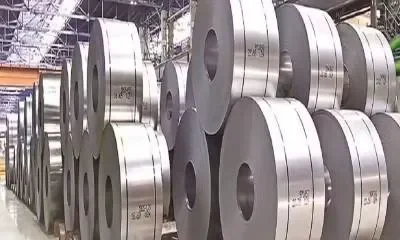
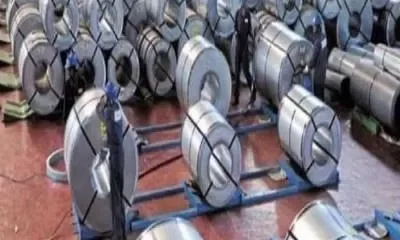
India’s steel exports to Europe are expected to decline once the European Union’s carbon tax comes into force next month, prompting domestic producers to look for alternative buyers in Africa and the Middle East, according to industry executives and analysts. From 1 January, steel imported into the European Economic Area will be subject to a levy under the EU’s Carbon Border Adjustment Mechanism (CBAM), which also covers cement, electricity, fertilisers and other emissions-intensive products.

India, the world’s second-largest crude steel producer after China, currently directs around two-thirds of its steel exports to Europe. Experts say the new regime will force Indian mills to accelerate emissions reduction. Former steel secretary Aruna Sharma said companies recognise the need for environmentally responsible production but are simultaneously scouting for new export markets.

Most Indian steel is produced using blast furnaces, which generate significantly higher emissions than electric arc furnaces. The Ministry of Steel’s top civil servant, Sandeep Poundrik, noted earlier that further blast furnace expansion is a concern. Global Energy Monitor estimates that upcoming capacity additions could increase sectoral emissions by roughly 680 million metric tonnes of carbon-dioxide equivalent.

Steady domestic demand—backed by infrastructure spending—has spurred Indian steelmakers to expand capacity. However, the new EU levy is expected to weigh on export volumes in the near term. “Most companies are still figuring out how to deal with CBAM,” said Ravi Sodah, analyst at Elara Capital. “It is expected to slow down India’s exports to the EU.”

Two senior executives at major steel firms said they had little clarity on how the tax would be calculated. One noted that with about 60 per cent of their exports heading to Europe, clarity on whether the tax would be uniform or company-specific was crucial.

According to CreditSights’ Lakshmanan R, the levy will increase the cost of Indian steel exports to Europe—particularly those produced via blast furnaces—compressing margins and eroding market share unless emissions fall. In response, producers are seeking to diversify their customer base, with mills targeting the Middle East through quick delivery commitments and flexible payment terms, said CRU Group principal analyst Shankhadeep Mukherjee.

Concrete

Niraj Cement JV Wins Railway and Metro Contracts

Two orders worth over Rs 1.64 billion boost infrastructure portfolio

Published

on

By

Shares

Niraj Cement Structurals (JV) has secured two major contracts from the Northeast Frontier Railway (NF Railway) and the Mumbai Metropolitan Region Development Authority (MMRDA), strengthening its position in large-scale infrastructure development.

The first contract, valued at Rs 815.2 million, has been awarded by NF Railway. It involves the construction of multiple-span 12.20-metre PSC slab underpasses, a major bridge (No. 727), retaining and guide walls, embankments and one minor bridge along the proposed UP and Down line near Deepor Beel. The project covers Km 163/00 to 164/200 between Azara and Kamakhya stations and forms part of the New Bongaigaon–Goalpara Town–Kamakhya (NBQ–GLPT–KYQ) railway doubling programme.

The second contract, worth Rs 826.6 million, has been awarded by MMRDA for constructing a foot overbridge (FOB) equipped with a travellator to improve connectivity between the SGMC monorail station and the Mahalaxmi metro and suburban railway stations.

The two projects underscore the company’s technical capabilities in both transportation infrastructure and environmentally sensitive construction, further strengthening its portfolio in key railway and urban mobility developments.

Continue Reading

Concrete

Peddapalli MP Seeks Clear Timelines for Rs 42.10 Bn Projects

Peddapalli MP Gaddam Vamshi Krishna has urged the Union Government to specify execution timelines for major infrastructure projects worth Rs 42.10 billion in his constituency.

Published

on

By

Shares

Peddapalli MP Gaddam Vamshi Krishna has called on the Centre to provide definitive timelines for a series of sanctioned infrastructure works that he said are essential for the region’s economic progress. Speaking in the Lok Sabha, he stressed that many approved projects remain stalled without clear implementation schedules, limiting their potential impact on connectivity and employment.

A key pending work is the Peddapalli–Manuguru Railway Line, a 137 km stretch linking Peddapalli with Manuguru in Bhadradri Kothagudem district. Although the line has received required approvals and special project status, the execution schedule has not yet been announced. The project is expected to support freight efficiency, improve coal logistics, and strengthen local job creation.

Extending his appeal beyond physical infrastructure, the MP urged the Centre to consider including Peddapalli in the India Semiconductor Mission, citing the district’s industrial ecosystem, skilled workforce, and readiness to support advanced manufacturing.

By pressing for structured timelines, Krishna emphasised the need for coordinated planning and timely execution to advance the constituency’s long-term development goals.

Continue Reading

Concrete

IndiaAI, Gujarat Govt Host Regional Conclave Ahead of 2026 AI Summit

A regional pre-summit event in Gandhinagar recently gathered leaders to advance AI for good governance.

Published

on

By

Shares

The IndiaAI Mission under the Ministry of Electronics and Information Technology, along with the Government of Gujarat and IIT Gandhinagar, convened a Regional Pre-Summit Event at Mahatma Mandir, Gandhinagar. The initiative is part of the build-up to the India–AI Impact Summit 2026, scheduled for 15–20 February 2026 at Bharat Mandapam, New Delhi.

The conclave brought together senior policymakers, technology leaders, researchers and industry practitioners to examine how AI can accelerate economic, digital and social transformation across sectors. The programme focused on the overarching theme of ‘AI for Good Governance: Empowering India’s Digital Future’.

The inaugural session featured key dignitaries including Bhupendrabhai Rajnikant Patel, Chief Minister of Gujarat; Harsh Rameshbhai Sanghavi, Deputy Chief Minister of Gujarat; Arjunbhai Devabhai Modhwadia, Minister for Science & Technology, Government of Gujarat; Manoj Kumar Das, Chief Secretary, Government of Gujarat; Abhishek Singh, Additional Secretary, MeitY and Director General, NIC; and Ponugumatla Bharathi, Secretary, Department of Science & Technology, Government of Gujarat.

High-impact keynote sessions led by national and global experts from MeitY, Bhashini, Google Cloud, Microsoft, IBM Research, NVIDIA, Oracle and AWS examined themes including AI in governance, public service delivery, urban development, rural transformation, healthcare, agriculture, fintech and multilingual accessibility enabled through Bhashini.
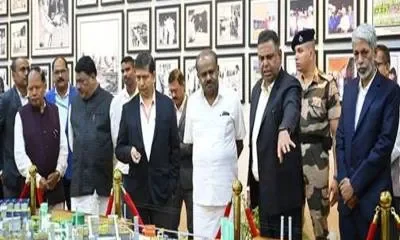
Delegates also visited an Experience Zone curated by IndiaAI and DST Gujarat, which showcased AI solutions across governance, agriculture, health and industry.

By convening government, industry and academic stakeholders, the conclave aimed to strengthen India’s AI ecosystem through frameworks that prioritise trust, scalability and public interest. Insights generated from the event will contribute directly to the agenda and outcomes of the India–AI Impact Summit 2026. 

Continue Reading

Trending News

SUBSCRIBE TO THE NEWSLETTER


Don't miss out on valuable insights and opportunities to connect with like minded professionals.


    This will close in 0 seconds