Connect with us

Concrete

AFCM Unveils 2035 Regional Decarbonisation Roadmap for Cement Sector

AFCM launches world’s first regional decarbonisation plan for cement at Brunei meet.

Published

on

Shares
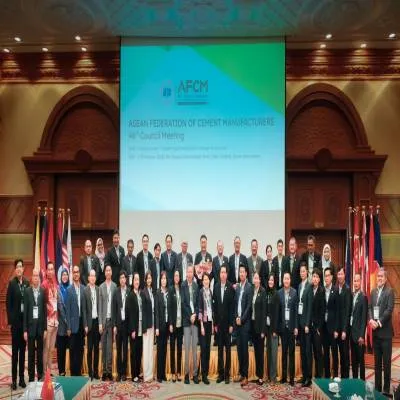
The ASEAN Federation of Cement Manufacturers (AFCM) has formally launched the 2035 AFCM Decarbonisation Roadmap, becoming the first regional bloc in the world to introduce a unified decarbonisation strategy for the cement sector. The announcement was made at the 46th AFCM Council Meeting in Brunei Darussalam, chaired by Dr Chana Poomee, and attended by leaders and representatives of cement associations from all eight AFCM member countries. The launch comes as global attention intensifies ahead of COP30 in Brazil, where climate action is expected to be a central priority.
Cement production remains integral to infrastructure and economic development across the ASEAN region, yet it is also a major contributor to CO? emissions. The 2035 AFCM Decarbonisation Roadmap signals a collective regional commitment to accelerating emissions reduction in alignment with national climate policies and global sustainability goals, reinforcing AFCM’s leadership in the transition to low carbon cement production.
Dr Chana Poomee, AFCM President and Chairman of the Thai Cement Manufacturers Association (TCMA), described the roadmap as a landmark achievement for the region’s cement industry. He noted that the shared framework would support systematic CO? reduction, strengthen regional competitiveness and enhance ASEAN’s contribution to global climate objectives.
Developed with strong support from the Global Cement and Concrete Association (GCCA), the 2035 Roadmap sets out a comprehensive transition pathway anchored around four strategic pillars:
• Expansion of low carbon cement enabled by performance-based standards;
• Transition to clean and renewable energy across production processes, alongside improved thermal and electrical efficiency;
• Deployment of advanced decarbonisation technologies, including Carbon Capture, Utilisation and Storage (CCUS); and
• Development of new supplementary cementitious materials to support next-generation low carbon cement products.
Dr Chana urged all AFCM members to treat the roadmap as a coordinated regional strategy for sustainable growth. At the ASEAN level, the measures outlined have the potential to reduce up to 38 million tonnes of CO2 by 2035. While the roadmap sets a collective vision, it acknowledges the diversity of national conditions, recognising that each member country will set its own targets based on regulatory frameworks, industrial maturity and technological capacity. One key early-action priority is the reduction and phasedown of Ordinary Portland Cement (OPC), providing an immediate opportunity for substantial emissions cuts.
Cement associations from Brunei Darussalam, Cambodia, Indonesia, Malaysia, the Philippines, Singapore, Thailand and Vietnam expressed strong support for the roadmap and reaffirmed their commitment to advancing decarbonisation within their national contexts. Members emphasised the need for supportive policies, expanded use of alternative fuels, improved energy efficiency, accelerated adoption of advanced technologies and greater promotion of low carbon cement and concrete solutions. They also recognised that specific decarbonisation pathways will vary based on each country’s energy mix, material availability, policy environment and market readiness.
“The 2035 AFCM Decarbonisation Roadmap presents a significant opportunity to enhance regional competitiveness, drive sustainable development and unlock substantial economic benefits. Government support, including policy adaptation, will be essential for effective implementation. Through collaboration, innovation and collective action, AFCM can accelerate the adoption of low carbon technologies, attract green investment, create new economic opportunities and build a resilient, future-ready cement industry that contributes meaningfully to global decarbonisation,” Dr Chana concluded.
The issuer is solely responsible for the content of this announcement.

Continue Reading

Concrete

Niraj Cement JV Wins Railway and Metro Contracts

Two orders worth over Rs 1.64 billion boost infrastructure portfolio

Published

on

By

Shares

Niraj Cement Structurals (JV) has secured two major contracts from the Northeast Frontier Railway (NF Railway) and the Mumbai Metropolitan Region Development Authority (MMRDA), strengthening its position in large-scale infrastructure development.

The first contract, valued at Rs 815.2 million, has been awarded by NF Railway. It involves the construction of multiple-span 12.20-metre PSC slab underpasses, a major bridge (No. 727), retaining and guide walls, embankments and one minor bridge along the proposed UP and Down line near Deepor Beel. The project covers Km 163/00 to 164/200 between Azara and Kamakhya stations and forms part of the New Bongaigaon–Goalpara Town–Kamakhya (NBQ–GLPT–KYQ) railway doubling programme.

The second contract, worth Rs 826.6 million, has been awarded by MMRDA for constructing a foot overbridge (FOB) equipped with a travellator to improve connectivity between the SGMC monorail station and the Mahalaxmi metro and suburban railway stations.

The two projects underscore the company’s technical capabilities in both transportation infrastructure and environmentally sensitive construction, further strengthening its portfolio in key railway and urban mobility developments.

Continue Reading

Concrete

Peddapalli MP Seeks Clear Timelines for Rs 42.10 Bn Projects

Peddapalli MP Gaddam Vamshi Krishna has urged the Union Government to specify execution timelines for major infrastructure projects worth Rs 42.10 billion in his constituency.

Published

on

By

Shares

Peddapalli MP Gaddam Vamshi Krishna has called on the Centre to provide definitive timelines for a series of sanctioned infrastructure works that he said are essential for the region’s economic progress. Speaking in the Lok Sabha, he stressed that many approved projects remain stalled without clear implementation schedules, limiting their potential impact on connectivity and employment.

A key pending work is the Peddapalli–Manuguru Railway Line, a 137 km stretch linking Peddapalli with Manuguru in Bhadradri Kothagudem district. Although the line has received required approvals and special project status, the execution schedule has not yet been announced. The project is expected to support freight efficiency, improve coal logistics, and strengthen local job creation.

Extending his appeal beyond physical infrastructure, the MP urged the Centre to consider including Peddapalli in the India Semiconductor Mission, citing the district’s industrial ecosystem, skilled workforce, and readiness to support advanced manufacturing.

By pressing for structured timelines, Krishna emphasised the need for coordinated planning and timely execution to advance the constituency’s long-term development goals.

Continue Reading

Concrete

IndiaAI, Gujarat Govt Host Regional Conclave Ahead of 2026 AI Summit

A regional pre-summit event in Gandhinagar recently gathered leaders to advance AI for good governance.

Published

on

By

Shares

The IndiaAI Mission under the Ministry of Electronics and Information Technology, along with the Government of Gujarat and IIT Gandhinagar, convened a Regional Pre-Summit Event at Mahatma Mandir, Gandhinagar. The initiative is part of the build-up to the India–AI Impact Summit 2026, scheduled for 15–20 February 2026 at Bharat Mandapam, New Delhi.

The conclave brought together senior policymakers, technology leaders, researchers and industry practitioners to examine how AI can accelerate economic, digital and social transformation across sectors. The programme focused on the overarching theme of ‘AI for Good Governance: Empowering India’s Digital Future’.

The inaugural session featured key dignitaries including Bhupendrabhai Rajnikant Patel, Chief Minister of Gujarat; Harsh Rameshbhai Sanghavi, Deputy Chief Minister of Gujarat; Arjunbhai Devabhai Modhwadia, Minister for Science & Technology, Government of Gujarat; Manoj Kumar Das, Chief Secretary, Government of Gujarat; Abhishek Singh, Additional Secretary, MeitY and Director General, NIC; and Ponugumatla Bharathi, Secretary, Department of Science & Technology, Government of Gujarat.

High-impact keynote sessions led by national and global experts from MeitY, Bhashini, Google Cloud, Microsoft, IBM Research, NVIDIA, Oracle and AWS examined themes including AI in governance, public service delivery, urban development, rural transformation, healthcare, agriculture, fintech and multilingual accessibility enabled through Bhashini.
Delegates also visited an Experience Zone curated by IndiaAI and DST Gujarat, which showcased AI solutions across governance, agriculture, health and industry.

By convening government, industry and academic stakeholders, the conclave aimed to strengthen India’s AI ecosystem through frameworks that prioritise trust, scalability and public interest. Insights generated from the event will contribute directly to the agenda and outcomes of the India–AI Impact Summit 2026. 

Continue Reading

Trending News