Concrete
FLSmidth Pipe Conveyors
Published
6 years agoon
By
admin
Flexible, cost-effective and reliable material transport.
Environmentally sensitive topography. Excessive dust and noise emissions. Restricted operating spaces. Unprotected commodities. Tight curves and large angles of inclination. Rough, broken and hilly terrain. Expensive transfer towers. These all can be challenges when you need to convey material efficiently and safely from point to point.
FLSmidth-engineered pipe conveyors are a cost-effective and reliable material transport solution that meets all these challenges head on. It secures the material and protects the environment with a dust- and noise-controlled conveyor system. They are suitable for all types of bulk material, from hot cement or clinker to coal, limestone, fly ash, phosphate granulates, and wood chips. These pipe conveyor systems can easily be integrated into existing and new installations and handle bulk material transport for reliable in-plant and long-distance conveying. Including two way conveying, where raw material is loaded at the jetty for bringing it to the plant and cement/clinker loaded on the same conveyor from the plant to the jetty.
How does it work?
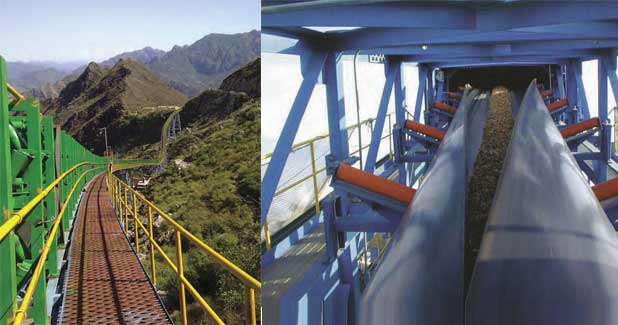
In the material loading area, the conveying belt is still open when the material loads onto the belt similar to conventional belt conveyors. Over a length of several metres, the belt closes and is formed by special devices into a tubular shape. From that point, the belt becomes an enclosed pipe that travels the entire conveying line before opening at the discharge end.
Flexibility
The flexible belt pipe design allows directional changes without the need for additional transfer stations. Its curves can either be horizontal or vertical, or a combination of both. The belt opens on its own before reaching the material discharging point. Following the material discharge, the belt on the lower strand is closed again on its return. This eliminates spilt material over the pipe conveyor line and has the advantage that the carrying side of the belt is once again inside the tube, before opening up near feed end.
Protection for your material and for the environment
The enclosed conveying means that your material is protected against external environmental factors, such as wind, humidity and rain, while the pipe configuration protects the environment against dust or any potential material loss. Where the environment is a concern, pipe conveyors have become the default choice, even preferred by regulatory bodies. There is no spillage on the return strand of enclosed section of conveyor, and extremely low dust occurrence during transport. Our systems are designed to handle up to 30-degree inclinations. We have engineered and installed systems with conveying angles from plus 29 degrees to minus 26.5 degrees, that includes conveying limestone, cement and other hot materials up to 160 degree Celsius.
A cost-effective solution
Our pipe conveyor systems are the go-to solution if you want to connect your mine or port to your plant for raw material; plant to port for finished product; or from plant to mines for waste disposal through the same conveyor. If you are upgrading an existing brownfield plant and have space constraints or are looking to tackle spillage from material handling conveyor systems, the pipe conveyors provide a cost-effective solution. In turn, maintenance and operating costs are also lowered. With more than 300 references and over 200 km of conveying length located in over 40 countries, our pipe conveyors are clearly the world’s foremost solutions in this area.
Features:
- Reduced dust and spillage
- Lower noise emissions
- Inclines up to 30 degree
- Horizontal and vertical curves starting with as small as 54 metres
- Steep downhill conveying with high slope angles
- Multiple feed and discharge points
- Eight km and greater distances possible without transfer stations
- Simultaneous conveying of different materials in both directions
- Intelligent drive control systems reducing belt stress by torque-sharing
- Lump sizes up to 200 mm (pipe diameter = 2.5 to three times maximum lump size)
Why choose FLSmidth to supply your pipe conveyor solution? Our systems incorporate patented features to deliver enhanced performance:
Belt rotation monitoring system to ensure that the pipe conveyor is not damaged due to uncontrolled rotation.
For two-way conveying systems, a unique pretzel arrangement of the crossing of the carry and return lines simplifies discharge end design and improves overall layout. Roller holding brackets that ensure ease of installation and maintenance.
Additional reasons why you should consider operating our pipe conveyors.
Safety elements ensures the pipe conveyor is not damaged because of oversized load or overfilling – in the case of overfilling, the upper part will be lifted, and an electrical switch will be activated to immediately stop the conveyor.
Apply energy saving technologies to reduce OPEX cost per tonne of material transport.
Our pipe conveyors are specially designed to ensure high availability and low investment costs for the transport of all types of bulk material. We incorporate our extensive know-how of conveyor design and experience working with a varied range of material into each pipe conveyor and varied applications we build. Our numerous specially developed design elements, many of them patented, have been fully tested and optimised in actual operation.
FLSmidth – a partner you can trust
We approach your project not just as suppliers, but as partners invested in your success. We provide equipment, software and advisory services to bring your pipe conveying operation to full potential, including electrical automation services for multi-drive synchronisation. We also provide aftermarket support. Our vast experience and knowledge ensure that you are given the advantage of global technology with a local presence.
ABOUT THE AUTHOR: The article is authored by Vivek Chaturvedi, Process Line Manager – Pipe Conveyors, FLSmidth Private Limited.
Communication by the management of the company
You may like
Concrete
ACC To Expand Cement Capacity Amid Strong Infrastructure Demand
Chairman signals calibrated growth and sustainability focus
Published
15 hours agoon
June 26, 2026By
admin
ACC will continue to expand its cement capacity in a calibrated manner, deepen its ready-mix concrete (RMC) footprint and accelerate the adoption of low-carbon technologies, the company chairman conveyed in the latest annual report. The note emphasised a balanced and disciplined approach as the business pursues growth while maintaining environmental safeguards.
He argued that the long-term growth outlook for the Indian economy remains strong but that demand conditions in the near term were likely to stay moderate, necessitating cautious expansion. He pointed to India’s relatively low per capita cement consumption compared with global averages as an indicator of significant long-term potential and highlighted the rise in public capital expenditure to Rs 12 trillion (Rs 12 tn), which he said accounted for about four point four per cent of the GDP.
Against this backdrop, ACC and the wider Adani Cement business are positioning themselves as integrated building materials solution providers rather than traditional commodity suppliers, prioritising capability creation over consolidation. The chairman framed cement as the ingredient and concrete as the performance and said that infrastructure and real estate development increasingly demand engineered solutions delivered at site.
He described how deeper integration across energy, logistics and digital systems is intended to improve responsiveness and efficiency across manufacturing, transport and market operations. The company intends to strengthen technical engagement, mix optimisation and application support to improve project timelines, reduce wastage and enhance structural durability while embedding data analytics and predictive systems.
On sustainability, ACC affirmed its commitment to reducing its environmental footprint through greater use of blended cement, renewable energy, alternative fuels and improved thermal efficiency, presenting industrial growth and environmental responsibility as parallel objectives. The message positioned the group to supply engineered concrete solutions at the point of application as it scales capacity and service offerings.
Concrete
Ambuja Sees Cement Demand Easing To Around Five Per Cent In FY27
Company Cites Housing, Infrastructure And Government Capex
Published
5 days agoon
June 22, 2026By
admin
Ambuja Cements has said in its latest annual report that cement demand in India is likely to moderate to around five per cent in fiscal year twenty seven, marking a slowdown from the estimated six point five to seven point five per cent growth anticipated for fiscal year twenty six. The company described this as a transition to a more measured pace of expansion after several years of strong momentum in the sector.
It said that underlying demand drivers such as housing, infrastructure development, urbanisation and government capital expenditure remain intact and are expected to sustain cement consumption across regions. The report noted that global geopolitical uncertainties and weather risks, including forecasts of a below normal monsoon, could influence near term demand, while emphasising that the longer term infrastructure story for India continues to provide a solid foundation for the sector.
Industry observers have said that the sector may move towards mid single digit growth rates in fiscal year twenty seven after stronger performances in recent years. The company outlined a calibrated expansion strategy with capacity additions phased to match project pipelines, regional demand patterns and market absorption, seeking to avoid oversupply and pressure on pricing.
Ambuja has crossed the 100 million tonnes per annum capacity milestone (100 mn t per annum) following acquisitions and organic expansion, strengthening its position in the competitive market. The outlook in the report broadly aligns with other market assessments that placed demand at around five per cent in fiscal year twenty five, a recovery to six point five to seven point five per cent in fiscal year twenty six and an easing in fiscal year twenty seven as capacity increases. Executives remain focused on long term demand fundamentals driven by infrastructure and housing.
Gears, drives, and motors have evolved from essential mechanical components into strategic enablers of reliability, efficiency, and sustainability in modern cement plants. ICR explores how advanced motion technologies, predictive maintenance, digitalisation, and intelligent drive systems are helping cement manufacturers reduce downtime, optimise energy use, and build future-ready operations.
As the Indian cement industry prepares for another phase of capacity expansion, the focus is shifting from merely increasing production volumes to improving operational efficiency, reliability, and sustainability. According to industry estimates, India is expected to add nearly 160–170 million tonnes of cement capacity between FY26 and FY28, driven by infrastructure investments, urbanisation, and housing demand. In this environment, gears, drives, and motors have emerged as critical enablers of productivity, forming the backbone of every major process from raw material extraction and grinding to clinker production and cement dispatch.
Motors alone account for nearly 60 per cent to 70 per cent of industrial electricity consumption globally, according to the International Energy Agency (IEA), while rotating equipment failures remain among the leading causes of unplanned downtime across heavy industries. In cement plants, where equipment operates under high loads, extreme dust conditions, elevated temperatures, and continuous-duty cycles, the performance of gears, drives, and motors directly influences energy consumption, maintenance costs, plant availability, and overall profitability. As digitalisation and Industry
4.0 technologies gain momentum, these systems are evolving from passive mechanical components into intelligent assets capable of delivering real-time operational insights.
Why gears, drives, and motors are the backbone of cement plant operations
Every major process in a cement plant depends on the seamless operation of gears, drives, and motors. Raw mills, vertical roller mills, crushers, kiln drives, conveyor systems, fans, and clinker coolers all rely on rotating equipment to maintain continuous production. A failure in any one of these systems can disrupt entire process chains, highlighting their strategic importance.
Modern cement plants process thousands of tonnes of material daily, requiring equipment capable of transmitting enormous torque while maintaining precision and reliability. Kiln drives and grinding systems, in particular, operate under some of the highest mechanical loads found in industrial manufacturing. The ability of gears and motors to withstand these conditions directly impacts plant throughput and production stability.
Satish Maheshwari, Chief Manufacturing Officer, Shree Cement says, “Effective lubrication management remains one of the most critical factors in extending the lifespan of cement plant drive systems. Proper lubrication, supported by regular oil analysis, vibration diagnostics, and condition monitoring, helps minimise wear, prevent unexpected failures, and maintain the integrity of critical components such as gearboxes, motors, and drive assemblies. By identifying potential issues at an early stage, plants can move from reactive maintenance to a more proactive and reliability-focused approach.”
“Smart motors, intelligent drives, and next-generation gearboxes are set to redefine cement plant maintenance and performance. Equipped with embedded sensors, IoT connectivity, digital twins, and AI-driven diagnostics, these technologies enable real-time condition monitoring, predictive maintenance, and seamless digital integration. As the industry embraces Industry 4.0, smart drive systems will play a pivotal role in improving energy efficiency, reducing downtime, and optimising asset performance across the cement manufacturing value chain” he adds.
Industry studies suggest that rotating equipment accounts for a significant proportion of maintenance expenditure in process industries. Effective design, selection, and maintenance of gears, drives, and motors therefore have a direct influence on asset utilisation, operational efficiency, and total cost of ownership.
The cost of downtime: reliability challenges in rotating equipment
Unplanned downtime remains one of the most expensive challenges facing cement manufacturers. Industry estimates indicate that a major failure involving a critical gearbox, kiln drive, or grinding mill can result in production losses running into lakhs of rupees per hour, depending on plant capacity and operating conditions.
Sanjeev Arora, President – Motion Business & IEC LV Motors Division, ABB India says, “One of the most significant shifts taking place in industrial decision-making today is moving away from evaluating equipment based solely on upfront capital cost toward understanding total cost of ownership (TCO). In a typical motor system, the purchase price often represents only a small fraction of the total lifecycle cost however energy consumption, maintenance requirements, downtime and operating efficiency account for the vast majority of long-term operational expenses. For cement manufacturers operating in highly competitive markets, this distinction is critical.”
“A high efficiency motor paired with an appropriately configured variable speed drive may require a higher initial investment, but the long-term benefits are substantial. Reduced electricity consumption, lower maintenance needs, longer service intervals and improved process stability can deliver faster payback and stronger profitability over time” he adds.
Cement plants present a particularly challenging environment for rotating equipment. Dust ingress, thermal fluctuations, shock loads, vibration, shaft misalignment, and lubrication contamination contribute significantly to equipment degradation. Studies by SKF indicate that nearly 50 per cent of bearing failures are linked to lubrication issues and contamination, while improper alignment and vibration-related problems remain leading causes of gearbox and motor failures.
Energy-efficient motors and drives: unlocking operational savings
Energy is one of the largest operating expenses for cement manufacturers, often accounting for 25 per cent to 35 per cent of total production costs. Grinding operations alone can consume nearly 60 per cent to 70 per cent of a plant’s electrical energy, making energy-efficient motors and drives a strategic investment.
According to the International Energy Agency, high-efficiency motors combined with Variable Frequency Drives (VFDs) can reduce energy consumption by 20 per cent to 30 per cent in suitable applications. By matching motor speed and torque to actual process requirements, VFDs minimise unnecessary power consumption while reducing mechanical stress on equipment, improving both efficiency and reliability.
Advances in gearbox design and power transmission technologies
Modern gearbox technology has evolved significantly in response to the increasing demands of cement manufacturing. Advanced materials, case-hardened gears, optimised tooth profiles, improved surface finishing, and enhanced lubrication systems are helping reduce friction, wear, and thermal loading.
Girish Hanchate, Director – Industrial Market, India SKF India (Industrial) says, “Smart diagnostics are significantly improving the lifecycle of gears, motors, and other rotating equipment by enabling a shift from reactive maintenance to condition-based asset management. Hidden issues such as vibration anomalies, bearing defects, misalignment, and temperature fluctuations can quietly reduce plant throughput by 10 per cent to 20 per cent while increasing energy consumption long before a breakdown occurs. By leveraging advanced sensors, predictive analytics, machine learning, and real-time monitoring of vibration, temperature, and motor current, cement manufacturers can detect developing faults early, optimise maintenance schedules, and prevent costly secondary damage. This not only improves reliability but also supports energy efficiency and sustainability objectives.”
“The next major evolution in drive and bearing technology lies in the development of fully integrated smart mechanical ecosystems that combine high-performance bearings, advanced lubrication management, and digital intelligence. Sensor-enabled condition monitoring embedded directly within bearings and drive systems allows operators to capture critical operational data at the source, enabling predictive maintenance and real-time performance optimisation. Innovations such as SKF’s VA9A1 Spherical Roller Bearing series, engineered specifically for demanding cement applications such as crushers and kilns, demonstrate this trend. By increasing internal bearing space and optimising lubricant flow, these designs improve grease retention, reduce wear, minimise downtime, and create more resilient, energy-efficient rotating equipment systems for the future of cement manufacturing” he adds.
Manufacturers are increasingly focusing on compact, high-torque gearbox designs capable of delivering higher power density while maintaining service life. Innovations such as condition-monitored gear systems, improved sealing technologies, and modular gearbox architectures are simplifying maintenance while enhancing operational reliability.
Predictive maintenance, condition monitoring, and asset health management
The shift from reactive to predictive maintenance is transforming asset management across the cement industry. Technologies such as vibration monitoring, thermography, oil analysis, ultrasound testing, and motor current signature analysis are enabling operators to identify potential failures before they occur.
Research by Deloitte suggests that predictive maintenance can reduce breakdowns by up to 70 per cent and lower maintenance costs by 25 per cent. In cement plants, where shutdown windows are limited and equipment operates continuously, predictive maintenance offers a powerful tool for improving reliability and extending asset life.
Digitalisation, industry 4.0, and the rise of intelligent drive systems
Industry 4.0 technologies are redefining the role of gears, drives, and motors. Smart sensors embedded within motors, bearings, and gear systems can continuously monitor temperature, vibration, load, lubrication condition, and energy consumption.
Girish Hanchate says, “As the industry embraces automation, sustainability, and digital transformation, the importance of intelligent motion technologies will continue to grow. The convergence of advanced engineering, predictive maintenance, and Industry 4.0 solutions is creating a new generation of cement plants where reliability, efficiency, and sustainability work together to deliver long-term value. For cement manufacturers navigating increasing production demands and environmental expectations, investing in smarter gears, drives, and motors is no longer optional—it is a business imperative.”
Cloud-based monitoring platforms and Industrial Internet of Things (IIoT) architectures enable maintenance teams to access equipment health data remotely, improving visibility across geographically dispersed operations. Advanced analytics and
artificial intelligence are further enhancing fault detection capabilities, enabling more accurate maintenance planning.
The emergence of digital twins represents another significant development. By creating virtual replicas of physical assets, operators can simulate operating conditions, predict failures, optimise maintenance schedules, and improve lifecycle management decisions. These technologies are helping transform rotating equipment into intelligent assets that actively contribute to operational decision-making.
Building future-ready cement plants through smart motion technologies
The future of cement manufacturing will depend heavily on the ability to integrate mechanical reliability with digital intelligence. Smart motion technologies combine high-efficiency motors,
intelligent drives, condition monitoring systems, and automation platforms to create more responsive and efficient operations.
Sustainability goals are also accelerating investment in advanced motion technologies. Reduced energy consumption, improved equipment efficiency, and extended asset life contribute directly to lower carbon emissions and reduced resource consumption.
These benefits align closely with the industry’s decarbonisation objectives.
As capacity expansions continue across India, future-ready cement plants will increasingly prioritise reliability, flexibility, and data-driven decision-making. Organisations that successfully integrate smart motion technologies into their operations will be better positioned to reduce costs, improve productivity, and maintain a competitive advantage in a rapidly evolving market.
Conclusion
Gears, drives, and motors are no longer viewed solely as mechanical components; they have become strategic assets that influence every aspect of cement plant performance. Their reliability affects production continuity, their efficiency impacts operating costs, and their digital capabilities increasingly shape maintenance and operational strategies.
- –Kanika Mathur
ACC To Expand Cement Capacity Amid Strong Infrastructure Demand
Ambuja Sees Cement Demand Easing To Around Five Per Cent In FY27
Powering Cement Through Intelligent Motion
Liquid Intelligence
The Logistics Imperative
ACC To Expand Cement Capacity Amid Strong Infrastructure Demand
Ambuja Sees Cement Demand Easing To Around Five Per Cent In FY27
Powering Cement Through Intelligent Motion
Liquid Intelligence