Connect with us

Concrete

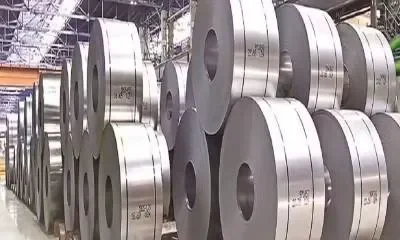
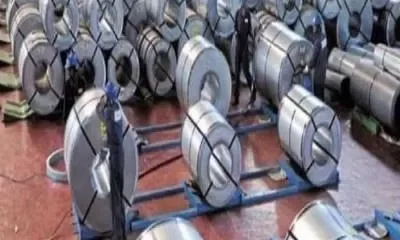
EU Carbon Tax Set To Hit India’s Steel Exports

Mills Shift Focus To Middle East And Africa As EU Costs Rise

Published

on

Shares

India’s steel exports to Europe are expected to decline once the European Union’s carbon tax comes into force next month, prompting domestic producers to look for alternative buyers in Africa and the Middle East, according to industry executives and analysts. From 1 January, steel imported into the European Economic Area will be subject to a levy under the EU’s Carbon Border Adjustment Mechanism (CBAM), which also covers cement, electricity, fertilisers and other emissions-intensive products.

India, the world’s second-largest crude steel producer after China, currently directs around two-thirds of its steel exports to Europe. Experts say the new regime will force Indian mills to accelerate emissions reduction. Former steel secretary Aruna Sharma said companies recognise the need for environmentally responsible production but are simultaneously scouting for new export markets.

Most Indian steel is produced using blast furnaces, which generate significantly higher emissions than electric arc furnaces. The Ministry of Steel’s top civil servant, Sandeep Poundrik, noted earlier that further blast furnace expansion is a concern. Global Energy Monitor estimates that upcoming capacity additions could increase sectoral emissions by roughly 680 million metric tonnes of carbon-dioxide equivalent.

Steady domestic demand—backed by infrastructure spending—has spurred Indian steelmakers to expand capacity. However, the new EU levy is expected to weigh on export volumes in the near term. “Most companies are still figuring out how to deal with CBAM,” said Ravi Sodah, analyst at Elara Capital. “It is expected to slow down India’s exports to the EU.”

Two senior executives at major steel firms said they had little clarity on how the tax would be calculated. One noted that with about 60 per cent of their exports heading to Europe, clarity on whether the tax would be uniform or company-specific was crucial.

According to CreditSights’ Lakshmanan R, the levy will increase the cost of Indian steel exports to Europe—particularly those produced via blast furnaces—compressing margins and eroding market share unless emissions fall. In response, producers are seeking to diversify their customer base, with mills targeting the Middle East through quick delivery commitments and flexible payment terms, said CRU Group principal analyst Shankhadeep Mukherjee.

Concrete

UltraTech Cement FY26 PAT Crosses Rs 80 bn

Company reports record sales, profit and 200 MTPA capacity milestone

Published

on

By

Shares

UltraTech Cement reported record financial performance for Q4 and FY26, supported by strong volumes, higher profitability and improved cost efficiency. Consolidated net sales for Q4 FY26 rose 12 per cent year-on-year to Rs 254.67 billion, while PBIDT increased 20 per cent to Rs 56.88 billion. PAT, excluding exceptional items, grew 21 per cent to Rs 30.11 billion.

For FY26, consolidated net sales stood at Rs 873.84 billion, up 17 per cent from Rs 749.36 billion in FY25. PBIDT rose 32 per cent to Rs 175.98 billion, while PAT increased 36 per cent to Rs 83.05 billion, crossing the Rs 80 billion mark for the first time.

India grey cement volumes reached 42.41 million tonnes in Q4 FY26, up 9.3 per cent year-on-year, with capacity utilisation at 89 per cent. Full-year India grey cement volumes stood at 145 million tonnes. Energy costs declined 3 per cent, aided by a higher green power mix of 43 per cent in Q4.

The company’s domestic grey cement capacity has crossed 200 MTPA, reaching 200.1 MTPA, while global capacity stands at 205.5 MTPA. UltraTech also recommended a special dividend of Rs 2.40 billion per share value basis equivalent to Rs 240.

Continue Reading

Concrete

Towards Mega Batching

Optimised batching can drive overall efficiencies in large projects.

Published

on

By

Shares

India’s pace of infrastructure development is pushing the construction sector to work at a significantly higher scale than previously. Tight deadlines necessitate eliminating concreting delays, especially in large and mega projects, which, in turn, imply installing the right batching plant and ensuring batching is efficient. CW explores these steps as well as the gaps in India’s batching plant market.

Choose well

Large-scale infrastructure and building projects typically involve concrete consumption exceeding 30,000-50,000 cum per annum or demand continuous, high-volume pours within compressed timelines, according to Rahul R Wadhai, DGM – Quality, Tata Projects.

Considering the daily need for concrete, “large-scale concreting involves pouring more than 1,000–2,000 cum per day while mega projects involve more than 3,000 cum per day,” says Satish R Vachhani, Advanced Concrete & Construction Consultant…

To read the full article Click Here

Continue Reading

Concrete

Andhra Offers Discom Licences To Private Firms Outside Power Sector

Policy allows firms over 300 MW to seek distribution licences

Published

on

By

Shares

The Andhra Pradesh government will allow private firms that require more than 300 megawatt (MW) of power to apply for distribution licences, making the state the first to extend such licences beyond the power sector. The policy targets information technology, pharmaceuticals, steel and data centres and aims to reduce reliance on state utilities as demand rises for artificial intelligence infrastructure.

Approved applicants will be able to procure electricity directly from generators through power purchase agreements, a change officials said will create more competitive tariffs and reduce supply risk. Licence holders will use the Andhra Pradesh Transmission Company (APTRANSCO) network on payment of charges and will not need a separate distribution network initially.

Licences will be granted under the Electricity Act, 2003 framework, with the Central and State electricity regulators retaining authority over terms and approvals. The recent Electricity (Amendment) Bill, 2025 sought to lower entry barriers, enable network sharing and encourage competition, while the state commission will set floor and ceiling tariffs where multiple discoms operate.

Industry players and original equipment manufacturers welcomed the policy, saying competitive supply is vital for large data centre investments. Major projects and partnerships such as those involving Adani and Google, Brookfield and Reliance, and Meta and Sify Technologies are expected to benefit as capacity expands in the state.

Analysts noted India’s data centre capacity is forecast to reach 10 gigawatts (GW) by 2030 and cited International Energy Agency estimates that global data centre electricity consumption could approach 945 terawatt hours by the same year. A one GW data centre needs an equivalent power allocation and one point five times the water, which authorities equated to 150 billion litres (150 bn litres).

Advisers warned that distribution licences will require close regulation and monitoring to prevent misuse and to ensure tariffs and supply obligations are met. Officials said the policy aims to balance investor requirements with regulatory oversight and could serve as a model for other states.

Continue Reading

Video Thumbnail

    SIGN-UP FOR OUR GENERAL NEWSLETTER


    Trending News

    SUBSCRIBE TO THE NEWSLETTER


    Don't miss out on valuable insights and opportunities to connect with like minded professionals.


      This will close in 0 seconds