Connect with us

Concrete

AFCM Unveils 2035 Regional Decarbonisation Roadmap for Cement Sector

AFCM launches world’s first regional decarbonisation plan for cement at Brunei meet.

Published

on

Shares
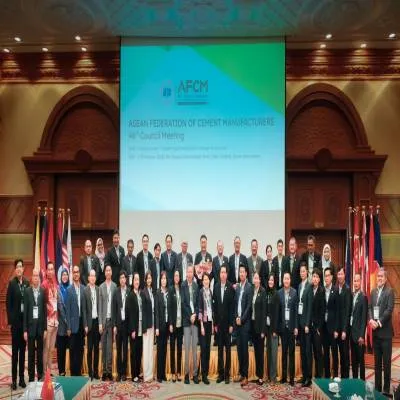
The ASEAN Federation of Cement Manufacturers (AFCM) has formally launched the 2035 AFCM Decarbonisation Roadmap, becoming the first regional bloc in the world to introduce a unified decarbonisation strategy for the cement sector. The announcement was made at the 46th AFCM Council Meeting in Brunei Darussalam, chaired by Dr Chana Poomee, and attended by leaders and representatives of cement associations from all eight AFCM member countries. The launch comes as global attention intensifies ahead of COP30 in Brazil, where climate action is expected to be a central priority.
Cement production remains integral to infrastructure and economic development across the ASEAN region, yet it is also a major contributor to CO? emissions. The 2035 AFCM Decarbonisation Roadmap signals a collective regional commitment to accelerating emissions reduction in alignment with national climate policies and global sustainability goals, reinforcing AFCM’s leadership in the transition to low carbon cement production.
Dr Chana Poomee, AFCM President and Chairman of the Thai Cement Manufacturers Association (TCMA), described the roadmap as a landmark achievement for the region’s cement industry. He noted that the shared framework would support systematic CO? reduction, strengthen regional competitiveness and enhance ASEAN’s contribution to global climate objectives.
Developed with strong support from the Global Cement and Concrete Association (GCCA), the 2035 Roadmap sets out a comprehensive transition pathway anchored around four strategic pillars:
• Expansion of low carbon cement enabled by performance-based standards;
• Transition to clean and renewable energy across production processes, alongside improved thermal and electrical efficiency;
• Deployment of advanced decarbonisation technologies, including Carbon Capture, Utilisation and Storage (CCUS); and
• Development of new supplementary cementitious materials to support next-generation low carbon cement products.
Dr Chana urged all AFCM members to treat the roadmap as a coordinated regional strategy for sustainable growth. At the ASEAN level, the measures outlined have the potential to reduce up to 38 million tonnes of CO2 by 2035. While the roadmap sets a collective vision, it acknowledges the diversity of national conditions, recognising that each member country will set its own targets based on regulatory frameworks, industrial maturity and technological capacity. One key early-action priority is the reduction and phasedown of Ordinary Portland Cement (OPC), providing an immediate opportunity for substantial emissions cuts.
Cement associations from Brunei Darussalam, Cambodia, Indonesia, Malaysia, the Philippines, Singapore, Thailand and Vietnam expressed strong support for the roadmap and reaffirmed their commitment to advancing decarbonisation within their national contexts. Members emphasised the need for supportive policies, expanded use of alternative fuels, improved energy efficiency, accelerated adoption of advanced technologies and greater promotion of low carbon cement and concrete solutions. They also recognised that specific decarbonisation pathways will vary based on each country’s energy mix, material availability, policy environment and market readiness.
“The 2035 AFCM Decarbonisation Roadmap presents a significant opportunity to enhance regional competitiveness, drive sustainable development and unlock substantial economic benefits. Government support, including policy adaptation, will be essential for effective implementation. Through collaboration, innovation and collective action, AFCM can accelerate the adoption of low carbon technologies, attract green investment, create new economic opportunities and build a resilient, future-ready cement industry that contributes meaningfully to global decarbonisation,” Dr Chana concluded.
The issuer is solely responsible for the content of this announcement.

Continue Reading

Concrete

Dalmia Bharat to Buy Jaypee Cement Assets for Rs 28.5 bn

Purchase under Adani led resolution plan valued at Rs 28.5 bn

Published

on

By

Shares

Dalmia Bharat will acquire the cement assets of JAL (Jaypee Associates Limited) for Rs 28.5 bn under an Adani led resolution plan, according to company sources. The transaction involves the purchase of manufacturing facilities and associated assets that form part of JAL’s cement operations, and it is framed as a strategic acquisition within a larger insolvency resolution overseen by an Adani group consortium. The move is presented as a consolidation play in a fragmented domestic cement market.

The company indicated that the acquisition will strengthen Dalmia Bharat’s geographic footprint and supply chain, enhancing its ability to serve regional demand and optimise logistics. The assets are expected to complement the purchaser’s existing capacity and provide additional clinker and grinding resources, allowing for potential efficiency gains through integration. Executives have described the deal as aligned with a broader strategy of targeted inorganic growth.

Financially, the headline consideration converts to roughly Rs 28.5 bn, reflecting the resolution price agreed under the plan. The purchase price and related terms are structured as part of the approved resolution framework and are subject to completion formalities. The parties expect customary regulatory clearances and creditor or adjudicatory confirmations to be completed before closing, with standard conditions precedent governing the transfer of assets.

Market observers noted that the deal illustrates ongoing consolidation in the sector, where larger groups are acquiring stressed or non core assets as part of resolution processes. Such transactions are seen as a mechanism to expedite recovery of value while enabling active players to expand capacity without developing greenfield projects. The combination of strategic fit and available asset bases is likely to influence competitive dynamics in specific regional markets.

Upon completion, Dalmia Bharat will integrate the acquired operations into its existing reporting and operational framework, with the intention of preserving operational continuity. Stakeholders will monitor execution on integration, regulatory approvals and the realisation of anticipated synergies as the parties move towards finalising the transfer of assets.

Continue Reading

Concrete

Dalmia Acquires Five Point Two MnTPA Cement Assets in Central Region

Acquisition adds capacity, power and rail access

Published

on

By

Shares

Dalmia Cement (Bharat) Limited (DCBL) executed a business transfer agreement on 21 May 2026 to acquire a cement undertaking from Jaiprakash Associates Limited (JAL) and Adani Infra (India) Limited. The assets include plants at Rewa in Madhya Pradesh and Churk, Chunar and Sadwa in Uttar Pradesh with five point two million tonnes per annum (mn tpa) cement capacity and three point three mn tpa clinker capacity, plus 99 megawatt (MW) thermal power and railway sidings. The transaction carries an enterprise value of Rs 28.5 billion (bn).

DCBL, a wholly owned subsidiary of Dalmia Bharat Limited (DBL), will see cement capacity rise to 54.7 mn tpa on completion. Ongoing expansions at Belgaum, Pune and Kadapa are expected to raise capacity to 66.7 mn tpa by the second to third quarter of fiscal 2028. The company said the transaction would be consummated within two weeks.

The deal follows a framework signed in December 2022 to settle long running disputes with JAL, including a long term clinker supply arrangement. Completion was delayed when JAL entered insolvency and the earlier sale did not finalise. Following approval of a resolution plan under the Insolvency and Bankruptcy Code, DCBL executed a fresh business transfer agreement to resolve pending legal and arbitral matters.

Company statements described the acquisition as strategic, accelerating access to central markets compared with a greenfield route and offering scope for expansion through debottlenecking and brownfield investment. Proximity to the company’s captive mines and established vendor relationships should support faster ramp up. The assets should augment EBITDA delivery and enhance returns by enabling entry into newer markets with relatively better prices.

Senior executives said the addition aligned with a long term plan to build a pan India presence and would provide a head start in central markets. They noted that familiarity with the plants under earlier tolling arrangements offers operational insight and strengthens channel relationships, supporting quicker market entry. Management expressed confidence that the assets’ expansion potential would generate value for stakeholders.

Continue Reading

Concrete

Ramco Cements Reports FY26 Revenue Growth And Higher Profit

Net debt reduced as exceptional items boost FY26 earnings

Published

on

By

Shares

Ramco Cements reported standalone audited results for FY26 with net revenue of Rs 90,560 million (mn) and profit after tax of Rs 6,940 mn. EBIDTA rose to Rs 14,820 mn and blended EBIDTA per tonne was Rs 788 on a two per cent volume rise to 18.81 million (mn) tonne (t). Cement revenue increased by five per cent and construction chemicals revenue rose by 66 per cent.

Raw material cost per tonne rose to Rs 1,023 from Rs 956 mainly due to a mineral bearing land tax of Rs 160 per t in Tamil Nadu, adding about Rs 86 per t. Power and fuel cost per tonne fell to Rs 1,098 from Rs 1,123 with petcoke mix down to 47 per cent and green power up to 40 per cent.

Profit before tax after exceptional items was Rs 8,790 mn. Net exceptional items were Rs 5,530 mn, including Rs 5,740 mn from sale of surplus land and Rs 200 mn of past service cost. The company monetised Rs 10,980 mn from non core asset sales over the past two years and recorded capex of Rs 9,970 mn, with guidance of Rs 8,000 mn for FY27.

Net debt fell by Rs 8,170 mn to Rs 36,640 mn at 31 March 2026 and cost of debt eased to 7.29 per cent, reducing net debt to EBIDTA to 2.47 times. Management indicated the full impact of higher fuel costs is expected from Q2 FY27, while packing and diesel cost increases will be visible in Q1 FY27. The board has proposed a dividend of Rs two point five zero per equity share and the company flagged risks from elevated fuel and logistics costs, commodity volatility and competitive pricing.

Continue Reading

Video Thumbnail

    SIGN-UP FOR OUR GENERAL NEWSLETTER


    Trending News

    SUBSCRIBE TO THE NEWSLETTER


    Don't miss out on valuable insights and opportunities to connect with like minded professionals.


      This will close in 0 seconds