Connect with us

Concrete

From Code to Context

Published

on

Shares

Dijam Panigrahi, Co-founder and COO, GridRaster, explores the concepts of Spatial AI and Mixed Reality as the evolution of Industry 5.0 sets in motion.

Beyond the data-driven efficiencies of Industry 4.0, a new paradigm is emerging for cement manufacturers, clinker producers, and heavy materials processors: Industry 5.0. This next evolution emphasises a human-centric, resilient and sustainable approach, calling for a more symbiotic relationship between highly skilled plant operators and intelligent machines.
The goal is to leverage the precision and tireless nature of automation while keeping human ingenuity, judgment, and creativity at the core of the operation. This vision promises greater flexibility, higher quality, and improved safety, yet a massive, persistent hurdle stands in the way: the debilitating complexity of integrating industrial robotics and drones for dynamic, high-risk tasks.

The technological moat
For decades, deploying and reprogramming specialised automation such as inspection drones or robotic maintenance arms has been a task reserved for highly specialised, six-figure engineers. The geometry of a massive rotary kiln shell is non-uniform and constantly exposed to high heat. The internal structure of a cement silo is a confined, hazardous space.
Setting up a new task be it a complex, real-time measurement for hot kiln alignment, a precise path for refractory gunning inside a cooler, or a meticulous inspection route for crack detection on a kiln shell can take hours, days, or even weeks of meticulous, line-by-line coding and calibration. This lengthy, expensive process makes automation uneconomical for many high-risk maintenance procedures, effectively creating a technological moat that keeps advanced automation out of reach for tasks that truly need it.

The solution: Spatial ai shatters the code barrier
A confluence of technologies namely Spatial AI and Mixed Reality (XR) is poised to shatter this status quo, fundamentally changing the economics of automation in cement production.
Spatial AI enables machines to see, understand, and interact with the physical world in real-time, in three dimensions, and in context. In the cement plant, this means an inspection drone or robotic arm is no longer a blind piece of hardware executing pre-written code; it is a collaborative partner that understands the exact curvature of the clinker cooler, the precise location of a worn refractory brick, or the dynamic environment around a moving girth gear.
This technology allows robot programming to move from a complex coding process to a simple demonstration.
Instead of writing thousands of lines of code, a maintenance engineer simply dons a Mixed Reality headset and visually guides a drone or robotic arm through the necessary steps. The Spatial AI immediately translates the human movement, path, and intent into a precise, executable robot programme. The entire setup time for a new dynamic task, which once took days, can now be reduced to mere minutes.

The transformative impact on robotics and automation
This leap in ease-of-use does more than save time; it fundamentally transforms the capabilities of industrial robots, moving automation from rigid, pre-programmed processes to truly adaptive and cognitive systems.
The cement industry relies heavily on scheduled, resource-intensive shutdowns for critical refractory maintenance. Spatial AI transforms this process by empowering specialised robots with sub-millimeter precision. For tasks like gunning (applying new refractory material) or welding inside the massive kiln or cooler, the robotic arm can now utilise the real-time 3D plant map to dynamically compensate for thermal expansion, structural shifts, and non-uniform material wear.
A human operator, trained in refractory repair, can use the XR headset to define the optimal material application pattern on the damaged area. The Spatial AI captures this intent and programs the robotic arm to execute the task perfectly, ensuring precise coverage and material thickness, thereby extending refractory lifespan and improving energy efficiency. This is an automation that learns from expert human judgment and executes with superhuman consistency.

Adaptive automation beyond the kiln
The benefits extend far beyond the kiln and cooler and into the often overlooked, yet crucial, areas of material handling and logistics:
Stockyard Management: In large, dynamic storage domes or stockyards, Spatial AI allows autonomous heavy machinery such as dozers, stackers, and reclaimers to operate efficiently. The system constantly maps the changing shape of the stockpiles (a non-uniform, dynamic geometry) and calculates the most energy-efficient and shortest path for material movement. Robots can perform real-time volume calculations, significantly improve inventory accuracy and reduce fuel consumption from unnecessary movements.
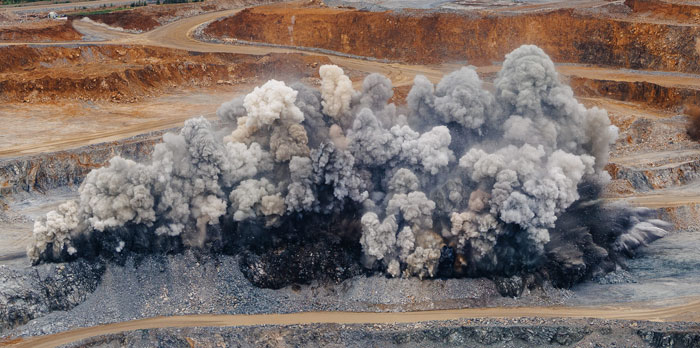
Quarry Operations: Similarly, autonomous drilling and hauling equipment in the quarry can utilise Spatial AI to maintain optimal blast-hole patterns and navigate complex, frequently changing terrain, avoiding dynamic obstacles (like other vehicles or temporary rock falls) without human intervention. The ability to instantly train a new haul path via XR guidance drastically cuts the time needed to adapt to new quarry faces, maximising raw material throughput.

The shift to cognitive and collaborative automation
Traditional industrial robotics require a stable, predictable environment. Spatial AI introduces cognition, allowing automation to thrive in the chaotic, high-risk reality of a cement plant. Robots equipped with Spatial AI can:
Adapt to Non-Uniformity: They can perform tasks on surfaces that are hot, dirty, and physically deformed (e.g., an aging kiln shell) because they are constantly referencing a dynamic, live 3D model, rather than a fixed, pre-programmed path.
Coordinate Fleets: Spatial AI provides a common operating picture, enabling drones, stationary arms, and ground vehicles to share real-time location and task data. This is crucial for complex operations, such as having a drone inspect an area while a robotic arm is simultaneously performing a repair.

Elevating the role of the plant worker
The core of Industry 5.0 is the human operator. By having Spatial AI systems safely take over repetitive, monotonous, or highly dangerous tasks, plant personnel are liberated to focus on the highest-value work: complex process management, troubleshooting, and continuous process optimisation. This fosters a human-machine collaboration that drives innovation, enhances safety and ensures sustainability.
Spatial AI is not merely a theoretical leap in digital twin technology; it is a concrete, actionable technology that is delivering immediate, impactful change on the plant floor. By simplifying complexity and driving setup time down to minutes, this technology is the essential accelerator that makes advanced industrial automation truly accessible to all cement manufacturers, marking the definitive arrival of the human-centric, high-efficiency world of Industry 5.0.

About the author:
Dijam Panigrahi, Co-founder and COO, GridRaster is a performance-driven leader with over 20 years of global experience in market development, product management, and business growth.

Concrete

Niraj Cement JV Wins Railway and Metro Contracts

Two orders worth over Rs 1.64 billion boost infrastructure portfolio

Published

on

By

Shares

Niraj Cement Structurals (JV) has secured two major contracts from the Northeast Frontier Railway (NF Railway) and the Mumbai Metropolitan Region Development Authority (MMRDA), strengthening its position in large-scale infrastructure development.

The first contract, valued at Rs 815.2 million, has been awarded by NF Railway. It involves the construction of multiple-span 12.20-metre PSC slab underpasses, a major bridge (No. 727), retaining and guide walls, embankments and one minor bridge along the proposed UP and Down line near Deepor Beel. The project covers Km 163/00 to 164/200 between Azara and Kamakhya stations and forms part of the New Bongaigaon–Goalpara Town–Kamakhya (NBQ–GLPT–KYQ) railway doubling programme.

The second contract, worth Rs 826.6 million, has been awarded by MMRDA for constructing a foot overbridge (FOB) equipped with a travellator to improve connectivity between the SGMC monorail station and the Mahalaxmi metro and suburban railway stations.

The two projects underscore the company’s technical capabilities in both transportation infrastructure and environmentally sensitive construction, further strengthening its portfolio in key railway and urban mobility developments.

Continue Reading

Concrete

Peddapalli MP Seeks Clear Timelines for Rs 42.10 Bn Projects

Peddapalli MP Gaddam Vamshi Krishna has urged the Union Government to specify execution timelines for major infrastructure projects worth Rs 42.10 billion in his constituency.

Published

on

By

Shares

Peddapalli MP Gaddam Vamshi Krishna has called on the Centre to provide definitive timelines for a series of sanctioned infrastructure works that he said are essential for the region’s economic progress. Speaking in the Lok Sabha, he stressed that many approved projects remain stalled without clear implementation schedules, limiting their potential impact on connectivity and employment.

A key pending work is the Peddapalli–Manuguru Railway Line, a 137 km stretch linking Peddapalli with Manuguru in Bhadradri Kothagudem district. Although the line has received required approvals and special project status, the execution schedule has not yet been announced. The project is expected to support freight efficiency, improve coal logistics, and strengthen local job creation.

Extending his appeal beyond physical infrastructure, the MP urged the Centre to consider including Peddapalli in the India Semiconductor Mission, citing the district’s industrial ecosystem, skilled workforce, and readiness to support advanced manufacturing.

By pressing for structured timelines, Krishna emphasised the need for coordinated planning and timely execution to advance the constituency’s long-term development goals.

Continue Reading

Concrete

IndiaAI, Gujarat Govt Host Regional Conclave Ahead of 2026 AI Summit

A regional pre-summit event in Gandhinagar recently gathered leaders to advance AI for good governance.

Published

on

By

Shares

The IndiaAI Mission under the Ministry of Electronics and Information Technology, along with the Government of Gujarat and IIT Gandhinagar, convened a Regional Pre-Summit Event at Mahatma Mandir, Gandhinagar. The initiative is part of the build-up to the India–AI Impact Summit 2026, scheduled for 15–20 February 2026 at Bharat Mandapam, New Delhi.

The conclave brought together senior policymakers, technology leaders, researchers and industry practitioners to examine how AI can accelerate economic, digital and social transformation across sectors. The programme focused on the overarching theme of ‘AI for Good Governance: Empowering India’s Digital Future’.

The inaugural session featured key dignitaries including Bhupendrabhai Rajnikant Patel, Chief Minister of Gujarat; Harsh Rameshbhai Sanghavi, Deputy Chief Minister of Gujarat; Arjunbhai Devabhai Modhwadia, Minister for Science & Technology, Government of Gujarat; Manoj Kumar Das, Chief Secretary, Government of Gujarat; Abhishek Singh, Additional Secretary, MeitY and Director General, NIC; and Ponugumatla Bharathi, Secretary, Department of Science & Technology, Government of Gujarat.

High-impact keynote sessions led by national and global experts from MeitY, Bhashini, Google Cloud, Microsoft, IBM Research, NVIDIA, Oracle and AWS examined themes including AI in governance, public service delivery, urban development, rural transformation, healthcare, agriculture, fintech and multilingual accessibility enabled through Bhashini.
Delegates also visited an Experience Zone curated by IndiaAI and DST Gujarat, which showcased AI solutions across governance, agriculture, health and industry.

By convening government, industry and academic stakeholders, the conclave aimed to strengthen India’s AI ecosystem through frameworks that prioritise trust, scalability and public interest. Insights generated from the event will contribute directly to the agenda and outcomes of the India–AI Impact Summit 2026. 

Continue Reading

Trending News

SUBSCRIBE TO THE NEWSLETTER


Don't miss out on valuable insights and opportunities to connect with like minded professionals.


    This will close in 0 seconds