Connect with us

Concrete

WCA President Emphasises Major Changes in Global Cement Industry

In contrast, cement production in India is rapidly expanding, with more than 200 million tons produced.

Published

on

Shares

The President of the World Cement Association (WCA), Wei Rushan, addresses members to highlight the significant transformations shaping the global cement industry. Emphasising the need for innovation, sustainability, and collaboration, he called on industry stakeholders to embrace the evolving economic, regulatory, and geopolitical challenges ahead.

“The cement industry is experiencing profound changes, with businesses managing overcapacity and upgrading, balancing sustainable development with short-term survival, and weighing social responsibility against shareholder returns,” stated Rushan. “While each region faces unique challenges, our shared focus remains on driving sustainable growth, embracing technological advancements, and tackling climate change.”

As outlined in the WCA’s recent White Paper, global cement demand is expected to decline by 22 per cent by 2050. In established markets like Europe and North America, price increases are expected to persist, while in some emerging markets, prices may experience a short-term decline. However, from a long-term perspective, we expect emerging market to remain dynamic and resilient.

Key regional developments

Multinational companies are adjusting their strategies and scaling back cement business, focusing instead on North America. Meanwhile cement production in Europe continues to decline due to strict CO2 regulations and necessary capacity reductions, driving up cement prices. Efforts to address overcapacity in China and Japan have led to significant consolidation and restructuring.

In contrast, cement production in India is rapidly expanding, with more than 200 million tons produced. Indian companies are strengthening their domestic leadership, while multinational companies are exiting this high-potential market.

Globally, regional leaders are gaining influence, except in Europe and North America, where European multinationals continue to dominate. Chinese cement producers and other independent companies are aggressively expanding, particularly in Africa and Southeast Asia, solidifying their market presence.

Addressing global challenges

Wei identifies overcapacity as a major challenge facing the industry today. As a global representative for the cement industry, the WCA is willing to work with producers and stakeholders to explore ways to modernise and upgrade outdated plants. “To remain both profitable and environmentally responsible, the cement industry must aim to reduce capacity by 50 per cent, from 4.7 billion tons to 2.3 billion tons within the next decade. This requires focusing on modern, sustainable production units.”

He also noted carbon reduction and carbon neutrality as another key challenge. Although progress has been made through Carbon Capture and Storage (CCS) technologies, Rushan acknowledged the high costs and energy intensity of these solutions.

“Cement plays a crucial role in building sustainable infrastructure,” Mr. Wei continued. “By accelerating innovation, adopting low-carbon technologies, and fostering global collaboration, we can ensure cement remains an environmentally responsible material.”

The WCA urges industry stakeholders worldwide to act now by adopting sustainable practices, embracing innovation, and redefining cement industry norms.

Concrete

UltraTech Board Approves Rs 50 bn Fundraise Via NCDs

Company to issue half a million debentures for expansion plan

Published

on

By

Shares

UltraTech Cement’s board of directors has approved raising Rs 5,000 crore (Rs 50 bn) through non?convertible debentures issued in rupees.

The finance committee cleared a proposal to issue up to 500,000 fully paid, unsecured, listed, rated, redeemable, rupee?denominated, non?convertible, non?cumulative debentures of Rs 1 lakh each (Rs 0.1 mn each), aggregating to the Rs 5,000 crore programme.

As of June 2026 the firm reported net debt of Rs 15,875 crore (Rs 158.75 bn) and said its capacity expansion projects under execution are backed by capital expenditure of about Rs 17,000 crore (Rs 170 bn) over the next two to two?and?a?half years.

UltraTech spent Rs 9,500 crore (Rs 95 bn) on capital expenditure in financial year 2026 and in April the group crossed 200.1 mn tonnes per annum of domestic grey cement capacity and 205.5 mn tonnes per annum of global capacity.

The chief financial officer indicated the company would take consolidated capacity beyond 242 mn tonnes per annum, with grey cement capacity reaching 212.7 mn tonnes per annum by the end of financial year 2027. He noted the net debt?to?earnings before interest, taxes, depreciation and amortisation ratio stood at 0.87 times as of June 2026 and the company was confident of ending financial year 2027 with the ratio below one time.

In the first quarter of financial year 2026?27 UltraTech’s net profit attributable to owners rose 16.8 per cent year?on?year to Rs 2,599.3 crore (Rs 25.993 bn) and revenue from operations increased 15.9 per cent to Rs 24,648.20 crore (Rs 246.482 bn). The board approval is expected to complement internal cash flows as the company advances its expansion programme.

Continue Reading

Concrete

Lokesh Lays Stone For Rs 31 Billion Cement Unit In Kadapa

Line-2 expansion to make Kadapa a major cement hub

Published

on

By

Shares

Andhra Pradesh Education and IT Minister Nara Lokesh on Wednesday laid the foundation stone for the Line-2 expansion of Dalmia Bharat Cement at Chinnakomerla village in Mylavaram Mandal in Kadapa district. The project carries an investment of Rs 31 billion (bn) and is slated for completion by the third quarter of the financial year 2028. The expansion is intended to boost industrial growth and employment generation across the Rayalaseema region.

Once commissioned, the Kadapa facility will become Dalmia Bharat’s largest integrated cement manufacturing ecosystem in southern India, creating over 1,000 direct and indirect jobs and opening new business avenues for regional micro, small and medium enterprises and transport operators. Lokesh said the expansion signalled growing corporate confidence in the state and reflected the practical ease of doing business that secured repeat investment.

He placed the project within the government’s wider economic targets and recalled the Yuvagalam padayatra commitment to generate two million (mn) jobs within five years, noting that the state would cultivate talent while industry created opportunities. Lokesh highlighted Andhra Pradesh’s competitive pursuit of major manufacturing accounts, mentioning past successes and a personal initiative to engage global investors when persuading them to anchor expansion in the state.

The plant will leverage Kadapa’s abundant limestone reserves to scale production and sustainability. Clinker capacity is planned to rise from two point five million tonnes per annum (mn tpa) to six point one mn tpa, while overall cement output will increase from three point six mn tpa to nine point six mn tpa. The unit is designed to operate on over eighty per cent renewable energy and deploy waste heat recovery, zero liquid discharge, water recycling and advanced AI systems to optimise efficiency. Industries Minister TG Bharat, BC Welfare Minister S. Savitha and Jammalamadugu MLA C. Adinarayana Reddy attended the ceremony.

Continue Reading

Concrete

Cement Prices to Stay Flat in Q2 FY27 as Costs Squeeze Margins

HDFC Securities warns monsoon slowdown and higher fuel costs

Published

on

By

Shares

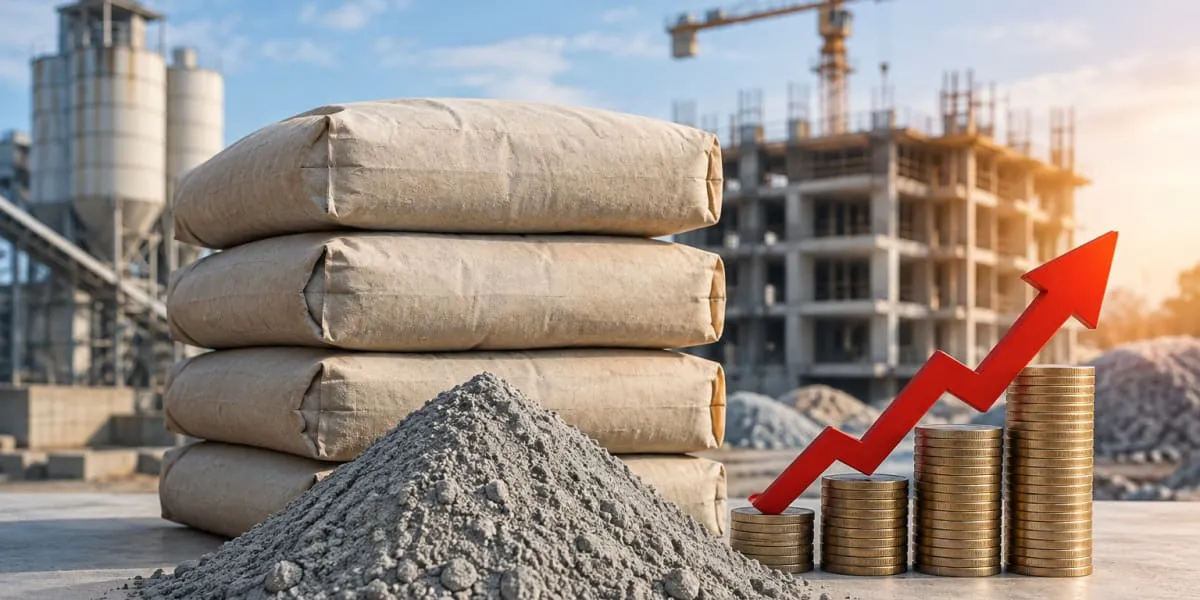
HDFC Securities has said the cement industry is unlikely to register a sequential increase in prices in Q2 FY27 as monsoon-related demand moderation coincides with rising fuel and packaging costs that will squeeze margins. The brokerage observed that price gains remained modest, with increases of two to three per cent quarter-on-quarter across regions, and noted subdued offtake in May with improvement in June as a delayed monsoon supported construction activity. The brokerage added that modest pricing gains so far have been insufficient to offset the input cost escalation.

The report stated that input cost pressures intensified in Q1 FY27 owing to the West Asia conflict, which pushed up coal and pet coke prices and is expected to keep fuel costs elevated, with a likely peak in Q2 FY27. It assessed that total variable costs, including packing, could rise by around Rs 150 per t quarter-on-quarter and that lower offtake and seasonal operating deleverage could further raise operating expenditure by about Rs 50 per t quarter-on-quarter.

Overall, cement prices were estimated to remain flat in Q2 FY27 as monsoon-led demand weakness offsets limited upside in realisation, and rising fuel costs alongside seasonal deleverage were expected to compress industry margins by over Rs 100 per t quarter-on-quarter to below Rs 880 per t. The brokerage indicated that the combined impact of energy inflation and higher packing expenditure would be the principal drivers of margin contraction in the near term. HDFC Securities projected a recovery in margins in H2 FY27 should the West Asia turmoil subside and energy and packing costs cool off.

The brokerage expressed optimism on long-term demand fundamentals and said improving realisation together with an anticipated cost cool-off should support a margin rebound from H2 FY27 onward, underpinning favourable industry prospects over the medium term. Its outlook rests on monsoon normalisation and a decline in imported fuel prices in the second half of the fiscal year.

Continue Reading

Video Thumbnail

    SIGN-UP FOR OUR GENERAL NEWSLETTER


    Trending News

    SUBSCRIBE TO THE NEWSLETTER


    Don't miss out on valuable insights and opportunities to connect with like minded professionals.


      This will close in 0 seconds