Connect with us

Process

Achieving Operational and Business Excellence

Published

on

Shares

ABB is at the forefront of offering integrated solutions for the cement sector including scalable automation solutions. Understanding user needs and making products user friendly are among the company?s success factors, says Manish Chordia.

Energy costs constitute the highest percentage of production cost, with the cement industry consuming approximately15 million toe (tonne of oil equivalent) per year, or about 9 per cent of total industrial fuel used. While efforts to reduce energy consumption and cost are possible by using higher efficiency equipment and substituting fuels and raw materials, product quality and plant productivity cannot be looked in silos.

The optimal operating point within the boundaries of these variable constraints depends on the right price mix of fuels and timely purchases of electrical energy. Plant-wide automation solutions from ABB aim at finding an optimal operation point while maximising product quality and productivity, at the lowest energy consumption and with the least environmental impact.

The need for operational excellence in cement manufacturing has reached a new pinnacle as demand-supply mechanics, capacity utilisation and price dynamics are enough variables to create huge margin pressures for every single manufacturer, independent of size and scale. One way to achieve excellence is deploying advanced collaborative production management solutions, which offer real-time process feedback and analytical tools.

The starting point is to have a reliable integrated process and power DCS that offers a host of functionality and features including improving operator effectiveness. ABB?s System 800xA is one such platform and ensures improvement in overall productivity and profitability.

The cement sector is remaining competitive by leveraging some key benefits that include:
Consistent product quality that can be achieved through optimisation solutions
Maximising energy efficiency by better process stabilisation across the value chain.
Minimising energy costs by focussing on reducing electrical & thermal energy
Optimise laboratory operation through simplified workflow and seamless integration with production info. system.

Benefits can be realised when all processes, operations and systems work in tandem in a truly integrated way. ABB?s Collaborated Production Management (CPM) solutions offer complete and true integration across the entire manufacturing process, while conserving energy and achieving consistent quality. We are seeing the growing need for operator effectiveness on account of the challenges associated with hiring and retaining experienced operators while ensuring legacy and contemporary systems are best utilised. ABB offers the Extender Operator Workstation (EOW); a state-of-the-art operating station that improves the productivity of operators, minimises production losses and improves plant performance.

Many technologies that improve energy efficiency are readily available and can help achieve typically energy savings of 5 to 35 per cent. But a greater scope for savings lies in what exists between multiple and many processes and systems that often go unnoticed including facilities management, maintenance and support processes such as electrification, compressed air, steam and water.

For this reason, ABB advocates a holistic approach -? understanding where and how energy is used so you can prioritise processes that will bring the highest benefits. This improved ?energy transparency? also helps build the business case for future efficiency investments, creating a process for continuous improvement much like those for quality and operational excellence.

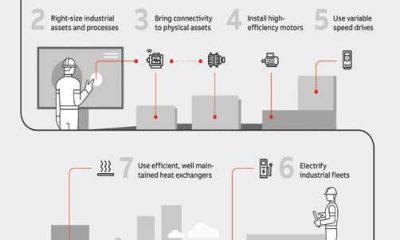
ABB?s plant-wide automation aims at optimal operations, maximising product quality and productivity, at the lowest energy consumption point and with the least environmental impact. This is achieved through a combination of variable speed drives (VSD), advanced process control, energy monitoring and reporting. Electrical energy savings of up to 70 per cent can be achieved by using VSD over a fixed-speed motor and damper. The multi-drive solution provides the optimised drive solution for the grate cooler.

Control and optimisation of the kiln reduces thermal fuel consumption by up to 8 per cent. ABB also offers an integrated system for effective utilisation of waste heat of a plant. Exhaust heat that is generally wasted, can be converted into electricity ? efficiently, economically and CO2-free. Reliable equipment and proven technical solutions ensure efficient use of energy without jeopardising the quality and productivity of a cement plant.

ABB offers the tools and systems to help reduce energy cost, and manage carbon footprint:
Expert Optimizer (EO) is based on proven ABB technology and with a user-friendly interface that enables operators optimise the entire process – at the push of a button. While addressing critical parameters such as variable raw material and fuel quality, shift-to-shift variations while providing optimal output and optimal process efficiency. EO modules cover the most critical components and equipment in your plant: kiln, alternative fuel, mills and blending (some of which are explained below).

Kiln optimisation – The kiln process is intrinsically unstable and influenced by long-time delays and large perturbations. EO firstly stabilises the process before driving the key manipulated variables to the process limits. Your benefits are significant: EO will control your kiln like your best operator performing at his optimum 365/24/7.

Alternative fuel management: Burning alternative fuels can lead to instability in the clinker manufacturing process. EO controls, mixes and monitors rates of alternative fuels to ensure consistent burning, whilst ensuring the kiln does not become unstable due to changes in fuel calorific value.

Mill optimisation: Grinding makes up a big portion of the electrical energy consumed on the plant, thus the efficiency of grinding operations has a big influence on your energy bill. EO optimises your grinding circuit to increase throughput and secure consistent output quality while lowering energy consumption.

Material blending: Stable and correct proportioned raw meal is essential for energy-efficient clinker production. Cement blended at the right proportions is essential for you to meet the specifications of your finished cements and thus to deliver a quality product to your end-customers. EO provides solutions for both raw material blending and cement blending.

About the author:
Manish Chordia
, is Asst Vice President, Market Segment Manager ? Cement Process utomation-Industry Solutions, ABB.

Continue Reading
Click to comment

Leave a Reply

Your email address will not be published. Required fields are marked *

Concrete

Steel: Shielded or Strengthened?

CW explores the impact of pro-steel policies on construction and infrastructure and identifies gaps that need to be addressed.

Published

on

By

Shares

Going forward, domestic steel mills are targeting capacity expansion
of nearly 40 per cent through till FY31, adding 80-85 mt, translating
into an investment pipeline of $ 45-50 billion. So, Jhunjhunwala points
out that continuing the safeguard duty will be vital to prevent a surge
in imports and protect domestic prices from external shocks. While in
FY26, the industry operating profit per tonne is expected to hold at
around $ 108, similar to last year, the industry’s earnings must
meaningfully improve from hereon to sustain large-scale investments.
Else, domestic mills could experience a significant spike in industry
leverage levels over the medium term, increasing their vulnerability to
external macroeconomic shocks.(~$ 60/tonne) over the past one month,
compressing the import parity discount to ~$ 23-25/tonne from previous
highs of ~$ 70-90/tonne, adds Jhunjhunwala. With this, he says, “the
industry can expect high resistance to further steel price increases.”

Domestic HRC prices have increased by ~Rs 5,000/tonne
“Aggressive
capacity additions (~15 mt commissioned in FY25, with 5 mt more by
FY26) have created a supply overhang, temporarily outpacing demand
growth of ~11-12 mt,” he says…

To read the full article Click Here

Continue Reading

Process

Price hikes, drop in input costs help cement industry to post positive margins: Care Ratings

Published

on

By

Shares

Region-wise,the southern region comprises 35% of the total cement capacity, followed by thenorthern, eastern, western and central region comprising 20%, 18%, 14% and 13%of the capacity, respectively.

The cement industry is expected to post positive margins on decent price hikes over the months, falling raw material prices and marked drop in overall production costs, said an analysis of Care Ratings.

Wholesale and retail prices of cement have increased 11.9% and 12.4%, respectively, in the current financial year. As whole prices have remained elevated in most of the markets in the months of FY20, against the corresponding period of the previous year.

Similarly, electricity and fuel cost have declined 11.9% during 9M FY20 due to drop in crude oil prices. Logistics costs, the biggest cost for cement industry, has also dropped 7.7% (selling and distribution) as the Railways extended the benefit of exemption from busy season surcharge. Moreover, the cost of raw materials, too, declined 5.1% given the price of limestone had fallen 11.3% in the same aforementioned period, the analysis said.

According to Care Ratings, though the overall sales revenue has increased only 1.3%, against 16% growth in the year-ago period, the overall expenditure has declined 3.2% which has benefited the industry largely given the moderation in sales.

Even though FY20 has been subdued in terms of production and demand, the fall in cost of production has still supported the cement industry by clocking in positive margins, the rating agency said.

Cement demand is closely linked to the overall economic growth, particularly the housing and infrastructure sector. The cement sector will be seeing a sharp growth in volumes mainly due to increasing demand from affordable housing and other government infrastructure projects like roads, metros, airports, irrigation.

The government’s newly introduced National Infrastructure Pipeline (NIP), with its target of becoming a $5-trillion economy by 2025, is a detailed road map focused on economic revival through infrastructure development.

The NIP covers a gamut of sectors; rural and urban infrastructure and entails investments of Rs.102 lakh crore to be undertaken by the central government, state governments and the private sector. Of the total projects of the NIP, 42% are under implementation while 19% are under development, 31% are at the conceptual stage and 8% are yet to be classified.

The sectors that will be of focus will be roads, railways, power (renewable and conventional), irrigation and urban infrastructure. These sectors together account for 79% of the proposed investments in six years to 2025. Given the government’s thrust on infrastructure creation, it is likely to benefit the cement industry going forward.

Similarly, the Pradhan Mantri Awaas Yojana, aimed at providing affordable housing, will be a strong driver to lift cement demand. Prices have started correcting Q4 FY20 onwards due to revival in demand of the commodity, the agency said in its analysis.

Industry’s sales revenue has grown at a CAGR of 7.3% during FY15-19 but has grown only 1.3% in the current financial year. Tepid demand throughout the country in the first half of the year has led to the contraction of sales revenue. Fall in the total expenditure of cement firms had aided in improving the operating profit and net profit margins of the industry (OPM was 15.2 during 9M FY19 and NPM was 3.1 during 9M FY19). Interest coverage ratio, too, has improved on an overall basis (ICR was 3.3 during 9M FY19).

According to Cement Manufacturers Association, India accounts for over 8% of the overall global installed capacity. Region-wise, the southern region comprises 35% of the total cement capacity, followed by the northern, eastern, western and central region comprising 20%, 18%, 14% and 13% of the capacity, respectively.

Installed capacity of domestic cement makers has increased at a CAGR of 4.9% during FY16-20. Manufacturers have been able to maintain a capacity utilisation rate above 65% in the past quinquennium. In the current financial year due to the prolonged rains in many parts of the country, the capacity utilisation rate has fallen from 70% during FY19 to 66% currently (YTD).

Source:moneycontrol.com

Continue Reading

Process

Wonder Cement shows journey of cement with new campaign

Published

on

By

Shares

The campaign also marks Wonder Cement being the first ever cement brand to enter the world of IGTV…

ETBrandEquity

Cement manufacturing company Wonder Cement, has announced the launch of a digital campaign ‘Har Raah Mein Wonder Hai’. The campaign has been designed specifically to run on platforms such as Instagram, Facebook and YouTube.

#HarRaahMeinWonderHai is a one-minute video, designed and conceptualised by its digital media partner Triature Digital Marketing and Technologies Pvt Ltd. The entire journey of the cement brand from leaving the factory, going through various weather conditions and witnessing the beauty of nature and wonders through the way until it reaches the destination i.e., to the consumer is very intriguing and the brand has tried to showcase the same with the film.

Sanjay Joshi, executive director, Wonder Cement, said, "Cement as a product poses a unique marketing challenge. Most consumers will build their homes once and therefore buy cement once in a lifetime. It is critical for a cement company to connect with their consumers emotionally. As a part of our communication strategy, it is our endeavor to reach out to a large audience of this country through digital. Wonder Cement always a pioneer in digital, with the launch of our IGTV campaign #HarRahMeinWonderHai, is the first brand in the cement category to venture into this space. Through this campaign, we have captured the emotional journey of a cement bag through its own perspective and depicted what it takes to lay the foundation of one’s dreams and turn them into reality."

The story begins with a family performing the bhoomi poojan of their new plot. It is the place where they are investing their life-long earnings; and planning to build a dream house for the family and children. The family believes in the tradition of having a ‘perfect shuruaat’ (perfect beginning) for their future dream house. The video later highlights the process of construction and in sequence it is emphasising the value of ‘Perfect Shuruaat’ through the eyes of a cement bag.

Tarun Singh Chauhan, management advisor and brand consultant, Wonder Cement, said, "Our objective with this campaign was to show that the cement produced at the Wonder Cement plant speaks for itself, its quality, trust and most of all perfection. The only way this was possible was to take the perspective of a cement bag and showing its journey of perfection from beginning till the end."

According to the company, the campaign also marks Wonder Cement being the first ever cement brand to enter the world of IGTV. No other brand in this category has created content specific to the platform.

Continue Reading

Trending News

SUBSCRIBE TO THE NEWSLETTER


Don't miss out on valuable insights and opportunities to connect with like minded professionals.


    This will close in 0 seconds