Connect with us

Concrete

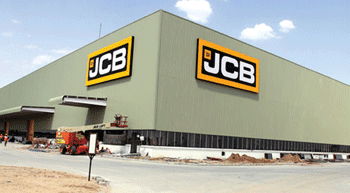
Pre-engineered building at JCB

Published

on

Shares

Interarch has delivered the largest pre-engineered building in Jaipur, Rajasthan for JCB India.
Interarch in 2014 designed, manufactured and delivered a fabrication shop and assembly shop for JCB India Ltd in Jaipur. The buildings are spread over the area of 30,400 sq m and 22,800 sq m, respectively.

The project is designed according to the latest IS design codes, IS 800: working stress design for both the buildings with consideration given to all the geographical data like wind velocity, seismic zone as per IS standard for every particular site. The lateral forces resulting from the seismic or wind loads are resisted by diagonal bracing and jack portals at intermediate column locations.

The design of the building was such that temperature was kept in control for monitoring the thermal expansion and contraction.

The expertise of Interarch design and engineering department reduced the engineering time of the fabrica?tion shop and assembly shop which were very complex due to functional requirement of the manufacturing and exceptional high loading required in the building. Interarch for the first time designed a building bearing heavy load of approximately 225 m hanging from the roof and for the column grid of 40 m x 24 m to take care of the high loads higher grade of steel 450 MPA has been used for the built up members.

Interarch certified builders and employees had to work under very stringent quality and safety conditions and had to deploy innovative solutions like the highest safety standard which were followed in line with the international standard to achieve zero accident and logistic and warehousing control at site to meet site standard norms. Daily tool box meeting to review the site status and way forward was done, regular quality check jointly with client was done and corrective measures to achieve the best quality in line with global standard were taken. The highest level of safety standard were showcased by the Interarch Project Management team at the site, achieving zero accident with over 150 skilled workers working at site. The hard work paid and the company delivered the largest pre-engineered building in Jaipur in record time with testimony and award from the largest EPC company in India. The project was completed in record period of six months.

Continue Reading
Click to comment

Leave a Reply

Your email address will not be published. Required fields are marked *

Concrete

Cement Makers’ Margins To Fall Rs 50-75 Per Tonne Amid West Asia Conflict

Crisil Sees Margins Easing Despite Steady Demand

Published

on

By

Shares

Crisil said operating margins of Indian cement manufacturers are expected to decline by Rs 50-75 per tonne (t) this fiscal to Rs 925-950 per t due to higher input costs triggered by the West Asia conflict. The analysis covered 18 cement companies accounting for nearly 90 per cent of India’s domestic cement capacity and noted margins had improved sharply to around Rs 1,000 per t in fiscal 2026.

Crisil noted that the reduction would be driven mainly by higher power and fuel costs, which account for about 30 per cent of total costs, as petcoke and imported coal prices have surged amid geopolitical uncertainties. Freight costs, which account for about a quarter of total costs, are also expected to remain elevated because of higher diesel prices. The impact on profitability is likely to be more pronounced in the first half of the fiscal year before easing commodity prices moderate cost pressures later.

The rating agency said steady domestic demand and strong balance sheets should keep credit profiles stable despite the moderation in margins. Green energy currently accounts for 35-40 per cent of the sector’s total electricity consumption and is expected to partly cushion higher energy costs. Operating cash flows are likely to remain resilient, supported by projected 6-7 per cent growth in cement demand this fiscal.

Crisil highlighted that demand growth will be driven primarily by infrastructure spending, which meets about one-third of sector consumption, and by a nearly 18 per cent higher budgetary allocation for core ministries that should support project execution. Weaker rural housing demand amid pressure on agricultural incomes from a possible below-average monsoon may be offset by improved urban housing demand supported by favourable home-loan rates and a strong pipeline of Pradhan Mantri Awas Yojana-Urban projects. Ongoing capacity additions will keep capital expenditure elevated and may lift net debt to EBITDA to between 1.2 and 1.4 times from around 1.0 time last fiscal, though ratios are expected to remain healthy.

Continue Reading

Concrete

UltraTech Board Approves Rs 50 bn Fundraise Via NCDs

Company to issue half a million debentures for expansion plan

Published

on

By

Shares

UltraTech Cement’s board of directors has approved raising Rs 5,000 crore (Rs 50 bn) through non?convertible debentures issued in rupees.

The finance committee cleared a proposal to issue up to 500,000 fully paid, unsecured, listed, rated, redeemable, rupee?denominated, non?convertible, non?cumulative debentures of Rs 1 lakh each (Rs 0.1 mn each), aggregating to the Rs 5,000 crore programme.

As of June 2026 the firm reported net debt of Rs 15,875 crore (Rs 158.75 bn) and said its capacity expansion projects under execution are backed by capital expenditure of about Rs 17,000 crore (Rs 170 bn) over the next two to two?and?a?half years.

UltraTech spent Rs 9,500 crore (Rs 95 bn) on capital expenditure in financial year 2026 and in April the group crossed 200.1 mn tonnes per annum of domestic grey cement capacity and 205.5 mn tonnes per annum of global capacity.

The chief financial officer indicated the company would take consolidated capacity beyond 242 mn tonnes per annum, with grey cement capacity reaching 212.7 mn tonnes per annum by the end of financial year 2027. He noted the net debt?to?earnings before interest, taxes, depreciation and amortisation ratio stood at 0.87 times as of June 2026 and the company was confident of ending financial year 2027 with the ratio below one time.

In the first quarter of financial year 2026?27 UltraTech’s net profit attributable to owners rose 16.8 per cent year?on?year to Rs 2,599.3 crore (Rs 25.993 bn) and revenue from operations increased 15.9 per cent to Rs 24,648.20 crore (Rs 246.482 bn). The board approval is expected to complement internal cash flows as the company advances its expansion programme.

Continue Reading

Concrete

Lokesh Lays Stone For Rs 31 Billion Cement Unit In Kadapa

Line-2 expansion to make Kadapa a major cement hub

Published

on

By

Shares

Andhra Pradesh Education and IT Minister Nara Lokesh on Wednesday laid the foundation stone for the Line-2 expansion of Dalmia Bharat Cement at Chinnakomerla village in Mylavaram Mandal in Kadapa district. The project carries an investment of Rs 31 billion (bn) and is slated for completion by the third quarter of the financial year 2028. The expansion is intended to boost industrial growth and employment generation across the Rayalaseema region.

Once commissioned, the Kadapa facility will become Dalmia Bharat’s largest integrated cement manufacturing ecosystem in southern India, creating over 1,000 direct and indirect jobs and opening new business avenues for regional micro, small and medium enterprises and transport operators. Lokesh said the expansion signalled growing corporate confidence in the state and reflected the practical ease of doing business that secured repeat investment.

He placed the project within the government’s wider economic targets and recalled the Yuvagalam padayatra commitment to generate two million (mn) jobs within five years, noting that the state would cultivate talent while industry created opportunities. Lokesh highlighted Andhra Pradesh’s competitive pursuit of major manufacturing accounts, mentioning past successes and a personal initiative to engage global investors when persuading them to anchor expansion in the state.

The plant will leverage Kadapa’s abundant limestone reserves to scale production and sustainability. Clinker capacity is planned to rise from two point five million tonnes per annum (mn tpa) to six point one mn tpa, while overall cement output will increase from three point six mn tpa to nine point six mn tpa. The unit is designed to operate on over eighty per cent renewable energy and deploy waste heat recovery, zero liquid discharge, water recycling and advanced AI systems to optimise efficiency. Industries Minister TG Bharat, BC Welfare Minister S. Savitha and Jammalamadugu MLA C. Adinarayana Reddy attended the ceremony.

Continue Reading

Video Thumbnail
â–

    SIGN-UP FOR OUR GENERAL NEWSLETTER


    Trending News

    SUBSCRIBE TO THE NEWSLETTER


    Don't miss out on valuable insights and opportunities to connect with like minded professionals.


      This will close in 0 seconds