Connect with us

Economy & Market

Core sector grew by 1.3% in Dec 2019

Published

on

Shares

The core sector growth for December 2019 improved and grew by 1.3 per cent as against the 0.6 per cent contraction seen a month ago. However, it was lower than 2.1 per cent growth witnessed in December 2018.

During the first nine months of the fiscal year 2019-20, the fiscal deficit of the central government has surpassed its budgeted estimate. During April-December 2020, the actual fiscal deficit was at 132.4 per cent of the budget target. The fiscal deficit during this period was Rs 9.4 lakh crore, higher than higher than the budgeted Rs 7.04 lakh crore for FY20. Lower tax collections and lower disinvestment proceeds coupled with significant growth seen in both revenue and capital expenditure has led to higher fiscal deficit.

  • The revenue receipts collection was lower at only 58.4 per cent of the budget estimate lower than 62.8 per cent seen in the corresponding period last year.
  • Tax collections were low at 54.9 per cent of the budgeted estimate for FY20. The decline has been on account of lower corporate tax collection, integrated GST, customs and service tax.
  • Non-tax revenue was higher at 77.3 per cent of the budget estimate compared with 60.3 per cent in the corresponding period last year. These are aided by higher receipts by way of dividends and profits (99 per cent of the budgeted).
  • Capital receipts are only 25.9 per cent of the budget estimate much lower than the 50.5 per cent in the comparable period last year.
  • Only 17 per cent of the disinvestment budgeted target has been achieved during the first nine months of FY20, lower than the 43 per cent last year. Disinvestment proceeds amounted to Rs 18,100 crore out of Rs 1.05 lakh crore budget target.
  • Revenue expenditure is on par with last year at 75.7 per cent of the budget target.
  • Capital expenditure is higher at 75.6 per cent of budget compared with 70.6 per cent in the comparable period last year indicative of focus of the government on asset creation.
  • We are expecting around 0.5 per cent slippage in the fiscal deficit, which is expected to move to 3.8 per cent of GDP for FY20.

    Core Sector update -December 2019
    The core sector growth for December 2019 improved and grew by 1.3 per cent as against the 0.6 per cent contraction seen a month ago. However, it was lower than 2.1 per cent growth witnessed in December 2018. The growth has been aided by improvement in the production in 3 industries namely refinery products, coal and fertilizers. In terms of cumulative growth in the eight core industries during April-December 2019, the growth was 0.2 per cent compared with the 4.8 per cent growth registered during April-December 2018.

    Industry-wise growth:

  • Coal production increased by 6.1 per cent in December 2019 over December 2018 with after sustained contraction seen in the previous five months.
  • Crude Oil production declined by 7.4 per cent in the month compared with the contraction by 4.3 per cent in the comparable month a year ago.
  • The production of the natural gas too has contracted by 9.2 per cent as against 4.2 per cent growth seen in December 2018 registering sustained contraction for the nine months.
  • Refinery products, which have highest weight in core sector, grew by 3 per cent as against a contraction by -4.8 per cent in December 2018.
  • Fertilizers have seen a double digit growth by 10.2 per cent in December 2019 as against -2.3 per cent de-growth seen in December 2018.
  • Steel production increased by 1.9 per cent in December 2019, after registering sustained contraction in the past 3 months. It is also lower than the 10.1 per cent growth seen in December 2018.
  • The production of cement grew by 5.5 per cent higher than previous month (4.3 per cent in November 2019) but it was much lower than the 11.6 per cent growth seen in December 2018.
  • Electricity production contracted for the successive fifth month in December 2019 by 1.9 per cent as against the 4.4 per cent growth seen in the corresponding month a year ago.
  • CARE Ratings- view
    Based on the core sector growth, IIP is expected to grow by 2 per cent for December 2019 which would also be aided by the base effect. We are expecting IIP to grow by 4 per cent for FY20.

    COURTESY: CARE RATINGS- Fiscal and Core Sector Update
    Disclaimer: This report is prepared by CARE Ratings Ltd. CARE Ratings has taken utmost care to ensure accuracy and objectivity while developing this report based on information available in public domain. However, neither the accuracy nor completeness of information contained in this report is guaranteed. CARE Ratings is not responsible for any errors or omissions in analysis/inferences/views or for results obtained from the use of information contained in this report and especially states that CARE Ratings has no financial liability whatsoever to the user of this report.

    ABOUT THE AUTHORS:

  • Madan Sabnavis is Chief Economist. He can be contacted on: madan.sabnavis@careratings.com or 91-22-68374433
  • Dr Rucha Ranadive is Economist. She can be contacted on: rucha.ranadive@careratings.com or 91-22-68374406
  • Continue Reading
    Click to comment

    Leave a Reply

    Your email address will not be published. Required fields are marked *

    Concrete

    Nuvoco Vistas, CleanMax Partner for Wind-Solar Hybrid Project in Rajasthan

    Published

    on

    By

    Shares

    The project – comprising 20 MW of wind and 26.4 MWdc of solar capacity – will support Nuvoco’s cement operations with cleaner power while strengthening its renewable energy and decarbonisation strategy.

    Mumbai, September 29, 2026

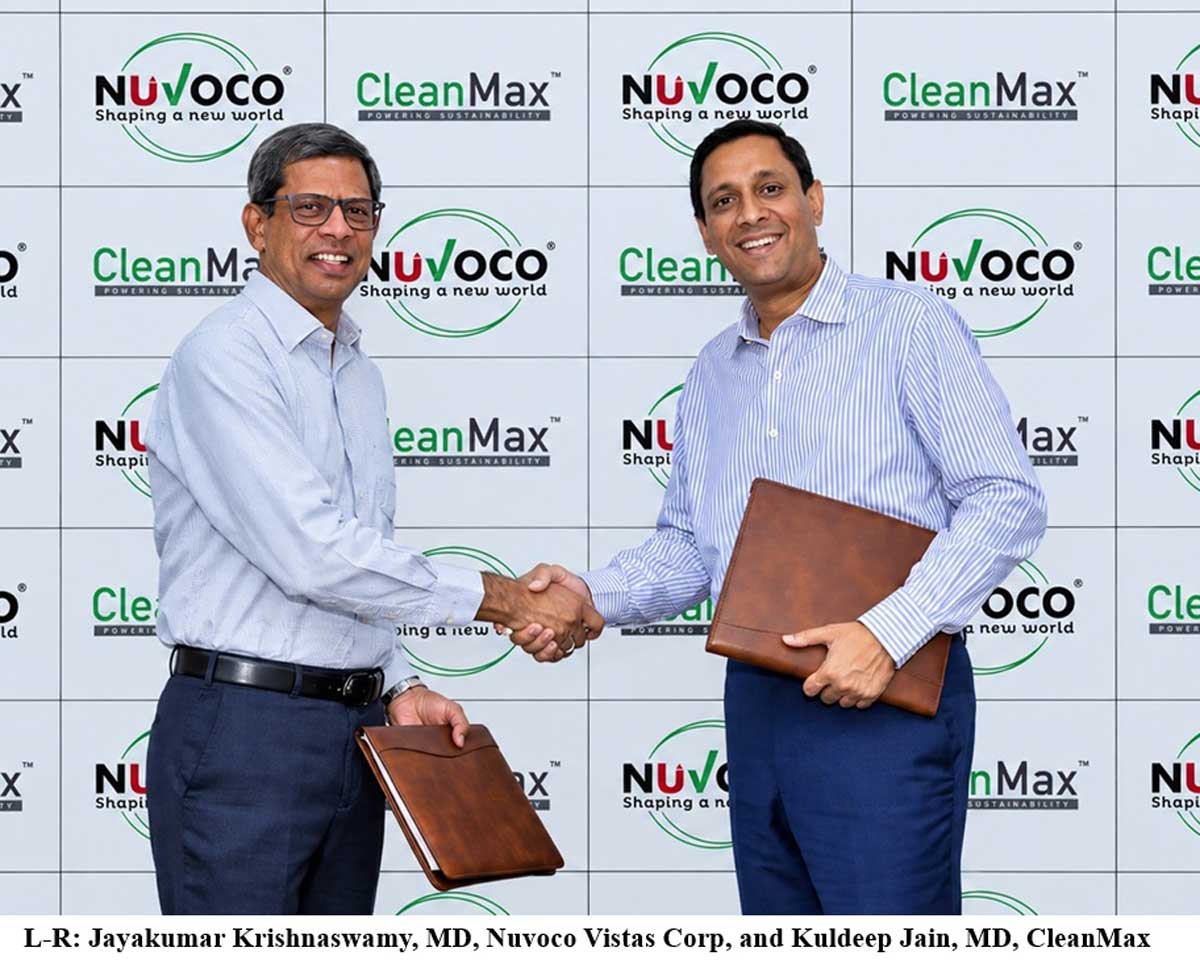
    Nuvoco Vistas Corp Ltd, part of Nirma Group and one of India’s leading cement companies, has partnered with Clean Max Enviro Energy Solutions Limited (CleanMax), a renewable energy solutions provider for the commercial and industrial (C&I) sector, to develop a 46.4 MW wind-solar hybrid renewable energy project in Rajasthan.

    The project will support Nuvoco’s cement operations with cleaner power while strengthening its renewable energy and decarbonisation strategy. It is expected to increase the share of renewable energy in Nuvoco’s power mix, reducing fossil fuel consumption and associated emissions.

    Developed by CleanMax, an Independent Power Producer (IPP), at Bhikamkhore, Rajasthan, the project will comprise 20 MW of wind capacity and 26.4 MWdc of solar capacity, along with a 2-MWh Battery Energy Storage System (BESS). Power generated from the facility will be supplied to Nuvoco through the State Transmission Utility (STU) Open Access network.

    The hybrid project is expected to generate approximately 100 million units (MU) of renewable electricity annually and help avoid around 1,25,485 tonnes of CO₂ emissions every year across Scope 1 and Scope 2 emissions.

    The initiative supports Nuvoco’s ongoing efforts to reduce the carbon intensity of its manufacturing operations through renewable energy adoption, Waste Heat Recovery Systems (WHRS), energy-efficiency measures and increased use of alternative fuels. It also aligns with the company’s DIRE (Digitalisation, Innovation and Renewables) agenda, which focuses on climate action, renewable energy transition, water stewardship, circularity and biodiversity conservation across its manufacturing ecosystem.

    Commenting on the initiative, Jayakumar Krishnaswamy, Managing Director, Nuvoco Vistas Corp Ltd, said, “This marks an important step in advancing Nuvoco’s journey towards more sustainable and resilient operations. Our collaboration with CleanMax will increase the share of renewable energy across our Rajasthan operations, strengthening our energy mix while improving long-term cost efficiency and reducing our dependence on conventional power sources. Initiatives such as these reinforce our commitment to operational excellence and responsible growth, while supporting our vision of Building a Safer, Smarter and Sustainable World.”

    Kuldeep Jain, Founder and Managing Director, CleanMax, said, “Cement plants run continuously, so the power behind them has to be dependable for decades, not years. We’re seeing manufacturing industries view clean energy as an integral part of their core operations and long-term strategy. Our partnership with Nuvoco reflects that shift, and we’re pleased to support its decarbonisation journey. This wind-solar hybrid project is designed to deliver long-term cost certainty while supporting the Company’s transition to cleaner power.”

    Nuvoco has been advancing its sustainability initiatives through renewable energy, operational efficiency and technology-driven solutions. The company operates across Cement, Ready-Mix Concrete (RMX) and Modern Building Materials (MBM) segments, with a presence across East, North and West India.

    The company began operations in 2014 with a greenfield cement plant in Nimbol, Rajasthan, and later acquired Lafarge India Limited, which entered India in 1999, along with Emami Cement Ltd in 2020 and Vadraj Cement Limited in April 2025. With planned expansion initiatives, including a new grinding mill at the Arasmeta Cement Plant and multiple debottlenecking projects, Nuvoco aims to achieve a cement capacity of 35 MMTPA.

    The company reported total income of Rs 113.62 billion in FY 2025-26, reflecting its continued growth trajectory. Its cement portfolio includes Concreto, Duraguard, Double Bull, PSC, Nirmax and Infracem brands, while its RMX business offers products under Concreto, Artiste, InstaMix, X-Con and Ecodure brands. Nuvoco also provides construction solutions under its Zero M range of modern building materials.

    Continue Reading

    Concrete

    UltraTech Cement achieves 100% green energy milestone at Chhattisgarh plant

    Published

    on

    By

    Shares

    UltraTech Cement’s Kukurdih Works becomes its first integrated unit to meet 100 per cent electricity needs through green energy every month.

    Raipur (Chhattisgarh)

    UltraTech Cement Limited, the world’s largest cement company outside China, has achieved a significant decarbonisation milestone, with its Kukurdih Cement Works integrated unit in Chhattisgarh meeting 100 per cent of its electricity requirement through green energy every month since April 2026.

    Commissioned in 2024, Kukurdih Cement Works has an installed grey cement capacity of 3.3 million tonnes per annum. The unit achieved this milestone through a combination of renewable power sourcing and Waste Heat Recovery Systems (WHRS), which now collectively meet its entire electricity demand while ensuring operational reliability.

    Since April 2026, nearly one-third of UltraTech’s 76 manufacturing units in India have maintained green energy utilisation above 50 per cent of their electricity requirements. Five units, including Kukurdih, have exceeded 95 per cent green energy utilisation. The company is also progressively deploying Battery Energy Storage Systems (BESS) across its network to enable deeper renewable energy integration.

    As part of its decarbonisation strategy, UltraTech has not invested in additional captive thermal power capacity for greenfield projects or brownfield expansions at its integrated units for over a decade.

    As of Q1FY27, the company’s captive green energy capacity stood at 1,897 MW, comprising 1,463 MW of renewable energy capacity from solar, wind and hybrid sources, along with 434 MW of WHRS capacity. Under its RE100 commitment, UltraTech aims to increase the share of green power in its total energy mix to 85 per cent by 2030 and achieve 100 per cent by 2050.

    UltraTech Cement Ltd, the cement flagship company of the Aditya Birla Group, is a $10-billion building solutions company and the largest cement producer globally by sales volume outside China. The company has a total grey cement capacity of 210.1 MTPA and white cement/putty capacity of 3.5 MTPA. It is a signatory to the GCCA Climate Ambition 2050 and has committed to the Net Zero Concrete roadmap announced by GCCA.

    Continue Reading

    Economy & Market

    From First Mile to Last Mile

    Published

    on

    By

    Shares

    Praveen Vashistha, Founder, Gxpress Solutions, speaks about building a holistic logistics network that encompasses latest technology and current challenges faced by logistics service providers.

    Logistics may seem to only entail transporting a package from one location to another. However, there is more to this term than just that. Logistics refers to the entire process of controlling all movement, transfers and decisions in the correct way at the right time and cost and with the desired level of visibility.

    People nowadays want to receive more than just the delivery. They want quick, efficient, reliable and transparent logistics service. On the other hand, companies are facing higher operating costs, broken supply chains, congested cities, changing habits of consumers and growing complexity of logistics services. In this situation, a full logistics package is gaining importance not only as a competitive advantage but also as a necessity for a successful business.

    The main challenge lies in uniting the first mile, the middle mile and the last mile into one seamless process.

    The journey begins before the package moves

    First-mile logistics may be the least recognised part of the logistics chain, but they have a crucial influence on all that follows.

    This stage starts from the moment the shipment leaves the manufacturer, supplier, farm, warehouse or distribution centre. Depending on the industry, first-mile logistics may involve grouping shipments from multiple suppliers, compiling paperwork and checking the inventory before sending the shipments to a central hub.

    Flaws in first-mile logistics produce effects later down the supply chain. Delays in cargo pickup can affect warehouse operations; improper packaging can damage goods in transit; and incorrect inventory information may cause stockholding or unnecessary replenishments.

    This is why building a reliable network involves simplifying the operations done at the beginning of the supply chain.

    Companies require accurate demand forecasts, supplier visibility, standard procedures, and software to capture information from the moment a shipment enters the supply chain. Route planning and fleet management are also important at this stage, especially as it may involve contacting multiple suppliers.

    The main goal is simply to make the first mile predictable.

    The middle mile: Where scale meets complexity

    When products leave the original site, they travel through the ‘middle mile,’ which connects fulfilment centres, warehouses, sorting centres, and regional distribution points. In this phase, logistics networks begin operating on a large scale. A shipment can pass through several facilities before reaching the final destination. Each additional transfer entails the risk of delay or damage and information losses. Accordingly, the ideal solution is not to minimise the number of transfers but rather to optimise them. The use of hub-and-spoke networks, regional distribution centres, and strategically placed distribution centres can help companies shorten transportation routes and optimise distribution costs. Besides, data can be used to determine the optimal placement of inventories.

    For instance, a retailer may find that it takes more time and is more expensive to deliver goods to customers if everything is stored in a central warehouse. Meanwhile, regional distribution helps meet the customer’s needs quicker and more efficiently.

    The last mile is where the customer judges you

    When it comes to the logistics experience, the customer experience comes down to the delivery. While the last mile might comprise a small part of the entire journey in actual distance, it could also entail expensive and difficult processes. Delivery runs through densely populated cities, through traffic jams, through unsuccessful delivery attempts, and through changing consumer preferences and narrowed time frames.

    Customers want to have control over their delivery. Delivery means that customers expect to know the exact moment when their order is delivered. They need to receive current updates about their orders and the ability to decide whether they want scheduled deliveries, or whether they want their order to be dropped off at a designated location far from their house.

    As a result, last-mile logistics must incorporate both efficiency and experience. The technology may be used to ensure timely and accurate delivery, through such products as route optimisation and real-time delivery tracking.

    However, technology is not enough to guarantee success in terms of last-mile delivery. Knowledge of the local area is still an important aspect that contributes to successful delivery.

    One network, not three separate operations

    First, the common mistake that organisations can make is treating the first mile, the middle, and the last mile separately.

    An effective first mile of logistics does not matter much if the shipment waits in a hub for many hours. A perfectly working warehouse does not make a happy customer if the last-mile delivery fails. Therefore, even the fastest last-mile delivery can become an expensive operation if the supply is not well geographically positioned.

    The three moments should work together as one whole system.

    This implies having a common view on inventory, transport capacities, shipment statuses and demand. The Transportation Management System, Warehouse Management System and order management system should give information to each other instead of acting like separate islands.

    That is where real-time information comes into play!

    If something happens, such as a vehicle gets delayed, the company has to know that from the start. If not, someone from Customer Service should be informed about the situation.

    Visibility is the new infrastructure

    Previously, companies had to rely on physical assets, such as warehouses, trucks, and sorting facilities, to create their logistics networks. Today, they have an additional layer of technology providing visibility.

    Command-and-control systems now include GPS tracking, Internet of Things devices, bar-coding, RFID, cloud computing, artificial intelligence, and analytics, which allow companies to know what the goods are doing, how well they are doing, and what is going to happen next.

    Predictive analytics reveal possible delays. AI-powered forecasting increases availability. Digital dashboards enable the manager to monitor all operations in one place. The efficiency of such technologies is not measured in the amount of information they gather, but rather in their capability of converting data into knowledge.

    Logistics managers should be able to answer the following questions: Where is it? When is it supposed to arrive? What causes the delay? What impact does it have? Can it be delivered some other way? How much will it cost?

    The sooner the answers are given, the more resilient the logistics system is.

    Resilience must be designed into the network

    The events of recent years have highlighted the vulnerability of interconnected supply chains. Geopolitical tensions, bad weather, a lack of labour, poorly developed infrastructure and an unexpected spike in demand are some events that can cause problems for logistics systems without prior notice. Thus, companies should create an end-to-end network not just for normal times but also capable of functioning quickly in problematic situations. In order to create such a network, it is necessary to find alternative suppliers, use several means of transportation, create several routes of delivery, and establish inventory. It is also important to use scenario planning to define what to do if the main hub becomes unavailable or any means of transportation is blocked.

    Sustainability: Part of the delivery equation

    The future of logistics will also be shaped by environmental considerations.

    As delivery volumes rise, businesses are under increasing pressure to reduce emissions without compromising service. Better route planning, load optimisation, electric vehicles, alternative fuels, renewable-energy-powered warehouses and consolidated deliveries can all contribute. The most sustainable shipment is often the one that does not require unnecessary movement in the first place.

    Better demand forecasting and inventory placement can reduce empty miles and avoid repeated transportation. Consolidating deliveries can improve vehicle utilisation. Reverse logistics can ensure that products, packaging and materials return efficiently instead of becoming waste.

    Sustainability, therefore, should not be treated as a separate initiative. It should be incorporated into network design itself.

    The future belongs to connected logistics

    An end-to-end logistics network ultimately seeks to close existing gaps between various processes.

    Every mile of the process should be interconnected with the other miles. Warehouses should be aware of the restraints imposed by transportation. Delivery crews should be able to know at every moment the inventory at their disposal. Clients must have access to this useful information.

    Companies that will be successful in this area will not necessarily be the ones with the biggest fleets or the most warehouses. They will simply be the ones that can employ their resources in the most effective manner.

    The future of logistics will be represented by an ecosystem consisting of the combination of the physical aspect, digital intelligence, and personnel decisions. Every mile in the process of delivery is important. However, the key advantage here is getting those miles to work together.

    For companies, it means having minimal resistance, enhancing their efficiency and improving customer care. For clients, it means simply having the right product delivered at the right time.

    About the author: Praveen Vashistha, Founder, Gxpress Solutions,

    Continue Reading

    Video Thumbnail
    ▶

      SIGN-UP FOR OUR GENERAL NEWSLETTER

      Trending News

      SUBSCRIBE TO THE NEWSLETTER


      Don't miss out on valuable insights and opportunities to connect with like minded professionals.


        This will close in 0 seconds