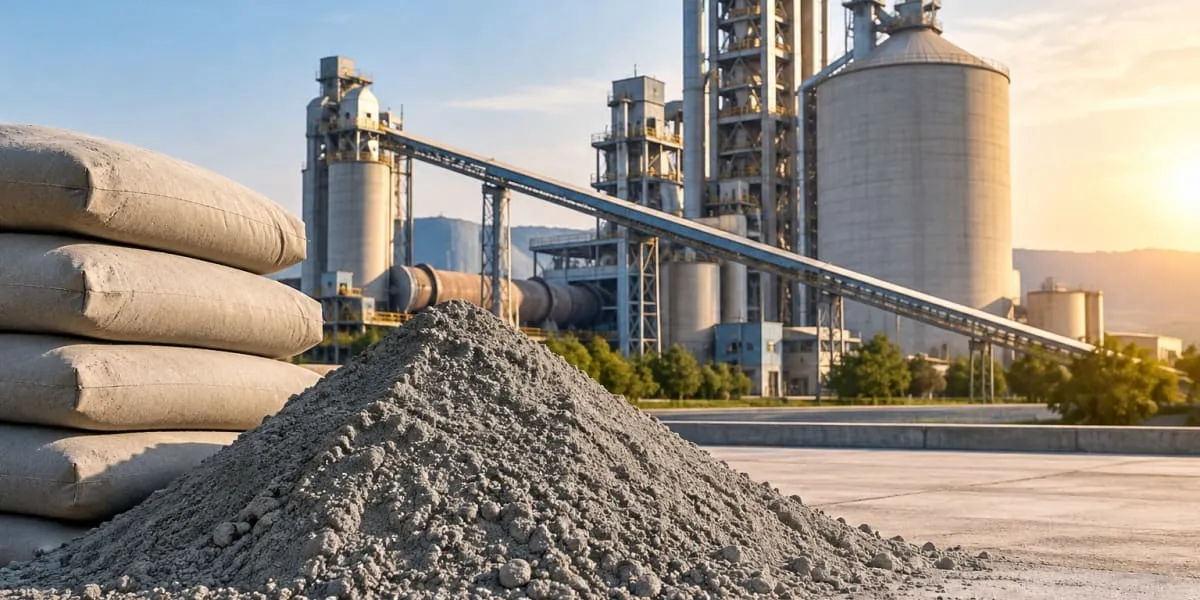
While we with our manufacturing capacity can satisfy all the critical areas of cement kiln, we are still dependent on valuable raw materials such as high purity DBM, high purity fused spinel and even high purity bauxite, writes Dr Arup Kumar Chattopadhyay.
Cement is a mineral binder produced by grinding a clinker, which contains hydraulic calcium silicates. Clinker is produced in a rotary kiln when the lime rich feed, which includes silica, alumina and iron oxide, is heated to approximately 1,450 degree Celsius.
Challenges for cement industry from the perspective of refractories supplier:
- Usage of alternative cost effective fuels
- Adaption to wide range of raw materials
- Higher thermal loading in ever increasing kiln capacity
- Minimum 335-340 days running requirement of kiln
- Compliance to strict norms to protect environment
Operating parameters and their effect on refractories lining:
Silica modulus (SM) = % of SiO2 / % of ( Al2O3+ Fe2O3): Typical range 1.8 to 2.7. If < 1.8 low melting phase is formed, which wash away the coating. If > 3. No coating is formed and produces off-grade cement.
Alumina modulus (AM) = % of Al2O3 / % of Fe2O3: Typical range 1.0- 1.5 If < 1.0 state is fluid, which promotes the formation of large balls in the kiln, which destroys coating. If > 2.5 viscous state is formed. As no solidification takes place, it is difficult to form coating.
% liquid phase (LP) = 1.13 C 3A + 1.35 C4AF + MgO+ Alkalis: This determine the type of coating formation on the surface of refractories.
- 30% LP – dense and hard coating
- 25% LP – Fairly good coating
- 20% LP – Loose and Porous coating
Alkali equivalent (AE): Usually 0.6% or below. Alkalies attack entire brickwork severely when AE is high. If AE index is higher, provision of alkali by-pass is required.
Alkali/sulphate ratio: By using high S coals and pet coke or other blended coals, S content goes up, which effects the coating, and allows material buildup on riser ducts.
ASM = 1
(Alkali salts in a balanced ratio)
ASM> 1
(Excess of Alkali)
ASM < 1
(SO2/ SO3 in excess)
Stress factors on refractories lining:
Stresses
- Thermal stress
- Mechanical stress
- Chemical stress
Thermal stress
- Thermal shocks (Break downs, kiln stoppage, coating fall off)
- Flame- heat load – overheat
Mechanical stress
- Erosion due to clinker/ coating movement
- Impact due to clinker fall off
- Mechanical tension due to kiln ovality
Chemical stress
- Redox reaction
- Corrosion due to volatile alkali salts components, which condenses and solidify at varying depth.
Essentials of good quality refractories for cement kilns
We require high quality raw materials such as:
- Fireclay with low iron and low alkali
- Imported low iron Chinese bauxite
- Fused magnesia
- High-sintered dolomite
- Andalusite
And synthetic raw materials like tabular alumina and Mullite. Among the machinery for efficient mixing of raw material batches:
- High intensity inclined mixture and for pressing bricks with uniform bulk density and accuracy of dimensions
- High capacity hydraulic presses with PLC controller
- We also require high temperature tunnel kiln for firing of the bricks.
Some special features of the refractories for critical area of the kiln:Preheater tower and TAD area: Extreme abrasion and impact is experienced in this area and where build up and coating occur- High density silicon carbide based compositions castables and plastics are the best solution for this area as the surface remains smooth and dust deposits can be moved very easily and maintained properly.
Silicon carbide based material not only give a higher thermal conductivity but also thermal shock resistance is improved. The attack by alkali salts also is prevented as SiC% is maintained in such a way Calsilite, i.e. mono calcium silicate is formed, the mechanism being at the operating temp SiC get oxidised and the oxidation product SiO2 first forms a self-glaze on the SiC grains which greatly reduces the coating built up.
Burning zone and transition zones: These zones are divided in three areas: upper transition zone, sintering zone and lower transition zone. Upper and lower transition zone bricks are made out of high purity dead burnt magnesite and magnesia alumina spinel. In the lower transition zone, most severe conditions occur as clinker fluids are present, temperature is the highest and the coating is normally unstable and thin. Spinel bricks are fired basic products; miner logically mainly consists of spinel, and are distinguished by very high chemical resistance to alkalis, alkali salts and SO3.
Their thermal shock resistance is also very high and after service these bricks present less disposal problems than magnesium chromite bricks. But refractories for burning zone or sintering zone are the bricks, which can initiate fastest coating formation and which have relatively reduced reactivity with the clinker melt. Many kilns use burnt dolomite and more common is magnesia chrome and magnesia -hercynite brick for the sintering zone. Chromite increases the thermal shock resistance and corrosion resistance of the MgO bricks and these bricks are very resistant to corrosion of varying basicity concerning application for bricks containing chromite. It is very important to consider the possible hazards to our environment. Therefore more recently magnesia-hercynite bricks are used in rotary kilns where a suitable content of Fe Al2O4 is used in grain form. Hercynite is again a spinel and capable to reduce the brittleness of magnesia products thus enhancing the flexibility.
Tip casting, bull nose and burner pipe: The above three areas are also very important and affect the kiln running. All these areas have high abrasion at elevated temperature and also are prone to thermal shock and low cement formulation with approximately 90 per cent Al2O3, i.e., corundum based is the most suitable material.
LCC castables based on 90 per cent alumina and lime content being close to 2.5 per cent the strength level is substantially higher because of high bulk density,, lower porosity and high thermal conductivity. The properties to combat thermal shocks and high abrasion have been achieved by controlled inclusion of reactive alumina with large specific surfaces. The further assistance have been provided by the suitable selection of deflocculation systems through commercially available long chain phosphates.
Conclusion
India is the second largest producer of cement clinker. Our country’s dry process larger kiln require basic bricks of the advanced level, and while we with our manufacturing capacity can satisfy all the critical areas of cement kiln, we are still dependent on valuable raw material such as high purity DBM, high purity fused spinel and even high purity bauxite. Our R&D and central research institutes should gear up for beneficiating the essential raw materials needed for refractory production of the cement rotary kiln systems.
ABOUT THE AUTHOR:
Dr Arup Kumar Chattopadhyay, Managing Director, National Refractories, is an M. Tech in Chemical Technology (Specialisation in Ceramic Technology). He has completed his Ph.D. (Tech.), and clutched several management degrees in Michigan, France and Switzerland. With 80+ technical papers and publication to his credit, Dr Chattopadhyay has been conferred with: Distinguished Life Member by Unified International Technical Conference on Refractories (UNITECR), and Best Refractory Technologist (ICS). Subsequent to the positions of the Managing Director, TRL Krosaki Refractories and the Chairman, TRL, China, he now holds the positions of Managing Director, National Refractories (Vantage Refractory Technologies), Chairman, Refractory Sectional Committee – MTD-15 of Bureau of Indian Standards, Member of Governing Body of College of Engineering & Ceramic Technology, Government of West Bengal, Member of Editorial Board of the Journal China Refractories, and Member of the National Advisory Committee of ASIA-PACIFIC Committee of Glass and Allied Industries.