Connect with us

Concrete

AFCM Unveils 2035 Regional Decarbonisation Roadmap for Cement Sector

AFCM launches world’s first regional decarbonisation plan for cement at Brunei meet.

Published

on

Shares
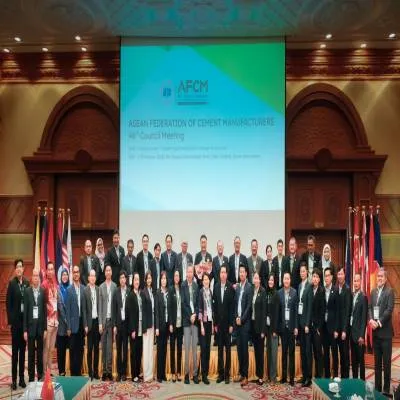
The ASEAN Federation of Cement Manufacturers (AFCM) has formally launched the 2035 AFCM Decarbonisation Roadmap, becoming the first regional bloc in the world to introduce a unified decarbonisation strategy for the cement sector. The announcement was made at the 46th AFCM Council Meeting in Brunei Darussalam, chaired by Dr Chana Poomee, and attended by leaders and representatives of cement associations from all eight AFCM member countries. The launch comes as global attention intensifies ahead of COP30 in Brazil, where climate action is expected to be a central priority.
Cement production remains integral to infrastructure and economic development across the ASEAN region, yet it is also a major contributor to CO? emissions. The 2035 AFCM Decarbonisation Roadmap signals a collective regional commitment to accelerating emissions reduction in alignment with national climate policies and global sustainability goals, reinforcing AFCM’s leadership in the transition to low carbon cement production.
Dr Chana Poomee, AFCM President and Chairman of the Thai Cement Manufacturers Association (TCMA), described the roadmap as a landmark achievement for the region’s cement industry. He noted that the shared framework would support systematic CO? reduction, strengthen regional competitiveness and enhance ASEAN’s contribution to global climate objectives.
Developed with strong support from the Global Cement and Concrete Association (GCCA), the 2035 Roadmap sets out a comprehensive transition pathway anchored around four strategic pillars:
• Expansion of low carbon cement enabled by performance-based standards;
• Transition to clean and renewable energy across production processes, alongside improved thermal and electrical efficiency;
• Deployment of advanced decarbonisation technologies, including Carbon Capture, Utilisation and Storage (CCUS); and
• Development of new supplementary cementitious materials to support next-generation low carbon cement products.
Dr Chana urged all AFCM members to treat the roadmap as a coordinated regional strategy for sustainable growth. At the ASEAN level, the measures outlined have the potential to reduce up to 38 million tonnes of CO2 by 2035. While the roadmap sets a collective vision, it acknowledges the diversity of national conditions, recognising that each member country will set its own targets based on regulatory frameworks, industrial maturity and technological capacity. One key early-action priority is the reduction and phasedown of Ordinary Portland Cement (OPC), providing an immediate opportunity for substantial emissions cuts.
Cement associations from Brunei Darussalam, Cambodia, Indonesia, Malaysia, the Philippines, Singapore, Thailand and Vietnam expressed strong support for the roadmap and reaffirmed their commitment to advancing decarbonisation within their national contexts. Members emphasised the need for supportive policies, expanded use of alternative fuels, improved energy efficiency, accelerated adoption of advanced technologies and greater promotion of low carbon cement and concrete solutions. They also recognised that specific decarbonisation pathways will vary based on each country’s energy mix, material availability, policy environment and market readiness.
“The 2035 AFCM Decarbonisation Roadmap presents a significant opportunity to enhance regional competitiveness, drive sustainable development and unlock substantial economic benefits. Government support, including policy adaptation, will be essential for effective implementation. Through collaboration, innovation and collective action, AFCM can accelerate the adoption of low carbon technologies, attract green investment, create new economic opportunities and build a resilient, future-ready cement industry that contributes meaningfully to global decarbonisation,” Dr Chana concluded.
The issuer is solely responsible for the content of this announcement.


Continue Reading

Concrete

Steel: Shielded or Strengthened?

CW explores the impact of pro-steel policies on construction and infrastructure and identifies gaps that need to be addressed.

Published

on

By

Shares

Going forward, domestic steel mills are targeting capacity expansion
of nearly 40 per cent through till FY31, adding 80-85 mt, translating
into an investment pipeline of $ 45-50 billion. So, Jhunjhunwala points
out that continuing the safeguard duty will be vital to prevent a surge
in imports and protect domestic prices from external shocks. While in
FY26, the industry operating profit per tonne is expected to hold at
around $ 108, similar to last year, the industry’s earnings must
meaningfully improve from hereon to sustain large-scale investments.
Else, domestic mills could experience a significant spike in industry
leverage levels over the medium term, increasing their vulnerability to
external macroeconomic shocks.(~$ 60/tonne) over the past one month,
compressing the import parity discount to ~$ 23-25/tonne from previous
highs of ~$ 70-90/tonne, adds Jhunjhunwala. With this, he says, “the
industry can expect high resistance to further steel price increases.”

Domestic HRC prices have increased by ~Rs 5,000/tonne
“Aggressive
capacity additions (~15 mt commissioned in FY25, with 5 mt more by
FY26) have created a supply overhang, temporarily outpacing demand
growth of ~11-12 mt,” he says…

To read the full article Click Here

Continue Reading

Concrete

JK Cement Commissions 3 MTPA Buxar Plant, Crosses 31 MTPA

Company becomes India’s fifth-largest grey cement producer

Published

on

By

Shares

JK Cement  has commissioned its new 3 MTPA grey cement plant in Buxar, Bihar, taking the company’s total installed capacity to 31.26 million tonnes per annum (MTPA) and moving it past the 30 MTPA milestone. With this addition, JK Cement now ranks among the top five grey cement manufacturers in India, strengthening its national presence.

Commenting on the development, Dr Raghavpat Singhania, Managing Director, JK Cement, said, “Crossing 31 MTPA is a significant turning point in JK Cement’s expansion and demonstrates the scale, resilience, and aspirations of our company. In addition to making a significant contribution to Bihar’s development vision, the commissioning of our Buxar plant represents a strategic step towards expanding our national footprint. We are committed to developing top-notch manufacturing capabilities that boost India’s infrastructure development and generate long-term benefits for local communities.”

Spread across 100 acres, the Buxar plant is located on the Patna–Buxar highway, enabling efficient distribution across Bihar and neighbouring regions. While JK Cement entered the Bihar market last year through supplies from its Prayagraj plant, the new facility will allow local manufacturing and deliveries within 24 hours across the state.

Mr Madhavkrishna Singhania, Joint Managing Director & CEO, JK Cement, said, “JK Cement is now among India’s top five producers of grey cement after the Buxar plant commissioning. Our capacity to serve Bihar locally, more effectively, and on a larger scale is strengthened by this facility. Although we had already entered the Bihar market last year using Prayagraj supplies, local manufacturing now enables us to be nearer to our clients and significantly raise service standards throughout the state. Buxar places us at the center of this chance to promote sustainable growth for both the company and the region in Bihar, a high-growth market with strong infrastructure momentum.”

The project has involved an investment of Rs 5 billion. Commercial production began on 29 January 2026, following construction commencement in March 2025. The company said the plant is expected to generate significant direct and indirect employment and support ancillary industrial development in the region.

Continue Reading

Concrete

JK Cement Crosses 31 MTPA Capacity with Commissioning of Buxar Plant in Bihar

Published

on

By

Shares

JK Cement has commissioned a 3 MTPA Grey Cement plant in Buxar, Bihar, taking its total capacity to 31.26 MTPA and placing it among India’s top five grey cement producers. The ₹500 crore investment strengthens the company’s national footprint while supporting Bihar’s infrastructure growth and local economic development.

JK Cement Ltd., one of India’s leading cement manufacturers, has announced the commissioning of its new state-of-the-art Grey Cement plant in Buxar, Bihar, marking a significant milestone in the company’s growth trajectory. With the commissioning of this facility, JK Cement’s total production capacity has increased to 31.26 million tonnes per annum (MTPA), enabling the company to cross the 30 MTPA threshold.

This expansion positions JK Cement among the top five Grey Cement manufacturers in India, strengthening its national footprint and reinforcing its long-term growth strategy.

Commenting on the strategic achievement, Dr Raghavpat Singhania, Managing Director, JK Cement, said, “Crossing 31 MTPA is a significant turning point in JK Cement’s expansion and demonstrates the scale, resilience, and aspirations of our company. In addition to making a significant contribution to Bihar’s development vision, the commissioning of our Buxar plant represents a strategic step towards expanding our national footprint. We are committed to developing top-notch manufacturing capabilities that boost India’s infrastructure development and generate long-term benefits for local communities.”

The Buxar plant has a capacity of 3 MTPA and is spread across 100 acres. Strategically located on the Patna–Buxar highway, the facility enables faster and more efficient distribution across Bihar and adjoining regions. While JK Cement entered the Bihar market last year through supplies from its Prayagraj plant, the Buxar facility will now allow the company to serve the state locally, with deliveries possible within 24 hours across Bihar.

Sharing his views on the expansion, Madhavkrishna Singhania, Joint Managing Director & CEO, JK Cement, said, “JK Cement is now among India’s top five producers of grey cement after the Buxar plant commissioning. Our capacity to serve Bihar locally, more effectively, and on a larger scale is strengthened by this facility. Although we had already entered the Bihar market last year using Prayagraj supplies, local manufacturing now enables us to be nearer to our clients and significantly raise service standards throughout the state. Buxar places us at the center of this chance to promote sustainable growth for both the company and the region in Bihar, a high-growth market with strong infrastructure momentum.”

The new facility represents a strategic step in supporting Bihar’s development vision by ensuring faster access to superior quality cement for infrastructure, housing, and commercial projects. JK Cement has invested approximately ₹500 crore in the project. Construction began in March 2025, and commercial production commenced on January 29, 2026.

In addition to strengthening JK Cement’s regional presence, the Buxar plant is expected to generate significant direct and indirect employment opportunities and attract ancillary industries, thereby contributing to the local economy and the broader industrial ecosystem.

Continue Reading

Trending News

SUBSCRIBE TO THE NEWSLETTER


Don't miss out on valuable insights and opportunities to connect with like minded professionals.


    This will close in 0 seconds