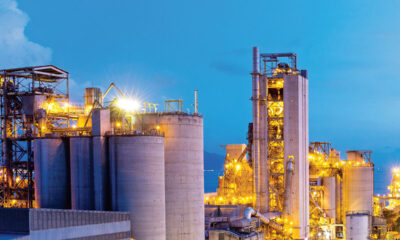
Use of alternate fuels not only saved the cement industry of Egypt but has addressed many other issues as well, like meeting regulatory requirements, saving money and growing public health threat from waste etc. An extract of a report from the International Finance Corporation.
The Egyptian cement industry is the world?s 12th largest and a vital economic force supporting the construction and building sector that accounts for nearly five per cent of Egypt?s Gross Domestic Product (GDP). The sector grew by nearly 10 percent in the past fiscal year, further expanding from a 7.4 percent growth rate in FY201. Today the energy-hungry industry is at a cross-roads due to fuel shortages, the cement sector is being forced to diversify its energy mix. Power production, effectively leaving most of the 25 operating cement companies with only a fraction of the gas needed to continue their operations. By 2013, domestic cement production had fallen by 50 percent. With no end to fuel shortages in sight, the industry lobbied to switch from natural gas to other fossil fuel-based alternatives, such as coal and pet coke. Yet, switching to coal entirely comes with a price. In 2015, about 49 million tonnes of clinker were produced with a thermal energy appetite of 46 million giga calories (GCal). By 2025, that figure is expected to grow to 72 million tonnes of clinker, demanding 68 million GCal.
On the other hand, integrating alternative fuels into the energy mix can help ensure a lower carbon transition that is commercially viable and economically attractive. The technological and financial viability of transforming waste streams into thermal energy for the cement industry is well- established internationally. Egypt?s substitution rate, by contrast, was only 6.4 percent in 2014, despite severe energy shortages and declining fuel subsidies.
In order to seek out viable and low carbon energy sources to help fill the energy demand gap, IFC has carried out this study. The research has mapped, quantified, and analyzed the price competitiveness of four alternative streams of waste fuels across the country: refuse derived fuel (RDF) from municipal solid waste, dried sewage sludge (DSS) from waste water treatment plants, agricultural waste, and derived fuel (TDF) from scrap s.
Market Drivers
The use of coal, which is not available domestically, puts pressure on Egypt?s hard currency reserves at a time when the country is struggling with foreign capital liquidity. Civil society stakeholders also point to another crucial drawback to switching to coal; environmental and health externalities associated with not only the combustion of coal, but also its importation.
The government, determined to meet national climate emissions targets and to respond to public concerns after a heated debate, reacted. In April of 2015, the Executive Regulations of the law on Environment have been amended to allow and regulate the use of coal. Under this amendment, each cement firm applying for a coal operational license must commit to mitigate the difference between assumed greenhouse gases (GHGs) emissions from the theoretical consumption of 100 per cent coal and a hypothetical baseline of 100 per cent heavy fuel oil (HFO) within two years of the license?s issuance. The coal license mitigation target could be fully achieved if the sector reached a TSR of 30 percent by 2025, which would require approximately 20.4 million GCal(Giga Calories) of AFR.
Adopting alternative fuels may help the cement industry in not only meeting these regulatory requirements, but in saving money. AFR is a locally available resource with immense growth prospects, a steadily growing population base generates a continuous flow of waste. Furthermore, key governmental entities and the current regulatory frameworks are receptive to the incorporation of AFR as a means to confront the challenge of emissions, and the growing public health threat of waste. AFR usage will have fewer negative externalities. It will conserve valuable fossil fuels, reduce pressure on foreign currency reserves and allow for safe disposal of waste that would otherwise be landfilled or illegally, openly dumped.
Estimated Available AFR Supply
Of the four waste streams evaluated as part of this study, agricultural waste is by far the largest in volume, at an annual estimate of 10.7 million tonnes. RDF from MSW, closely follows, at two to five million tons, with DSS offering another one million tonnes are a distant fourth, due primarily to competition from the retread and reuse industry. The study concludes that current waste volumes in Egypt from this first three sources offer between 46-72 million GCal of potential fuel that goes untapped each year. Combined, the three waste streams contain enough technically viable fuel potential to supply nearly 1.6 times the 46 million GCal of the Egyptian cement industry?s 2015 energy needs.
AFR Financial Viability and Commercial Potential
In order for AFR to be competitive, the price difference between traditional fuels and alternative fuels must be taken into account. AFR prices are dictated by factors that include, the amortization of the equipment installed at the cement plant to co-process with either fuel; the operational cost of co-processing (also covers handling and maintenance); the cost of procuring the AFR; and the cost of potential negative impacts of the AFR on the kiln process and equipment.
An economic viability analysis of the four waste streams demonstrates that AFR is commercially competitive with coal. The cost competitiveness of each fuel varies, depending on preparation and processing costs, the price of other fuels and the cost of transport. IFC?s initial analysis shows that for 2015, average AFR pricing was between 5 and 40 percent less expensive per GCal than coal at the burner point. That price difference also reflects pre-processing, handling, transportation, and co-processing costs.
The necessary capital investment by a cement plant for co-processing AFR in the kiln ranges from $1 million for agricultural wastes (fine materials) to $4 million for MSW. However, most cement plants needed to make capital investments to burn coal, investments which ranged much higher than that for AFR. For each coal line, the figure varied from $15 to $25 million (excluding land prices). However, the payback periods for investments required for AFR co-processing are expected to be less than five years.
To reach a TSR of 20 percent by 2025, total investments for pre-processing are estimated at $114 million and may potentially be as much as $320 million. This represents a significant opportunity to attract investors and financial institutions. Based on the findings of the study, the economic feasibility of AFR pre-processing projects (with the exception of TDF) could result in an internal rate of return (IRR) above 15 percent, and a payback period of three to five years.
AFR Substitution Scenarios
Theoretically kilns in Egypt could accept TSR up to 30 percent without significant kiln modifications and related investments. Though achieving a limited TSR of 5-15 percent is relatively easy, the path to a higher TSR (> 20 to 30 percent), is long and requires technical knowledge that needs to be encouraged and developed.
Growth rates in the average thermal substitution rates will follow a gradual learning curve. In order to reach 20 percent TSR by 2025, cement plants would need to spend around $217 million annually on procuring AFR. This could help the cement industry save $51 million annually. It would also replace about 1.9 million tonnes of coal in 2025 and avoid 3.9 million tonnes of CO emissions.
Reaching 20 percent TSR by the year 2025 is a realistic scenario. A 30 percent TSR is also technically achievable, but only with the implementation of significant regulatory interventions.
AFR Supply Chain
A key challenge is the lack of an established supply chain to collect, process and deliver waste to cement plants at the required quality and with a mutually accepted price. In order for AFR to grow, commercially and sustainably, strong partnerships between waste suppliers, waste management operators, and the cement industry must be forged.International experience shows that there are different levels of AFR pre-processing integration in the cement sector. In general, there are three levels of integration in AFR upstream activities: i) outsourcing (no integration), ii) partial integration, and iii) full integration. The cement plant would select the model most relevant by evaluating the degree of AFR quality control it requires, the scale of investment a firm can afford, and the complexity of operations it can tolerate. The appropriate business model will vary depending on the type of waste stream and the cement.
Challenges and Recommendations
There are several issues that should be considered carefully and addressed prior to an investment decision, in order to ensure a long term and more sustainable market for AFR in Egypt. These issues include the following, along with options for mitigation. Logistics and transportation costs: Transportation costs can significantly impact the profit margins of an otherwise viable financial model. Waste streams like MSW and DSS are overwhelmingly concentrated in urban areas. Others, particularly agricultural waste, are geographically distributed and may lack central collection and processing points.
Mitigation: In order to help address this issue, IFC has created a map which indicates the locations of a) cement plants, b) the distribution of various types of crops c) various sources of AFR and d) locations of the existing waste processing/composting sites, which may be considered as potential future pre-processing locations. The map could be accessed at this link: http://arcg.is/1ToAspz Waste markets remain fragmented and dominated by informal players, most of which lack the technological knowledge and nevertheless, a viable AFR sector is not an opportunity for wind-fall profits. Local governments are encouraged to support potential investors by selecting AFR pre-processing sites and making them available for development.
Feedback from the cement producers surveyed for the purposes of this study has indicated that both availability and quality of AFR is of unreliable or of lower quality than required.
Mitigation: IFC recommends that the cement companies contractually agree with AFR suppliers on various standard terms such as a) minimum volume off-take, b) pricing, and c) quality characteristics and technical specifications of the AFR supplied. The more the cement industry can harmonize its requirements from a quality and characteristic perspective, the greater the economies of scale.
Support from local governments: Cooperation from the government is vital to ensure the security of supply and off-take agreements, particularly for MSW. If price and volume are fixed under a longer- term supply contract to allow for investment cost recovery and minimum returns on investment, waste management firms can obtain financing and qualified players may be willing to become involved.
Mitigation: Local governments are encouraged to see AFR processing companies as an opportunity to help solve the waste problem, particularly in urban areas where waste endangers public health. Furthermore, investing in AFR will help minimize public expenditure costs and reduce the environmental impact of dumping and land filling. Local governments are encouraged to support potential investors by selecting AFR pre-processing sites and making them available for development.
Enforcement of regulations and an efficient waste management chain. Extensive bans exist to prevent waste dumping and other disposal methods. But, a lack of enforcement impacts the availability of AFR supply, as well as the financial margins of co-processing. Existing facilities are currently treating less than 10 per cent of generated MSW, which reduces the AFR volumes available to interested investors. Mitigation: After adequate rehabilitation, operation and maintenance of existing pre-processing facilities, and the establishment of new ones, illegal dumpers may find it is just as economical, if not in fact cheaper, to deposit their collected waste with an AFR pre-processing plant even with a tipping fee. AFR represents a potential market-based solution to this serious environmental problem.
A Sustainable AFR Market in Egypt
IFC?s analysis underscores the opportunity for the private sector to promote and invest in a commercially attractive market for alternative fuels in Egypt. If the supply chain for AFR can be unlocked by the private sector through developing and investing in pre-processing facilities and operations, investors will be rewarded with sustainable and long-term demand from the cement industry. There is a clear opportunity for the private sector to transform these waste streams into a financially sustainable business. The challenges in making the switch to alternative fuels are significant. But the rewards far outstrip the hardships of reaching the goal.
Five drivers supporting AFR growth in Egypt:
a)Local fossil fuel shortages constraining cement production,
b)Competitiveness amid rising fuel costs,
c)A severe shortage of foreign currency reserves hindering imports of clinker and coal,
d)CO2 mitigation requirements and licensing mandates, and
e)Corporate and/or company-set AFR substitution targets.