Connect with us

Technology

National Conclave on Smart Technologies

Published

on

Shares

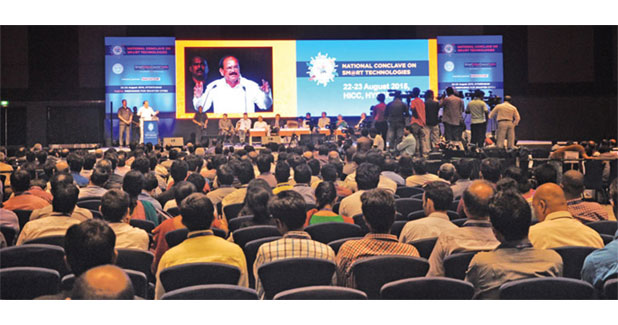
The conclave, held on August 22-23, 2015, in Hyderabad, brought together international experts on technologies and smart cities along with urban development officials from across India.
International experts on technologies and smart cities along with urban development officials from across India – constituting 600 cities covering the 100 smart cities and 500 AMRUT cities – came together at the Hyderabad International Convention Centre to participate in the National Conclave on Smart Technologies. The event was jointly hosted by Smart Cities Council India and the Telengana Government.

At the inaugural session on day one, Pratap Padode, Founder & Director, Smart Cities Council India, delivered the welcome address advocating that India has many successful smart cities practices carried out in different parts of the country, and that by sharing we can enhance their footprint. Then, BVR Mohan Reddy, Chairman, NASSCOM, expounded on the role of ?Technology in Developing Smart Cities?. Guest of Honour KT Rama Rao, Minister-IT, Telangana, spoke about ?creating a smart technologies hub?. Citing digital infrastructure and digital literacy as big challenges, he said,?The one-size-fits-all formula will not work for Indian smart cities…India needs its own formula.? And Chief Guest Venkaiah Naidu, Union Minister for Urban Development, Government of India, enthralled the audience on ?how India will build smart cities? with his witty one-liners and alliterations.?The need for today is a smart liveable city with transparency and accountability,? he emphasised.?Revenue generation and mobilisation should be the main focus of urban local bodies.? After the inaugural session, Padode commented,?Union Minister Venkaiah Naidu has confirmed that the Smart Cities Mission rollout has been very smooth and no obstacles have come their way. He has assured that the list of smart cities as per Phase-I of the Smart Cities Challenge will be declared on September 1, but declared the list earlier on August 27, itself, after which the cities will move into the second round of the competition.?

Then, the conclave kicked-off in right earnest with the theme, ?100 Smart Cities: Leapfrog to the Future?. There were four keynote addresses for the day: ?Preparing for Smart Cities? by Prof Carlo Ratti, Director, MIT Senseable City Laboratory, Boston; ?Transforming Indian Cities? by Dr Isher Ahluwalia, Chairperson, ICRIER; ?Building Smart City of Barcelona? by Vicente Guallart, Architect, Urban Habitat Lab, IAAC Barcelona; and ?Indian Smart Cities Mission? by Sameer Sharma, Additional Secretary, Ministry of Urban Development, Government of India.

At the plenary session, ?Keys to Future Energy?, chaired by Nikhil Agarwal, CEO, Innovation Society, Government of Andhra Pradesh, and Vijay Ratnaparkhe, Managing Director & President, Robert Bosch Engineering, the focus was on distributed production, renewables and energy storage, etc. Speakers included Anirban Choudhury, Vice President-Infrastructure, Vittal Innovation City; Aniruddha Ganguly, President, GMR Group; and the moderator was Kavan Mukhtayar, Senior Partner, Frost & Sullivan.

At the parallel session, ?Improving Urban Waste Management?, chaired by M Goutham Reddy, Executive Director, Ramky Group, the Smart Discussion was on new techniques and technologies for managing solid waste and waste-to-energy practices. Speakers included Willie Driessen, Global Technology and Product Manager, Paques BV; TR Rao, Managing Director, Steps Energy; S Sampat, CEO, Samkitec Resources; and JB Venkatakrishnan, Director, Quavac India Pvt Ltd.

The next plenary session, ?Governance Challenges for Smart Cities?, was chaired by Navin Mittal (IAS), Special Commissioner, Greater Hyderabad Municipal Corporation. The Smart Focus was on smart economic development through governance; smart and open government; governance and funding; and m-governance. Speakers included Krishna Mohan, Stesalit Ltd; Sandhya Godey, Phoenix IT; and Srinivas Bhoosarapu, IT Consultant, IRDAI. The moderator was Kailash Adhikari, Director, Governance Now.

At the parallel session, ?Developing Secure and Resilient Cities?, chaired by Rajendra Prasad Telugu, Executive Manager, Intergraph, the Smart Discussion was on making the city resilient to natural disasters and new technologies and techniques for better security management. Speakers included Sanjay Kamtam, Founder and CEO, VotaryTech; Ashish Shah, Director, The POC Centre; S Paul Antony, Director, Secuvision Networks; and Vinod Kamath, President-Strategic Solutions Group, Topsgrup. The moderator was Biju Kadapurath, Director, PwC India.

Day two began with a recap of the first day by Padode, followed by a special address by Somesh Kumar, Commissioner, Greater Hyderabad Municipal Corporation, titled, ?Swachh Bharat Mission – On Track with Hyderabad?. There were also two keynote addresses: ?A Case Study on Masdar? by Gaurish Wagle, Urban Planning Manager, Masdar City; and ?Evaluation of the Value of Leveraging Technology in Land Administration? by David Hickman, Director of International Sales, Thomson Reuters.

Next came ?Innovative Start-Ups and Apps for Society?. Spotlighting innovation and entrepreneurship, this served as a platform for new companies to showcase apps that will drive the execution of smart cities in the coming years. These included the Swachh Bharat App, which aims to build maps of dirty or unhygienic areas around the country to pinpoint areas for timely action; MyBusTickets.in, an e-commerce website that provides booking for intercity bus services in 20 states and almost 200 cities in India through the web or Android mobile; Zippr, an eight-digit alphanumeric code that gives the complete address and precise location overlaid on a Google map and will help integrate public utilities; and ZIFY, a Web and mobile-enabled dynamic car-pooling service.

Then, the sessions swung back into action. The plenary session on ?Technology Strategies for Innovative Cities? was chaired and moderated by Bipin Kumar, Co-founder, GAIA Smart Cities. The topics discussed included ICT infrastructure as a key enabler of smart cities; IoT and its benefits; big data challenges; technology strategies for innovative cities; developing web-based applications and e-services; and integrating the city to make it smarter. Speakers included Jayesh Ranjan, Secretary-IT, Government of Telangana; Aamer Azeemi, Managing Director, CISCO; Neelesh Kelkar, Sales Leader-Smart Building & Integrated Cities, IBM; Harri Rautio, CEO, bt.tn; and Dhiraj Wali, Vice President, Robert Bosch Engineering.

At the plenary session, ?Future of Sustainable Built Environment?, the Smart Focus was on rethinking cities in terms of livable and sustainable growth and smart utilities for innovative cities. Speakers included Dipankar Khasnabish, Industry Principal, Infosys Technologies; Udaya Bhaskar Rao Abburu, Managing Director, iRam Technologies; and Dr Ramesh Biswas, Professor, Consultant, AIT, Austria. The moderator was Biju Kadapurath, Director, PwC India.

A parallel session, ?Innovation Hackathon?, aimed to convert urban challenges into opportunities. The app community and students were challenged to come up with solutions that addressed the themes of smart energy, smart mobility, smart waste management and several others. The session showcased the most interesting and exciting solutions, such as drone services from hospital to patient, a smart bin system for tackling waste management and a smart leakage detector for LPG cylinders.

At the next plenary session, ?Mobility for Innovative Cities?, the Smart Focus was on mobility for innovative cities; smart mobility solutions; intelligent transport systems; and parking solutions. Speakers included Apurba Dhar, Director, RATP Dev Transdev; Prashant Bachu, Director, EMBARQ; Manish Tyagi, CEO, Motivity Labs; and Anil Kumar Saini, Head-Railways, L&T Metro Hyderabad.

At the parallel session on ?Water Management? chaired by JVR Murty, International Development Consultant, the Smart Discussion was on smart technologies for water management; drinking water for all; and harvesting rainwater for better use. Speakers included Tejus Kumar, Head-IT & Integrated Solutions, SPML Infra Ltd; and Prabhakar Kumar, Head, Ion Exchange. The moderator was SVS Sudhakara Rao, Managing Director, EnviroTech Water Management.

Continue Reading
Click to comment

Leave a Reply

Your email address will not be published. Required fields are marked *

Concrete

Redefining Efficiency with Digitalisation

Published

on

By

Shares

Professor Procyon Mukherjee discusses how as the cement industry accelerates its shift towards digitalisation, data-driven technologies are becoming the mainstay of sustainability and control across the value chain.

The cement industry, long perceived as traditional and resistant to change, is undergoing a profound transformation driven by digital technologies. As global infrastructure demand grows alongside increasing pressure to decarbonise and improve productivity, cement manufacturers are adopting data-centric tools to enhance performance across the value chain. Nowhere is this shift more impactful than in grinding, which is the energy-intensive final stage of cement production, and in the materials that make grinding more efficient: grinding media and grinding aids.

The imperative for digitalisation
Cement production accounts for roughly 7 per cent to 8 per cent of global CO2 emissions, largely due to the energy intensity of clinker production and grinding processes. Digital solutions, such as AI-driven process controls and digital twins, are helping plants improve stability, cut fuel use and reduce emissions while maintaining consistent product quality. In one deployment alongside ABB’s process controls at a Heidelberg plant in Czechia, AI tools cut fuel use by 4 per cent and emissions by 2 per cent, while also improving operational stability.
Digitalisation in cement manufacturing encompasses a suite of technologies, broadly termed as Industrial Internet of Things (IIoT), AI and machine learning, predictive analytics, cloud-based platforms, advanced process control and digital twins, each playing a role in optimising various stages of production from quarrying to despatch.

Grinding: The crucible of efficiency and cost
Of all the stages in cement production, grinding is among the most energy-intensive, historically consuming large amounts of electricity and representing a significant portion of plant operating costs. As a result, optimising grinding operations has become central to digital transformation strategies.
Modern digital systems are transforming grinding mills from mechanical workhorses into intelligent, interconnected assets. Sensors throughout the mill measure parameters such as mill load, vibration, mill speed, particle size distribution, and power consumption. This real-time data, fed into machine learning and advanced process control (APC) systems, can dynamically adjust operating conditions to maintain optimal throughput and energy usage.
For example, advanced grinding systems now predict inefficient conditions, such as impending mill overload, by continuously analysing acoustic and vibration signatures. The system can then proactively adjust clinker feed rates and grinding media distribution to sustain optimal conditions, reducing energy consumption and improving consistency.

Digital twins: Seeing grinding in the virtual world
One of the most transformative digital tools applied in cement grinding is the digital twin, which a real-time virtual replica of physical equipment and processes. By integrating sensor data and
process models, digital twins enable engineers to simulate process variations and run ‘what-if’
scenarios without disrupting actual production. These simulations support decisions on variables such as grinding media charge, mill speed and classifier settings, allowing optimisation of energy use and product fineness.
Digital twins have been used to optimise kilns and grinding circuits in plants worldwide, reducing unplanned downtime and allowing predictive maintenance to extend the life of expensive grinding assets.

Grinding media and grinding aids in a digital era
While digital technologies improve control and prediction, materials science innovations in grinding media and grinding aids have become equally crucial for achieving performance gains.
Grinding media, which comprise the balls or cylinders inside mills, directly influence the efficiency of clinker comminution. Traditionally composed of high-chrome cast iron or forged steel, grinding media account for nearly a quarter of global grinding media consumption by application, with efficiency improvements translating directly to lower energy intensity.
Recent advancements include ceramic and hybrid media that combine hardness and toughness to reduce wear and energy losses. For example, manufacturers such as Sanxin New Materials in China and Tosoh Corporation in Japan have developed sub-nano and zirconia media with exceptional wear resistance. Other innovations include smart media embedded with sensors to monitor wear, temperature, and impact forces in real time, enabling predictive maintenance and optimal media replacement scheduling. These digitally-enabled media solutions can increase grinding efficiency by as much as 15 per cent.
Complementing grinding media are grinding aids, which are chemical additives that improve mill throughput and reduce energy consumption by altering the surface properties of particles, trapping air, and preventing re-agglomeration. Technology leaders like SIKA AG and GCP Applied Technologies have invested in tailored grinding aids compatible with AI-driven dosing platforms that automatically adjust additive concentrations based on real-time mill conditions. Trials in South America reported throughput improvements nearing 19 per cent when integrating such digital assistive dosing with process control systems.
The integration of grinding media data and digital dosing of grinding aids moves the mill closer to a self-optimising system, where AI not only predicts media wear or energy losses but prescribes optimal interventions through automated dosing and operational adjustments.

Global case studies in digital adoption
Several cement companies around the world exemplify digital transformation in practice.
Heidelberg Materials has deployed digital twin technologies across global plants, achieving up to 15 per cent increases in production efficiency and 20 per cent reductions in energy consumption by leveraging real-time analytics and predictive algorithms.
Holcim’s Siggenthal plant in Switzerland piloted AI controllers that autonomously adjusted kiln operations, boosting throughput while reducing specific energy consumption and emissions.
Cemex, through its AI and predictive maintenance initiatives, improved kiln availability and reduced maintenance costs by predicting failures before they occurred. Global efforts also include AI process optimisation initiatives to reduce energy consumption and environmental impact.

Challenges and the road ahead
Despite these advances, digitalisation in cement grinding faces challenges. Legacy equipment may lack sensor readiness, requiring retrofits and edge-cloud connectivity upgrades. Data governance and integration across plants and systems remains a barrier for many mid-tier producers. Yet, digital transformation statistics show momentum: more than half of cement companies have implemented IoT sensors for equipment monitoring, and digital twin adoption is growing rapidly as part of broader Industry 4.0 strategies.
Furthermore, as digital systems mature, they increasingly support sustainability goals: reduced energy use, optimised media consumption and lower greenhouse gas emissions. By embedding intelligence into grinding circuits and material inputs like grinding aids, cement manufacturers can strike a balance between efficiency and environmental stewardship.
Conclusion
Digitalisation is not merely an add-on to cement manufacturing. It is reshaping the competitive and sustainability landscape of an industry often perceived as inertia-bound. With grinding representing a nexus of energy intensity and cost, digital technologies from sensor networks and predictive analytics to digital twins offer new levers of control. When paired with innovations in grinding media and grinding aids, particularly those with embedded digital capabilities, plants can achieve unprecedented gains in efficiency, predictability and performance.
For global cement producers aiming to reduce costs and carbon footprints simultaneously, the future belongs to those who harness digital intelligence not just to monitor operations, but to optimise and evolve them continuously.

About the author:
Professor Procyon Mukherjee, ex-CPO Lafarge-Holcim India, ex-President Hindalco, ex-VP Supply Chain Novelis Europe,
has been an industry leader in logistics, procurement, operations and supply chain management. His career spans 38 years starting from Philips, Alcan Inc (Indian Aluminum Company), Hindalco, Novelis and Holcim. He authored the book, ‘The Search for Value in Supply Chains’. He serves now as Visiting Professor in SP Jain Global, SIOM and as the Adjunct Professor at SBUP. He advises leading Global Firms including Consulting firms on SCM and Industrial Leadership and is a subject matter expert in aluminum and cement. An Alumnus of IIM Calcutta and Jadavpur University, he has completed the LH Senior Leadership Programme at IVEY Academy at Western University, Canada.

Continue Reading

Concrete

Digital Pathways for Sustainable Manufacturing

Published

on

By

Shares

Dr Y Chandri Naidu, Chief Technology Officer, Nextcem Consulting highlights how digital technologies are enabling Indian cement plants to improve efficiency, reduce emissions, and transition toward sustainable, low-carbon manufacturing.

Cement manufacturing is inherently resource- and energy-intensive due to high-temperature clinkerisation and extensive material handling and grinding operations. In India, where cement demand continues to grow in line with infrastructure development, producers must balance capacity expansion with sustainability commitments. Energy costs constitute a major share of operating expenditure, while process-related carbon dioxide emissions from limestone calcination remain unavoidable.
Traditional optimisation approaches, which are largely dependent on operator experience, static control logic and offline laboratory analysis, have reached their practical limits. This is especially evident when higher levels of alternative fuel and raw materials (AFR) are introduced or when raw material variability increases.
Digital technologies provide a systematic pathway to manage this complexity by enabling
real-time monitoring, predictive optimisation and integrated decision-making across cement manufacturing operations.
Digital cement manufacturing is enabled through a layered architecture integrating operational technology (OT) and information technology (IT). At the base are plant instrumentation, analysers, and automation systems, which generate continuous process data. This data is contextualised and analysed using advanced analytics and AI platforms, enabling predictive and prescriptive insights for operators and management.

Digital optimisation of energy efficiency

  • Thermal energy optimisation
    The kiln and calciner system accounts for approximately 60 per cent to 65 per cent of total energy consumption in an integrated cement plant. Digital optimisation focuses on reducing specific thermal energy consumption (STEC) while maintaining clinker quality and operational stability.
    Advanced Process Control (APC) stabilises critical parameters such as burning zone temperature, oxygen concentration, kiln feed rate and calciner residence time. By minimising process variability, APC reduces the need for conservative over-firing. Artificial intelligence further enhances optimisation by learning nonlinear relationships between raw mix chemistry, AFR characteristics, flame dynamics and heat consumption.
    Digital twins of kiln systems allow engineers to simulate operational scenarios such as increased AFR substitution, altered burner momentum or changes in raw mix burnability without operational risk. Indian cement plants adopting these solutions typically report STEC reductions in the range of 2 per cent to 5 per cent.
  • Electrical energy optimisation
    Electrical energy consumption in cement plants is dominated by grinding systems, fans and material transport equipment. Machine learning–based optimisation continuously adjusts mill parameters such as separator speed, grinding pressure and feed rate to minimise specific power consumption while maintaining product fineness.
    Predictive maintenance analytics identify inefficiencies caused by wear, fouling or imbalance in fans and motors. Plants implementing plant-wide electrical energy optimisation typically achieve
    3 per cent to 7 per cent reduction in specific power consumption, contributing to both cost savings and indirect CO2 reduction.

Digital enablement of AFR
AFR challenges in the Indian context: Indian cement plants increasingly utilise biomass, refuse-derived fuel (RDF), plastic waste and industrial by-products. However, variability in calorific value, moisture, particle size, chlorine and sulphur content introduces combustion instability, build-up formation and emission risks.
Digital AFR management: Digital platforms integrate real-time AFR quality data from online analysers with historical kiln performance data. Machine learning models predict combustion behaviour, flame stability and emission trends for different AFR combinations. Based on these predictions, fuel feed distribution, primary and secondary air ratios, and burner momentum are dynamically adjusted to ensure stable kiln operation. Digitally enabled AFR management in cement plants will result in increased thermal substitution rates by 5-15 percentage points, reduced fossil fuel dependency, and improved kiln stability.

Digital resource and raw material optimisation
Raw mix control: Raw material variability directly affects kiln operation and clinker quality. AI-driven raw mix optimisation systems continuously adjust feed proportions to maintain target chemical parameters such as Lime Saturation Factor (LSF), Silica Modulus (SM), and Alumina Modulus (AM). This reduces corrective material usage and improves kiln thermal efficiency.
Clinker factor reduction: Reducing clinker factor through supplementary cementitious materials (SCMs) such as fly ash, slag and calcined clay is a key decarbonisation lever. Digital models simulate blended cement performance, enabling optimisation of SCM proportions while maintaining strength and durability requirements.

Challenges and strategies for digital adoption
Key challenges in Indian cement plants include data quality limitations due to legacy instrumentation, resistance to algorithm-based decision-making, integration complexity across multiple OEM systems, and site-specific variability in raw materials and fuels.
Successful digital transformation requires strengthening the data foundation, prioritising high-impact use cases such as kiln APC and energy optimisation, adopting a human-in-the-loop approach, and deploying modular, scalable digital platforms with cybersecurity by design.

Future Outlook
Future digital cement plants will evolve toward autonomous optimisation, real-time carbon intensity tracking, and integration with emerging decarbonisation technologies such as carbon capture, utilisation and storage (CCUS). Digital platforms will also support ESG reporting and regulatory compliance.
Digital pathways offer a practical and scalable solution for sustainable cement manufacturing in India. By optimising energy consumption, enabling higher AFR substitution and improving resource efficiency, digital technologies deliver measurable environmental and economic benefits. With appropriate data infrastructure, organisational alignment and phased implementation, digital transformation will remain central to the Indian cement industry’s low-carbon transition.

About the author:
Dr Y Chandri Naidu is a cement industry professional with 30+ years of experience in process optimisation, quality control and quality assistance, energy conservation and sustainable manufacturing, across leading organisations including NCB, Ramco, Prism, Ultratech, HIL, NCL and Vedanta. He is known for guiding teams, developing innovative plant solutions and promoting environmentally responsible cement production. He is also passionate about mentoring professionals and advancing durable, resource efficient technologies for future of construction materials.

Continue Reading

Concrete

Turning Downtime into Actionable Intelligence

Published

on

By

Shares

Stoppage Insights instantly identifies root causes and maps their full operational impact.

In cement, mining and minerals processing operations, every unplanned stoppage equals lost production and reduced profitability. Yet identifying what caused a stoppage remains frustratingly complex. A single motor failure can trigger cascading interlocks and alarm floods, burying the root cause under layers of secondary events. Operators and maintenance teams waste valuable time tracing event chains when they should be solving problems. Until now.
Our latest innovation to our ECS Process Control Solution(1) eliminates this complexity. Stoppage Insights, available with the combined updates to our ECS/ControlCenter™ (ECS) software and ACESYS programming library, transforms stoppage events into clear, actionable intelligence. The system automatically identifies the root cause of every stoppage – whether triggered by alarms, interlocks, or operator actions – and maps all affected equipment. Operators can click any stopped motor’s faceplate to view what caused the shutdown instantly. The Stoppage UI provides a complete record of all stoppages with drill-down capabilities, replacing manual investigation with immediate answers.

Understanding root cause in Stoppage Insights
In Stoppage Insights, ‘root cause’ refers to the first alarm, interlock, or operator action detected by the control system. While this may not reveal the underlying mechanical, electrical or process failure that a maintenance team may later discover, it provides an actionable starting point for rapid troubleshooting and response. And this is where Stoppage Insights steps ahead of traditional first-out alarm systems (ISA 18.2). In this older type of system, the first alarm is identified in a group. This is useful, but limited, as it doesn’t show the complete cascade of events, distinguish between operator-initiated and alarm-triggered stoppages, or map downstream impacts. In contrast, Stoppage Insights provides complete transparency:

  • Comprehensive capture: Records both regular operator stops and alarm-triggered shutdowns.
  • Complete impact visibility: Maps all affected equipment automatically.
  • Contextual clarity: Eliminates manual tracing through alarm floods, saving critical response time.


David Campain, Global Product Manager for Process Control Systems, says, “Stoppage Insights takes fault analysis to the next level. Operators and maintenance engineers no longer need to trace complex event chains. They see the root cause clearly and can respond quickly.”

Driving results
1.Driving results for operations teams
Stoppage Insights maximises clarity to minimise downtime, enabling operators to:
• Rapidly identify root causes to shorten recovery time.
• View initiating events and all affected units in one intuitive interface.
• Access complete records of both planned and unplanned stoppages

  1. Driving results for maintenance and reliability teams
    Stoppage Insights helps prioritise work based on evidence, not guesswork:
    • Access structured stoppage data for reliability programmes.
    • Replace manual logging with automated, exportable records for CMMS, ERP or MES.(2)
    • Identify recurring issues and target preventive maintenance effectively.

  2. A future-proof and cybersecure foundation
    Our Stoppage Insights feature is built on the latest (version 9) update to our ACESYS advanced programming library. This industry-leading solution lies at the heart of the ECS process control system. Its structured approach enables fast engineering and consistent control logic across hardware platforms from Siemens, Schneider, Rockwell, and others.
    In addition to powering Stoppage Insights, ACESYS v9 positions the ECS system for open, interoperable architectures and future-proof automation. The same structured data used by Stoppage Insights supports AI-driven process control, providing the foundation for machine learning models and advanced analytics.
    The latest releases also respond to the growing risk of cyberattacks on industrial operational technology (OT) infrastructure, delivering robust cybersecurity. The latest ECS software update (version 9.2) is certified to IEC 62443-4-1 international cybersecurity standards, protecting your process operations and reducing system vulnerability.

What’s available now and what’s coming next?
The ECS/ControlCenter 9.2 and ACESYS 9 updates, featuring Stoppage Insights, are available now for:

  • Greenfield projects.
  • ECS system upgrades.
  • Brownfield replacement of competitor systems.
    Stoppage Insights will also soon integrate with our ECS/UptimeGo downtime analysis software. Stoppage records, including root cause identification and affected equipment, will flow seamlessly into UptimeGo for advanced analytics, trending and long-term reliability reporting. This integration creates a complete ecosystem for managing and improving plant uptime.

(1) The ECS Process Control Solution for cement, mining and minerals processing combines proven control strategies with modern automation architecture to optimise plant performance, reduce downtime and support operational excellence.
(2) CMMS refers to computerised maintenance management systems; ERP, to enterprise resource planning; and MES to manufacturing execution systems.

Continue Reading

Trending News

SUBSCRIBE TO THE NEWSLETTER


Don't miss out on valuable insights and opportunities to connect with like minded professionals.


    This will close in 0 seconds