Concrete
Span of Success


Hyderabad certainly has reason to celebrate! The newly constructed Durgam Cheruvu cable-stay bridge eases traffic and reduces commute time. What?? more, it has set a record for being the world?? longest precast segmental span of 233.85-m in concrete on a cable-stay bridge. Constructed under Telangana?? Strategic Road Development Programme, and recently inaugurated by KT Rama Rao, Minister of Municipal Administration & Urban Development Industries, IT&C, Telangana, the construction of the bridge was completed by Larsen & Toubro (L&T) and it was dedicated to the people of the city.
??ur association with this young state of Telangana has been rich and we are proud to have delivered yet another pearl to the City of Pearls,??says SN Subrahmanyan, Chief Executive Officer & Managing Director, Larsen & Toubro. ??nfrastructure development should ultimately improve the life of citizens and this bridge will certainly improve connectivity within the city of Hyderabad manifold. We are also grateful to the Telangana Government for having reposed their faith in us once again to deliver world-class infrastructure once again. And we are happy to have delivered to their complete satisfaction.??/p>
Speaking on the USP of the bridge, SV Desai, Whole-Time Director & Senior Executive Vice-President (Civil Infrastructure), L&T, elaborates, ??t has the world?? longest precast segmental span of 233.85-m in concrete for a cable stay bridge. We have constructed it despite extremely challenging conditions and terrain using a total of 428 mt of high-tensile strand, 26,600 cu m of concrete, 4,800 mt of steel and 287 mt of stay cables. We are happy we delivered the project in time even during these unprecedent times of the pandemic.??/p>
While the entire bridge with its approaches at both ends is 764.38 m, the cable-stayed bridge portion is 435-m long and 25.8-m wide with a total of 52 stay cables. The 53 CC (cement concrete) segments of the bridge are supported by stay cables sourced from Germany. The approach viaduct and solid ramps are 309.8-m long with 1.8-m wide footpaths on both sides.

Hyderabad is another Indian metro notorious for its traffic and this bridge will ease traffic flow towards HITEC City. Studies have revealed that the average time taken to reach the ITC Junction from Jubilee Hills (Road No. 45) is anywhere between 25 minutes and 30 minutes. The Durgam Cheruvu bridge will reduce commute time from Jubilee Hills to Madhapur from 30 minutes to a mere 10 minutes and the distance from Mind Space to Jubilee Hills by 2 km.
Why an extradosed cable-stay bridge?
An extradosed bridge is a cross between a girder and a conventional cable-stayed bridge, wherein the deck is directly supported by the pylon and the tension of the cables acts more to support it vertically. The cable stay acts as a prestressing cable for the concrete deck. Hence, the deck is comparatively thinner and the span length more in an extradosed bridge. Precast engineering has significantly reduced execution time and costs.
The world?? longest precast segmental span
The bridge has the world?? longest precast segmental span of 233.85-m in concrete for a cable-stay bridge. Although extradosed bridges are commonly constructed using the balanced cantilever erection method, in this case, a back span was constructed with complete staging from the ground and then the main span was constructed by cantilever erection with precast segment using a derrick crane.
Speedy construction
The precast segments were made ready by the time the anchor spans were casted in-situ, which speeded up construction. Precast segments of 3.5-m length and weighing 155 tonne were cast or fabricated in a casting yard and transported to site for erection while the derrick crane was designed and fabricated by L&T.
Challenging conditions and terrain
The bridge has been constructed in extremely challenging conditions and terrain with a lot of the work happening at 20-m above ground or above water. Executed within contractual stipulations, the 4.7-m depth of the precast elements was a challenge as was the task of transporting the huge precast elements from the casting yard through the busy, round-the-clock traffic near the site and erecting them at site. A unique aspect of the project was the casting yard that was synchronised with a load-out jetty that substantially reduced cycle time.
The bridge is equipped with aesthetically pleasing, first-of-its-kind carriageway lighting and will be a major recreational and tourist attraction for citizens with its specially designed footpath. Apart from the cables and the lighting system, everything else has been sourced from India making this bridge a shining example of the ??ake in India??movement.
– SHRIYAL SETHUMADHAVAN


World Environment Day spotlight on innovation and circularity
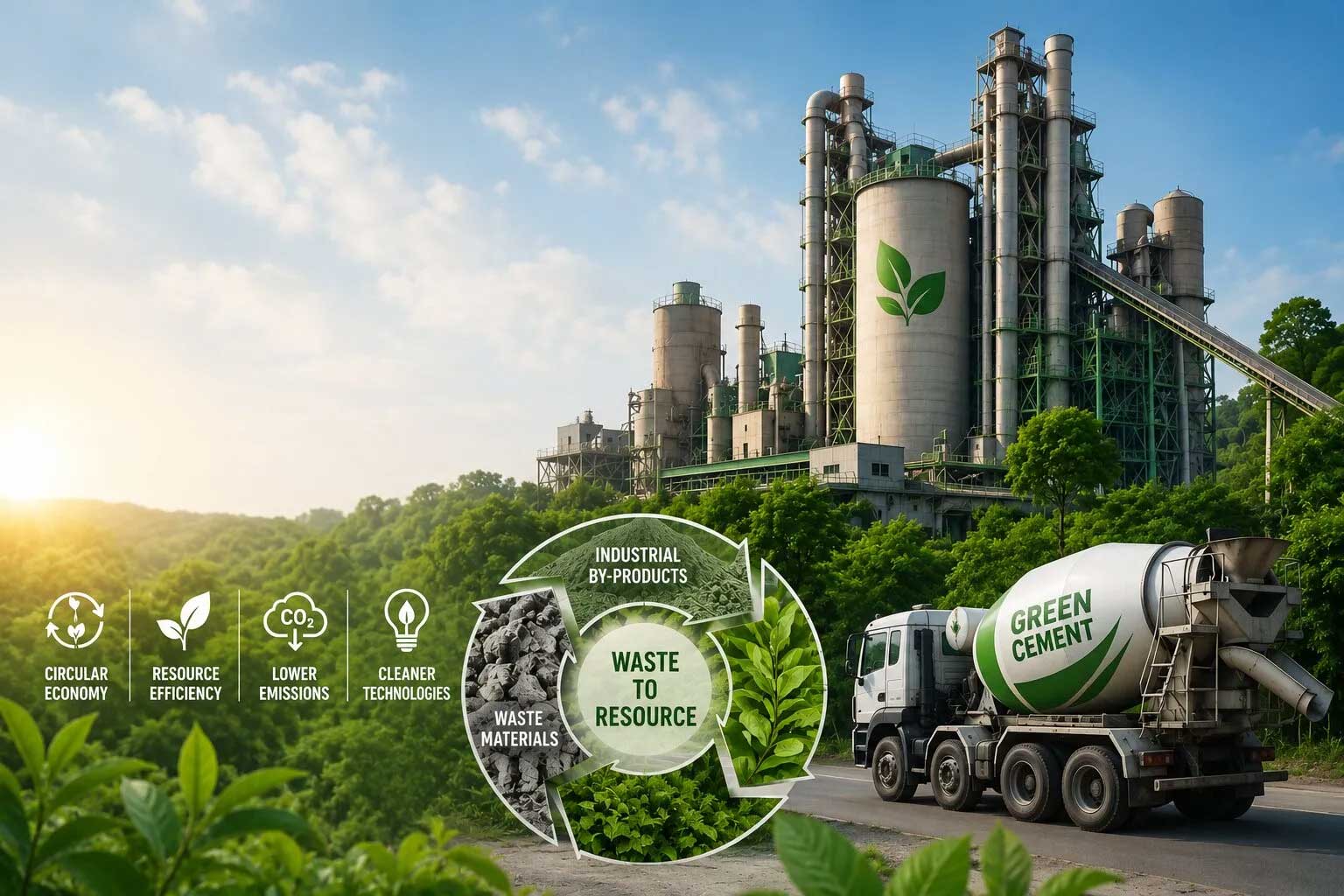
On World Environment Day, the Indian cement industry reiterated its commitment to supporting India’s climate ambitions through sustainable manufacturing, resource efficiency and the adoption of cleaner technologies.
The Cement Manufacturers’ Association (CMA) said the sector remains aligned with the Government of India’s Net Zero commitments and is accelerating efforts to reduce its environmental footprint while supporting the country’s infrastructure and development agenda.

Parth Jindal, President, CMA and Managing Director, JSW Cement, said the industry is increasingly adopting cleaner technologies, improving energy efficiency and expanding the use of alternative fuels and raw materials. He also highlighted the growing importance of circular economy practices, where industrial by-products and waste streams from one sector are utilised as resources in another.
“The Indian Cement Industry is aligned to the Government’s commitments on carbon mitigation and is accelerating the adoption of cleaner technologies, resource efficiency and circular economy practices while actively exploring the potential of Carbon Capture, Utilisation and Storage (CCUS) as a critical pathway for deep decarbonisation,” said Jindal.
He added that coprocessing industrial waste and by-products helps conserve natural resources, reduce disposal requirements and lower the environmental footprint across multiple sectors.
According to Jindal, sustainability is no longer limited to manufacturing processes but is increasingly influencing investment decisions, innovation strategies and long-term growth plans within the industry.
Echoing similar views, Dr Raghavpat Singhania, Vice President, CMA and Managing Director, JK Cement, said sustainable development extends beyond emissions reduction and must also focus on responsible resource utilisation and waste minimisation.

“Sustainability in the built environment cannot be measured by emissions alone. It is equally about how efficiently we use resources, how effectively we minimise waste and how responsibly we create the infrastructure that will serve future generations,” said Singhania.
He noted that the cement industry is advancing its sustainability agenda through greater resource efficiency, increased circularity, technological innovation and continuous improvements in manufacturing practices. As a key contributor to India’s infrastructure development, the sector has a critical role to play in balancing economic growth with environmental responsibility.
On the occasion of World Environment Day, industry leaders reaffirmed their commitment to supporting India’s climate goals while delivering the materials required for resilient, durable and sustainable infrastructure.
Concrete
JK Lakshmi Advances LC3 Cement Expansion
Company highlights commercial production and research partnerships



Cement Makers Reaffirm Commitment to Sustainable Growth

Building a Greener Future Together

JK Lakshmi Advances LC3 Cement Expansion

Burnpur Cement Reports Standalone Net Loss Of Rs 207.4 Million

Ramco Cements Campaign Wins Six Kyoorius Honours
Cement Makers Reaffirm Commitment to Sustainable Growth
Building a Greener Future Together
JK Lakshmi Advances LC3 Cement Expansion
Burnpur Cement Reports Standalone Net Loss Of Rs 207.4 Million